Research
Pricing and Packaging
Playbook #18: How To Run a Pricing and Packaging Analysis
Playbook #18: How To Run a Pricing and Packaging Analysis
Playbook #18: How To Run a Pricing and Packaging Analysis
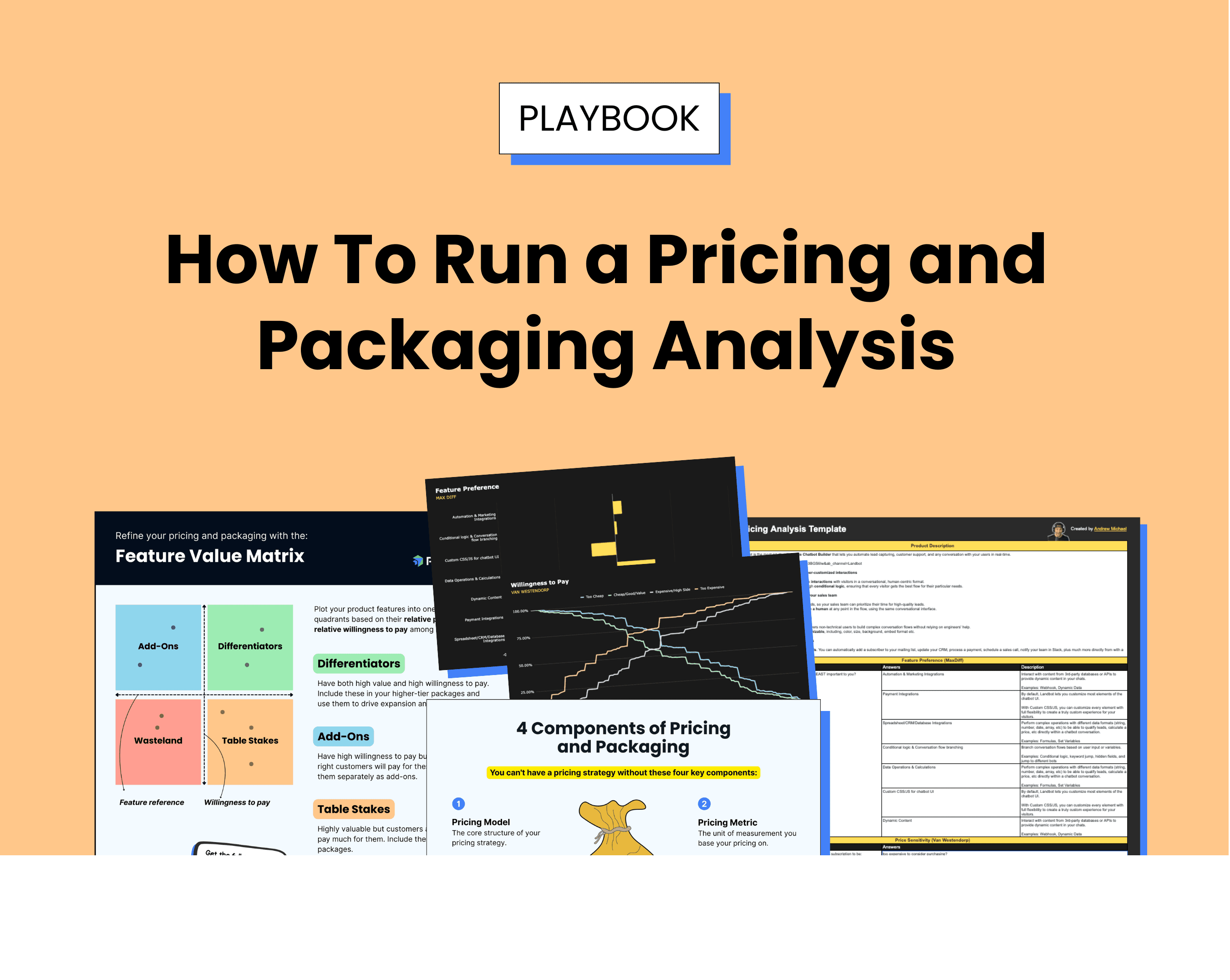
This playbook gives you a practical, PMM-friendly way to approach SaaS pricing. You’ll learn how to frame pricing discussions, pressure-test assumptions, and help your team land on a pricing model that supports growth.
Introduction
Pricing is one of the highest-impact decisions your company will ever make. It’s also one of the least structured.
Most founding or solo PMMs are pulled into pricing conversations late, handed a number, and asked to “help bring it to market.” There’s rarely a clear framework, shared assumptions, or a repeatable process behind the price.
This playbook gives you a practical, PMM-friendly way to approach SaaS pricing — even if you don’t “own” pricing. You’ll learn how to frame pricing discussions, pressure-test assumptions, and help your team land on a pricing model that supports growth.
Pricing is one of the highest-impact decisions your company will ever make. It’s also one of the least structured.
Most founding or solo PMMs are pulled into pricing conversations late, handed a number, and asked to “help bring it to market.” There’s rarely a clear framework, shared assumptions, or a repeatable process behind the price.
This playbook gives you a practical, PMM-friendly way to approach SaaS pricing — even if you don’t “own” pricing. You’ll learn how to frame pricing discussions, pressure-test assumptions, and help your team land on a pricing model that supports growth.
Pricing is one of the highest-impact decisions your company will ever make. It’s also one of the least structured.
Most founding or solo PMMs are pulled into pricing conversations late, handed a number, and asked to “help bring it to market.” There’s rarely a clear framework, shared assumptions, or a repeatable process behind the price.
This playbook gives you a practical, PMM-friendly way to approach SaaS pricing — even if you don’t “own” pricing. You’ll learn how to frame pricing discussions, pressure-test assumptions, and help your team land on a pricing model that supports growth.
Playbook Contributors
Tamara Grominsky is a longtime product marketing leader who’s built PMM teams, shaped company strategy, and led major launches across five leadership roles, including Director, VP, and Chief Strategy Officer. Along the way, she realized that great PMM leadership shouldn’t be a solo pursuit, which inspired her to create PMM Camp — a private community for PMM leaders. Tamara was also one of the co-creators of Ready for Launch, a course helping product marketers nail product launches from start to finish. This playbook is an adaptation of her lesson on Pricing and Packaging. Andrew Michael is an entrepreneur with over 14 years of experience building and scaling digital growth companies as a founder and senior leader. B2B SaaS pricing is one of his specialties, and the core template accompanying this playbook is a simplified version of the system he perfected helping well-known companies analyze, test, and optimize their pricing strategies. He’s also the founder of Churn FM, where he interviews top SaaS leaders about building products and experiences that customers stick with.
Playbook Contributors
Tamara Grominsky is a longtime product marketing leader who’s built PMM teams, shaped company strategy, and led major launches across five leadership roles, including Director, VP, and Chief Strategy Officer. Along the way, she realized that great PMM leadership shouldn’t be a solo pursuit, which inspired her to create PMM Camp — a private community for PMM leaders. Tamara was also one of the co-creators of Ready for Launch, a course helping product marketers nail product launches from start to finish. This playbook is an adaptation of her lesson on Pricing and Packaging. Andrew Michael is an entrepreneur with over 14 years of experience building and scaling digital growth companies as a founder and senior leader. B2B SaaS pricing is one of his specialties, and the core template accompanying this playbook is a simplified version of the system he perfected helping well-known companies analyze, test, and optimize their pricing strategies. He’s also the founder of Churn FM, where he interviews top SaaS leaders about building products and experiences that customers stick with.
Playbook Contributors
Tamara Grominsky is a longtime product marketing leader who’s built PMM teams, shaped company strategy, and led major launches across five leadership roles, including Director, VP, and Chief Strategy Officer. Along the way, she realized that great PMM leadership shouldn’t be a solo pursuit, which inspired her to create PMM Camp — a private community for PMM leaders. Tamara was also one of the co-creators of Ready for Launch, a course helping product marketers nail product launches from start to finish. This playbook is an adaptation of her lesson on Pricing and Packaging. Andrew Michael is an entrepreneur with over 14 years of experience building and scaling digital growth companies as a founder and senior leader. B2B SaaS pricing is one of his specialties, and the core template accompanying this playbook is a simplified version of the system he perfected helping well-known companies analyze, test, and optimize their pricing strategies. He’s also the founder of Churn FM, where he interviews top SaaS leaders about building products and experiences that customers stick with.
Why This Matters
Pricing quietly touches everything: positioning, sales motion, expansion, retention, and even product roadmap decisions.
When pricing is done poorly:
Deals stall or die late in the funnel.
Sales discounts become the default.
Customers struggle to understand value.
PMMs are left trying to “explain away” confusing packages.
But when it's done well:
Buyers self-select faster.
Sales conversations focus on value, not negotiation.
Expansion paths are clear.
Messaging and pricing reinforce each other.
For most companies, pricing comes down to a gut decision with little structure or strategy behind it. Unless someone in your company, cough cough you, brings frameworks and a structured approach to the table, nothing will change.
This playbook gives you a step-by-step approach to understand, analyze, and optimize your pricing. At minimum, you'll learn some frameworks that make you a valuable voice in pricing discussions, and ideally help drive better decisions.
The Four Components of Pricing
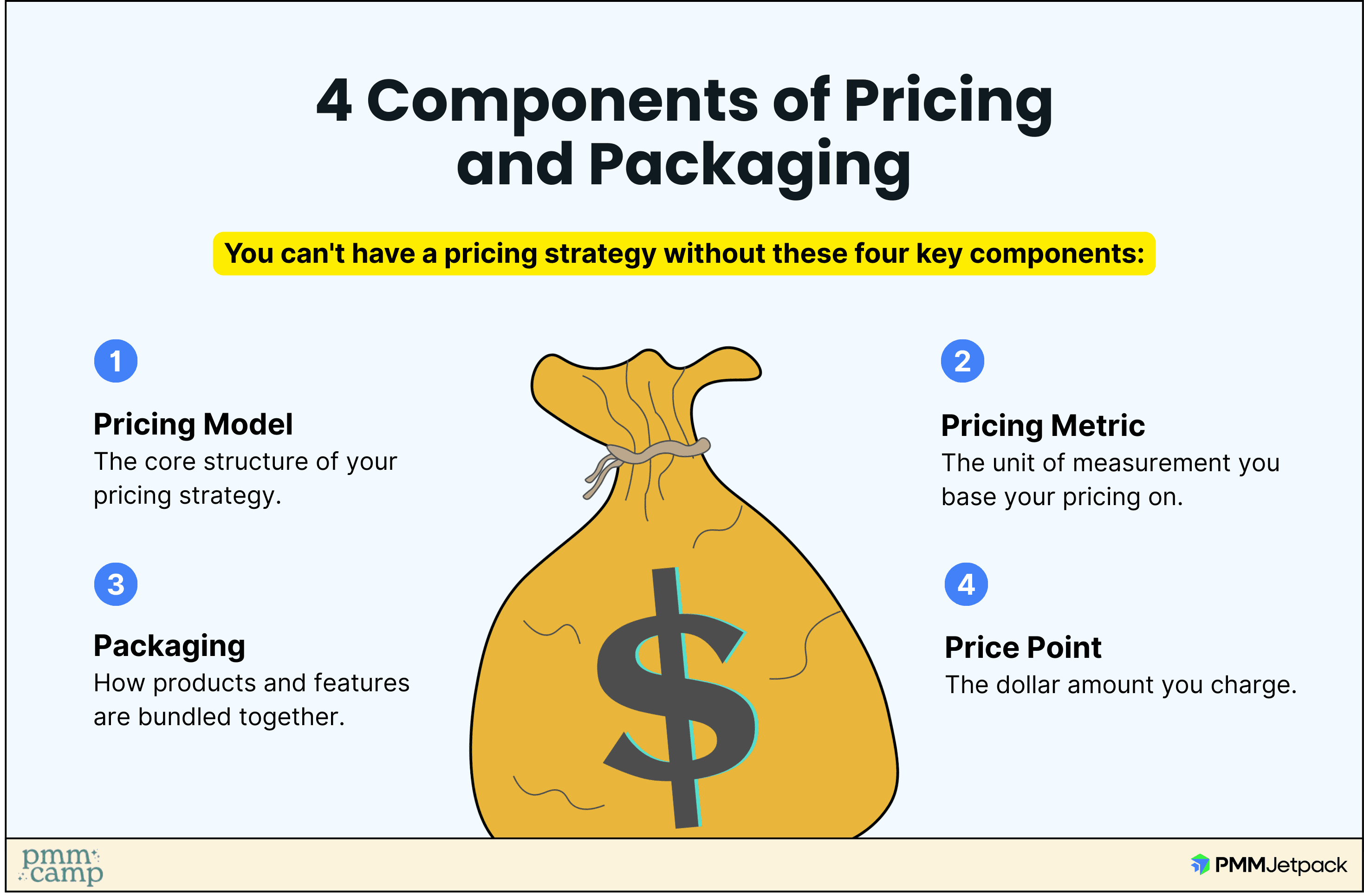
For the purpose of this playbook, we are going to break down your pricing strategy into four key components.
And they are:
Pricing Model - The core structure of your pricing strategy.
Pricing Metric - The unit of measurement you base your pricing on.
Packaging - How products and features are bundled together.
Price Point - The dollar amount you charge.
Why This Matters
Pricing quietly touches everything: positioning, sales motion, expansion, retention, and even product roadmap decisions.
When pricing is done poorly:
Deals stall or die late in the funnel.
Sales discounts become the default.
Customers struggle to understand value.
PMMs are left trying to “explain away” confusing packages.
But when it's done well:
Buyers self-select faster.
Sales conversations focus on value, not negotiation.
Expansion paths are clear.
Messaging and pricing reinforce each other.
For most companies, pricing comes down to a gut decision with little structure or strategy behind it. Unless someone in your company, cough cough you, brings frameworks and a structured approach to the table, nothing will change.
This playbook gives you a step-by-step approach to understand, analyze, and optimize your pricing. At minimum, you'll learn some frameworks that make you a valuable voice in pricing discussions, and ideally help drive better decisions.
The Four Components of Pricing
For the purpose of this playbook, we are going to break down your pricing strategy into four key components.
And they are:
Pricing Model - The core structure of your pricing strategy.
Pricing Metric - The unit of measurement you base your pricing on.
Packaging - How products and features are bundled together.
Price Point - The dollar amount you charge.
Why This Matters
Pricing quietly touches everything: positioning, sales motion, expansion, retention, and even product roadmap decisions.
When pricing is done poorly:
Deals stall or die late in the funnel.
Sales discounts become the default.
Customers struggle to understand value.
PMMs are left trying to “explain away” confusing packages.
But when it's done well:
Buyers self-select faster.
Sales conversations focus on value, not negotiation.
Expansion paths are clear.
Messaging and pricing reinforce each other.
For most companies, pricing comes down to a gut decision with little structure or strategy behind it. Unless someone in your company, cough cough you, brings frameworks and a structured approach to the table, nothing will change.
This playbook gives you a step-by-step approach to understand, analyze, and optimize your pricing. At minimum, you'll learn some frameworks that make you a valuable voice in pricing discussions, and ideally help drive better decisions.
The Four Components of Pricing
For the purpose of this playbook, we are going to break down your pricing strategy into four key components.
And they are:
Pricing Model - The core structure of your pricing strategy.
Pricing Metric - The unit of measurement you base your pricing on.
Packaging - How products and features are bundled together.
Price Point - The dollar amount you charge.
Component 1: Pricing Model
Your pricing model is the foundational structure of your pricing. It sets the path for how you'll price and package your product — one of the first strategic decisions you need to make. To put this in perspective, here are a few popular pricing models you've likely encountered as a product marketer or buyer:
Competitor-based
With competitor-based pricing, you benchmark and optimize based on what competitors are doing in your market. You can be a price setter and position at the highest price, a price taker and price in line with the competition, or a price fighter and position at the lowest price. The idea is to look at your competition and decide your approach from there, following the general pricing model used in your market.
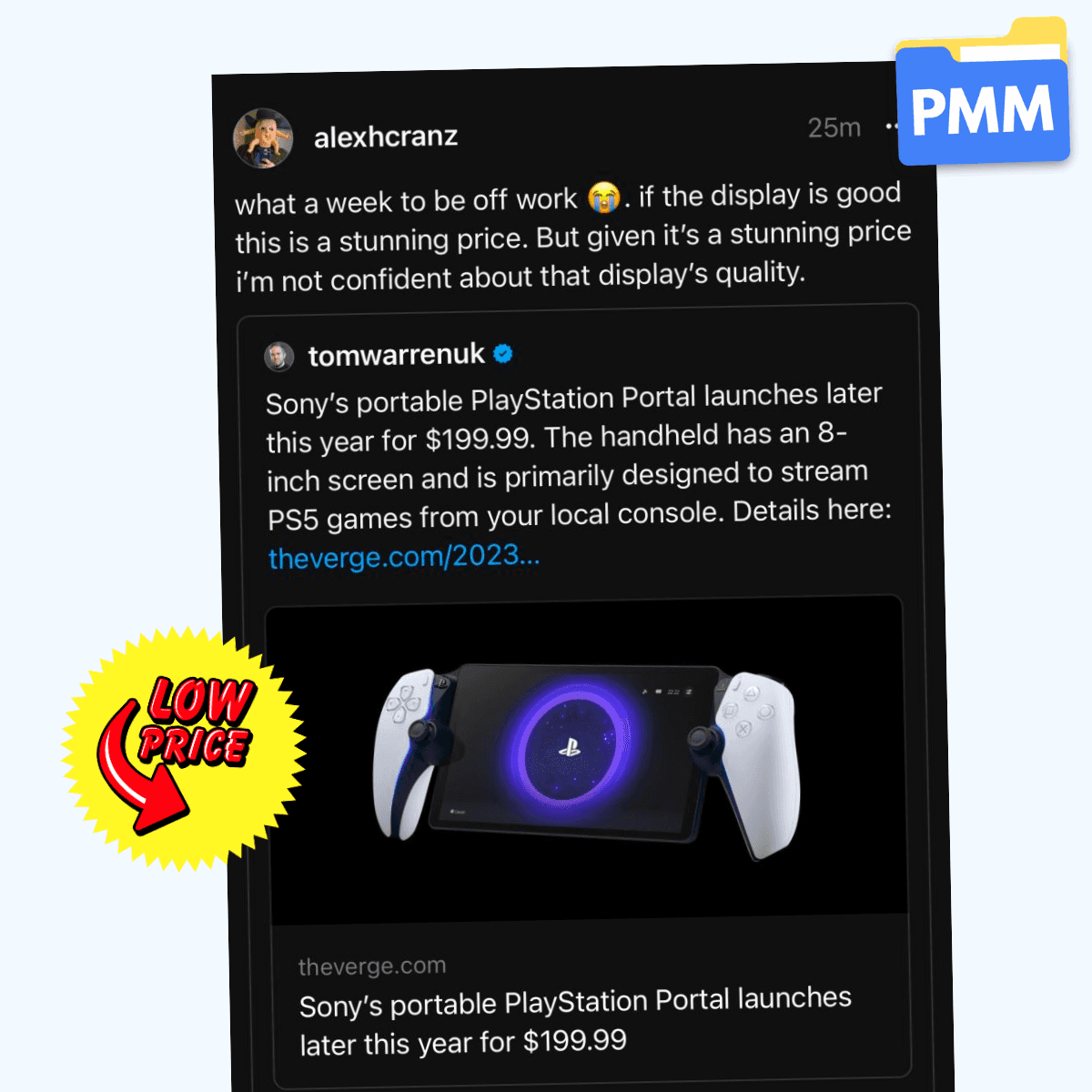
Ex. The PlayStation Portable launched at a surprising price of $199. That’s about half the price of the Nintendo Switch, a seemingly close competitor. While some people rejoiced, others (like Alex) were skeptical about the quality.
Component 1: Pricing Model
Your pricing model is the foundational structure of your pricing. It sets the path for how you'll price and package your product — one of the first strategic decisions you need to make. To put this in perspective, here are a few popular pricing models you've likely encountered as a product marketer or buyer:
Competitor-based
With competitor-based pricing, you benchmark and optimize based on what competitors are doing in your market. You can be a price setter and position at the highest price, a price taker and price in line with the competition, or a price fighter and position at the lowest price. The idea is to look at your competition and decide your approach from there, following the general pricing model used in your market.
Ex. The PlayStation Portable launched at a surprising price of $199. That’s about half the price of the Nintendo Switch, a seemingly close competitor. While some people rejoiced, others (like Alex) were skeptical about the quality.
Component 1: Pricing Model
Your pricing model is the foundational structure of your pricing. It sets the path for how you'll price and package your product — one of the first strategic decisions you need to make. To put this in perspective, here are a few popular pricing models you've likely encountered as a product marketer or buyer:
Competitor-based
With competitor-based pricing, you benchmark and optimize based on what competitors are doing in your market. You can be a price setter and position at the highest price, a price taker and price in line with the competition, or a price fighter and position at the lowest price. The idea is to look at your competition and decide your approach from there, following the general pricing model used in your market.
Ex. The PlayStation Portable launched at a surprising price of $199. That’s about half the price of the Nintendo Switch, a seemingly close competitor. While some people rejoiced, others (like Alex) were skeptical about the quality.
Cost-plus
This is when you determine your cost of goods sold (or cost of delivery/service), then add a profit margin on top. Either a flat dollar amount or a percentage. This isn't common in SaaS pricing, but if you know exactly how much it costs to deliver your product or service, you can guarantee certain profit margins with this approach.
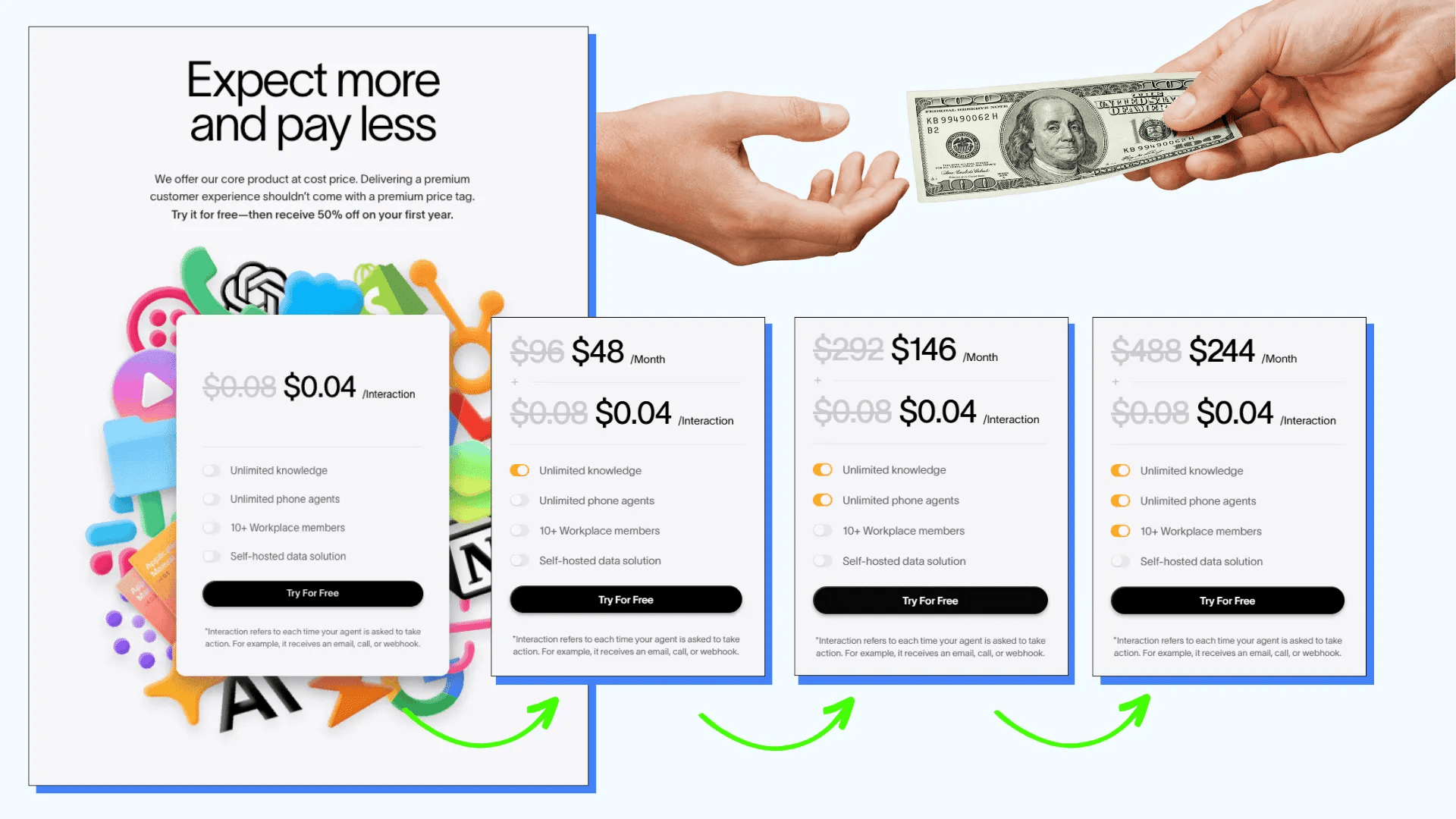
Ex. In the example below, Lemni starts by offering their core product at cost and then adds additional fees on top of that depending on which premium features you want unlimited access to or additional usage of. Even for them, you can tell that part of their strategy is being able to offer their core product at a lower cost than the rest of the market.
Cost-plus
This is when you determine your cost of goods sold (or cost of delivery/service), then add a profit margin on top. Either a flat dollar amount or a percentage. This isn't common in SaaS pricing, but if you know exactly how much it costs to deliver your product or service, you can guarantee certain profit margins with this approach.
Ex. In the example below, Lemni starts by offering their core product at cost and then adds additional fees on top of that depending on which premium features you want unlimited access to or additional usage of. Even for them, you can tell that part of their strategy is being able to offer their core product at a lower cost than the rest of the market.
Cost-plus
This is when you determine your cost of goods sold (or cost of delivery/service), then add a profit margin on top. Either a flat dollar amount or a percentage. This isn't common in SaaS pricing, but if you know exactly how much it costs to deliver your product or service, you can guarantee certain profit margins with this approach.
Ex. In the example below, Lemni starts by offering their core product at cost and then adds additional fees on top of that depending on which premium features you want unlimited access to or additional usage of. Even for them, you can tell that part of their strategy is being able to offer their core product at a lower cost than the rest of the market.
Value-based
This is when your pricing is directly linked to the value customers get from your product. This approach relies on knowing your customer's key value metric and being able to measure it confidently. The big benefit: you can typically charge higher prices and extract more value because your pricing aligns with the exact value customers are seeking. As customers get more value, you generate more revenue from them. Your incentives are aligned, and you're motivated to help them succeed.
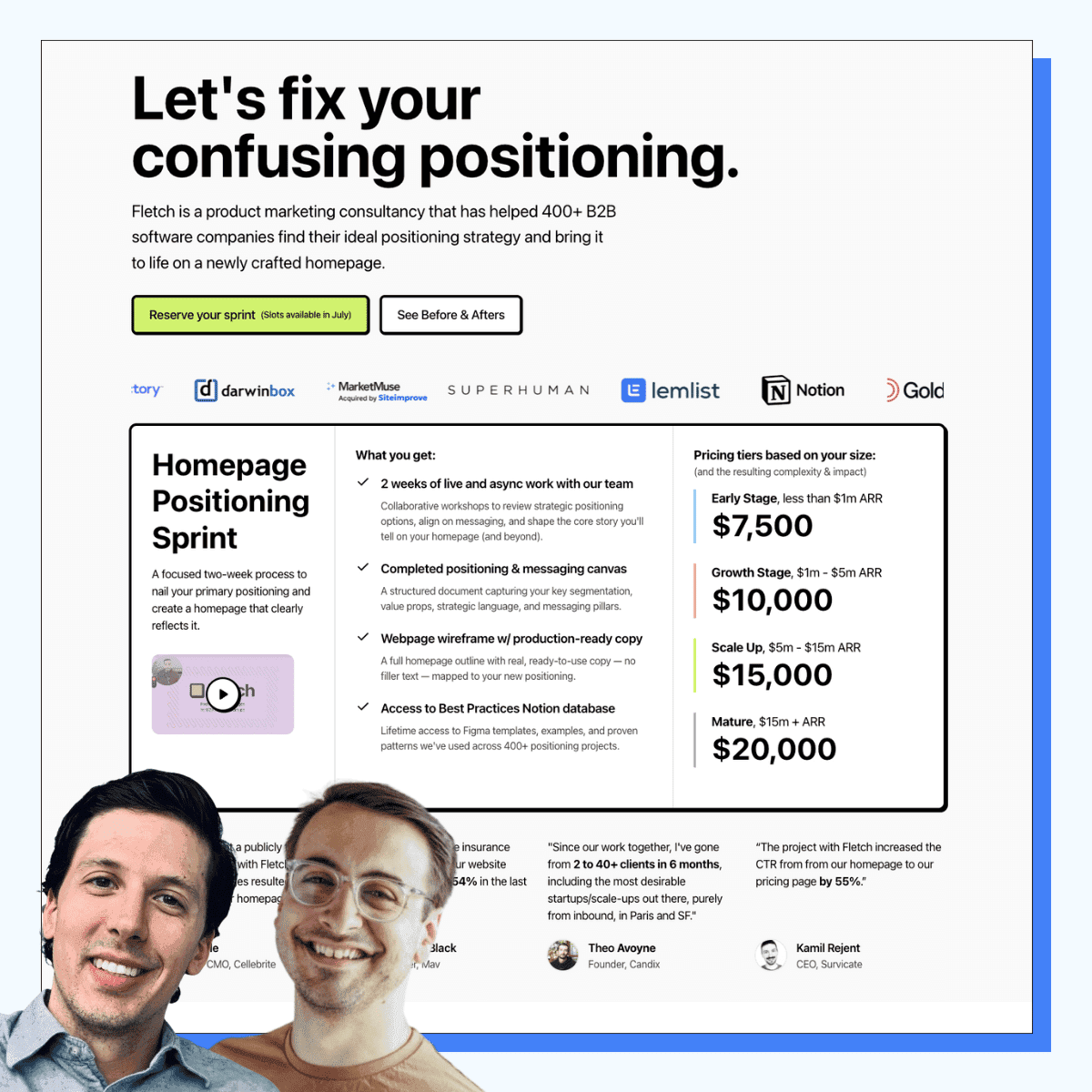
Ex. In the example below, you can see that Fletch offers the same positioning sprint, but at a higher price depending on the size of the company that they work with. Based on their experience, they know that a $15M+ ARR company is going to get more financial impact from working with them than a $1M ARR company. So they adjust their pricing accordingly.
Value-based
This is when your pricing is directly linked to the value customers get from your product. This approach relies on knowing your customer's key value metric and being able to measure it confidently. The big benefit: you can typically charge higher prices and extract more value because your pricing aligns with the exact value customers are seeking. As customers get more value, you generate more revenue from them. Your incentives are aligned, and you're motivated to help them succeed.
Ex. In the example below, you can see that Fletch offers the same positioning sprint, but at a higher price depending on the size of the company that they work with. Based on their experience, they know that a $15M+ ARR company is going to get more financial impact from working with them than a $1M ARR company. So they adjust their pricing accordingly.
Value-based
This is when your pricing is directly linked to the value customers get from your product. This approach relies on knowing your customer's key value metric and being able to measure it confidently. The big benefit: you can typically charge higher prices and extract more value because your pricing aligns with the exact value customers are seeking. As customers get more value, you generate more revenue from them. Your incentives are aligned, and you're motivated to help them succeed.
Ex. In the example below, you can see that Fletch offers the same positioning sprint, but at a higher price depending on the size of the company that they work with. Based on their experience, they know that a $15M+ ARR company is going to get more financial impact from working with them than a $1M ARR company. So they adjust their pricing accordingly.
Usage-based
Customers are charged based on their consumption of your product. This is easy to track as long as it's built into your product. It's also easy to scale — as customers use more, you naturally generate more revenue. It typically aligns with value, as long as the metric you track correlates with the value they receive.
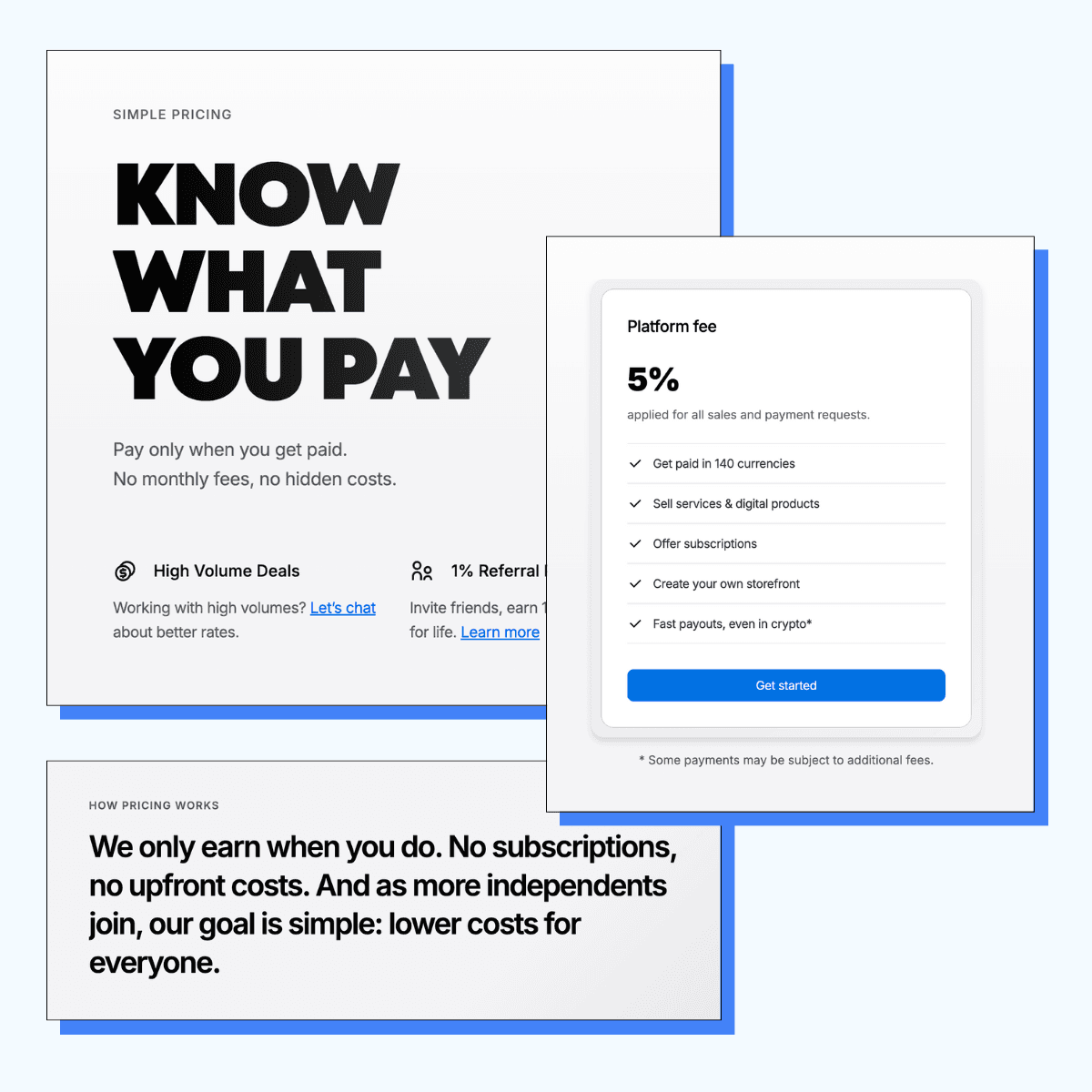
Ex. In the example below, you can see that Ruul charges a set percentage of any revenue you process or earn through their platform. In essence, charging you every time you use their product to successfully charge a customer. As you earn more and use their product more, they naturally earn more as well. So your incentives are aligned, and it's also very closely tied to value.
Usage-based
Customers are charged based on their consumption of your product. This is easy to track as long as it's built into your product. It's also easy to scale — as customers use more, you naturally generate more revenue. It typically aligns with value, as long as the metric you track correlates with the value they receive.
Ex. In the example below, you can see that Ruul charges a set percentage of any revenue you process or earn through their platform. In essence, charging you every time you use their product to successfully charge a customer. As you earn more and use their product more, they naturally earn more as well. So your incentives are aligned, and it's also very closely tied to value.
Usage-based
Customers are charged based on their consumption of your product. This is easy to track as long as it's built into your product. It's also easy to scale — as customers use more, you naturally generate more revenue. It typically aligns with value, as long as the metric you track correlates with the value they receive.
Ex. In the example below, you can see that Ruul charges a set percentage of any revenue you process or earn through their platform. In essence, charging you every time you use their product to successfully charge a customer. As you earn more and use their product more, they naturally earn more as well. So your incentives are aligned, and it's also very closely tied to value.
Component 2: Pricing Metric
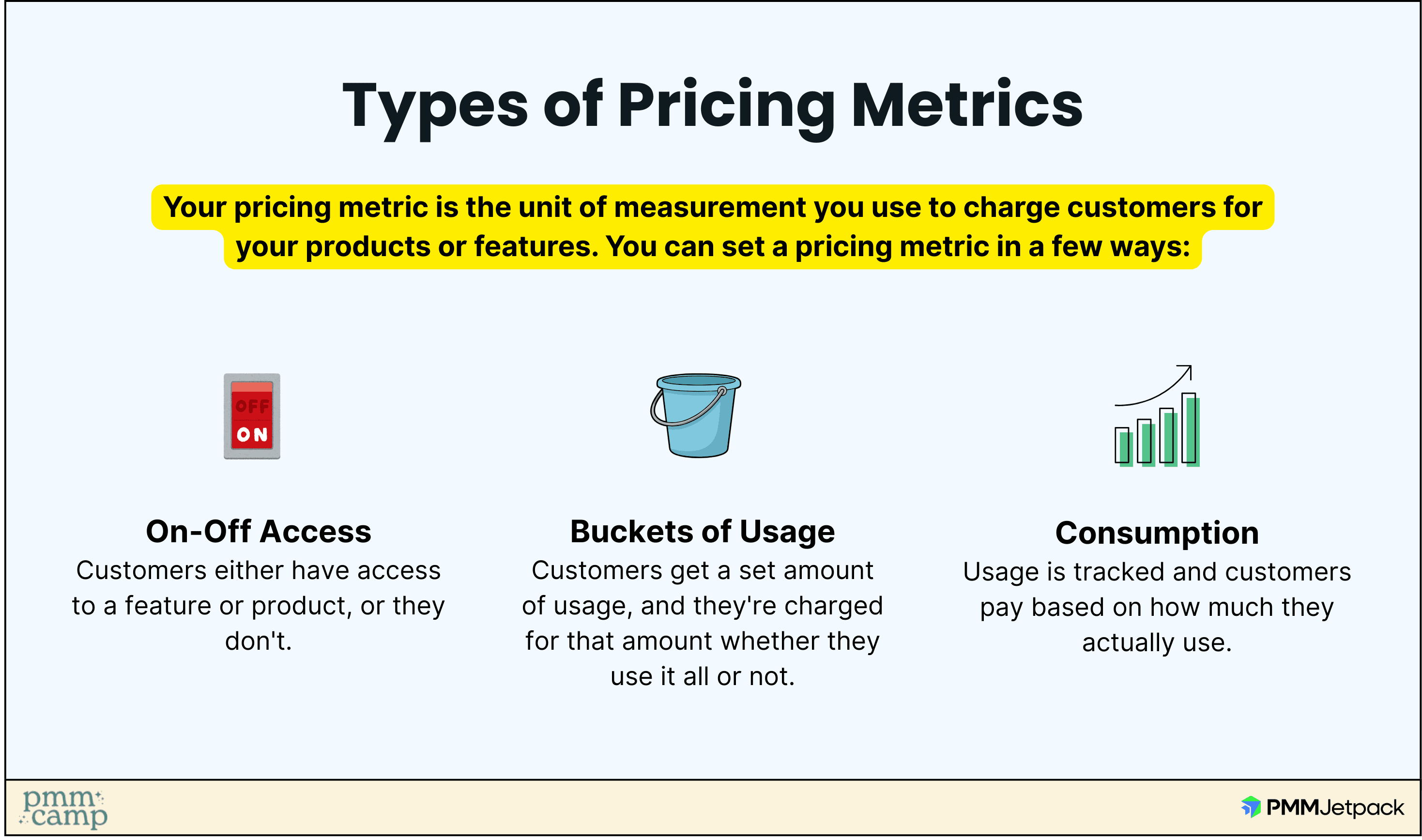
Your pricing metric is the unit of measurement you use to charge customers for your products or features. You can set a pricing metric in a few ways:
On-Off Access - Customers either have access to a feature or product, or they don't.
Buckets of Usage - Customers get a set amount of usage, and they're charged for that amount whether they use it all or not. If they exceed it, overage charges or tier upgrades kick in.
Consumption - Usage is tracked and customers pay based on how much they actually use.
Component 2: Pricing Metric
Your pricing metric is the unit of measurement you use to charge customers for your products or features. You can set a pricing metric in a few ways:
On-Off Access - Customers either have access to a feature or product, or they don't.
Buckets of Usage - Customers get a set amount of usage, and they're charged for that amount whether they use it all or not. If they exceed it, overage charges or tier upgrades kick in.
Consumption - Usage is tracked and customers pay based on how much they actually use.
Component 2: Pricing Metric
Your pricing metric is the unit of measurement you use to charge customers for your products or features. You can set a pricing metric in a few ways:
On-Off Access - Customers either have access to a feature or product, or they don't.
Buckets of Usage - Customers get a set amount of usage, and they're charged for that amount whether they use it all or not. If they exceed it, overage charges or tier upgrades kick in.
Consumption - Usage is tracked and customers pay based on how much they actually use.
When choosing your pricing metric, ask yourself:
Can and should usage scale with your product or feature? Or should it be unlimited?
Does it cost you more when customers use more (or less)?
Does your pricing metric align with the value your product delivers and the outcomes customers hope to see?
These questions will guide you toward the optimal pricing metric, or combination of metrics, for your product.
Here are a few examples of pricing metrics in action:
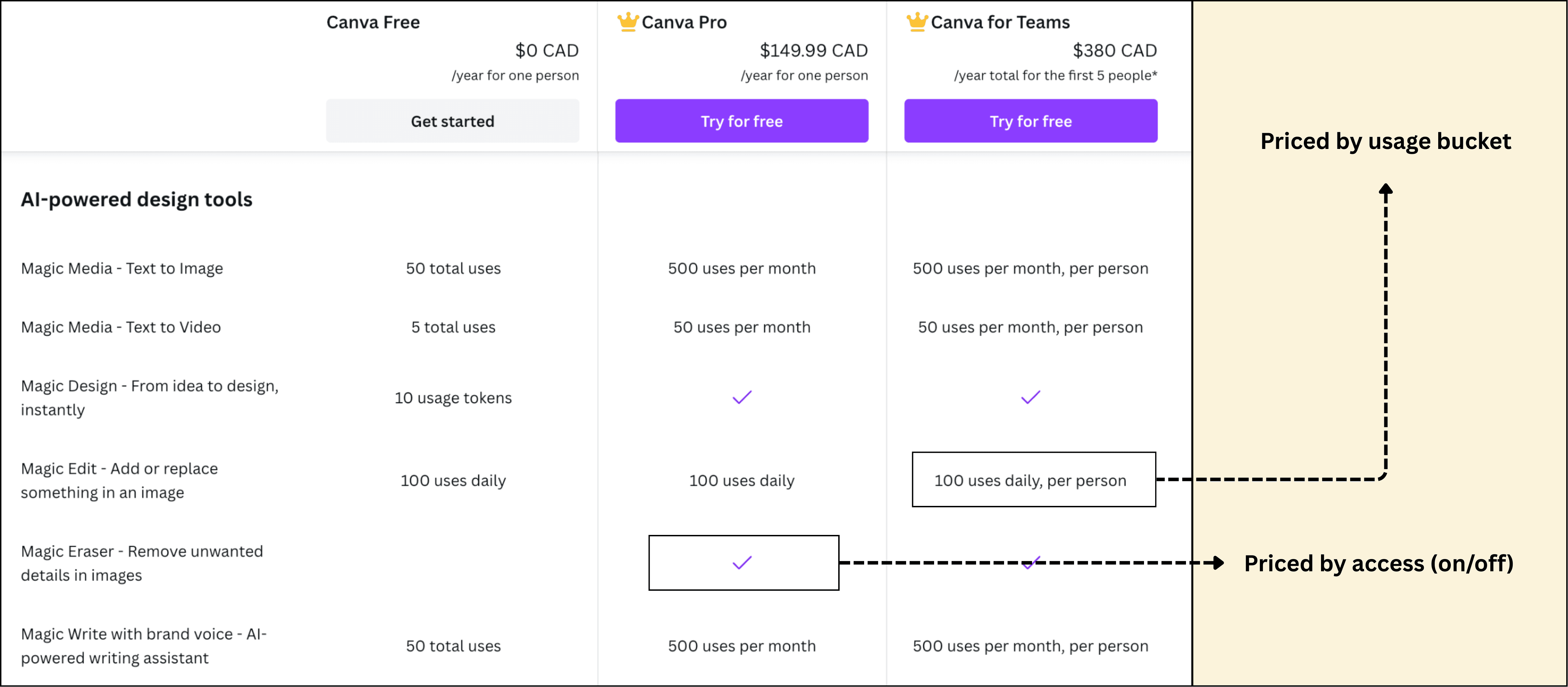
Ex. In this example from Canva, you can see two different pricing metrics in action.
For their Magic Edit feature, they use usage buckets, giving users 100 uses per day. For their Magic Eraser feature, it's simply on or off, depending on which tier you're on.
When choosing your pricing metric, ask yourself:
Can and should usage scale with your product or feature? Or should it be unlimited?
Does it cost you more when customers use more (or less)?
Does your pricing metric align with the value your product delivers and the outcomes customers hope to see?
These questions will guide you toward the optimal pricing metric, or combination of metrics, for your product.
Here are a few examples of pricing metrics in action:
Ex. In this example from Canva, you can see two different pricing metrics in action.
For their Magic Edit feature, they use usage buckets, giving users 100 uses per day. For their Magic Eraser feature, it's simply on or off, depending on which tier you're on.
When choosing your pricing metric, ask yourself:
Can and should usage scale with your product or feature? Or should it be unlimited?
Does it cost you more when customers use more (or less)?
Does your pricing metric align with the value your product delivers and the outcomes customers hope to see?
These questions will guide you toward the optimal pricing metric, or combination of metrics, for your product.
Here are a few examples of pricing metrics in action:
Ex. In this example from Canva, you can see two different pricing metrics in action.
For their Magic Edit feature, they use usage buckets, giving users 100 uses per day. For their Magic Eraser feature, it's simply on or off, depending on which tier you're on.
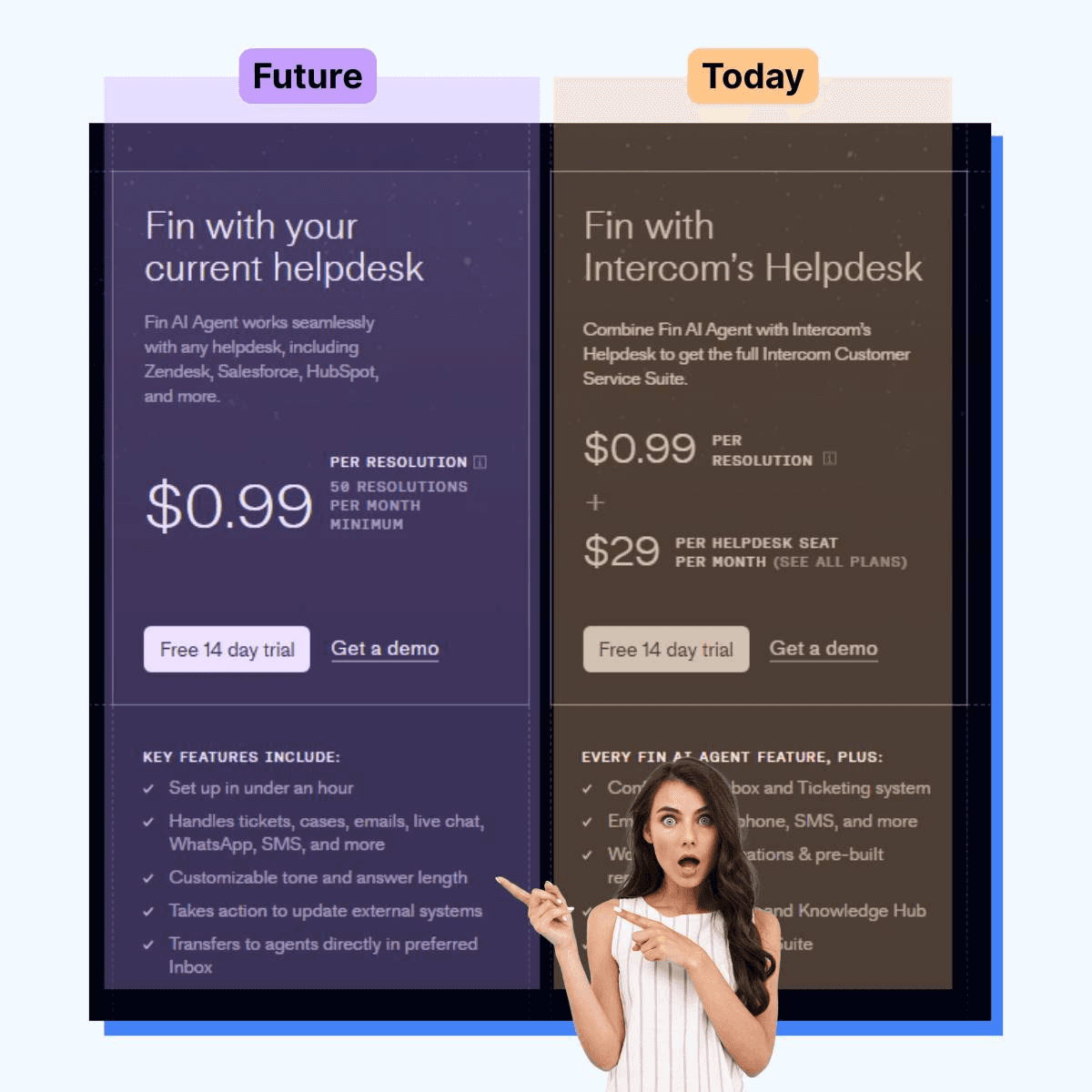
Ex. In this example from Intercom, their Fin product is priced by resolutions, meaning each time their AI resolves a support ticket, you're charged $0.99. This uses the consumption model.
Ex. In this example from Intercom, their Fin product is priced by resolutions, meaning each time their AI resolves a support ticket, you're charged $0.99. This uses the consumption model.
Ex. In this example from Intercom, their Fin product is priced by resolutions, meaning each time their AI resolves a support ticket, you're charged $0.99. This uses the consumption model.
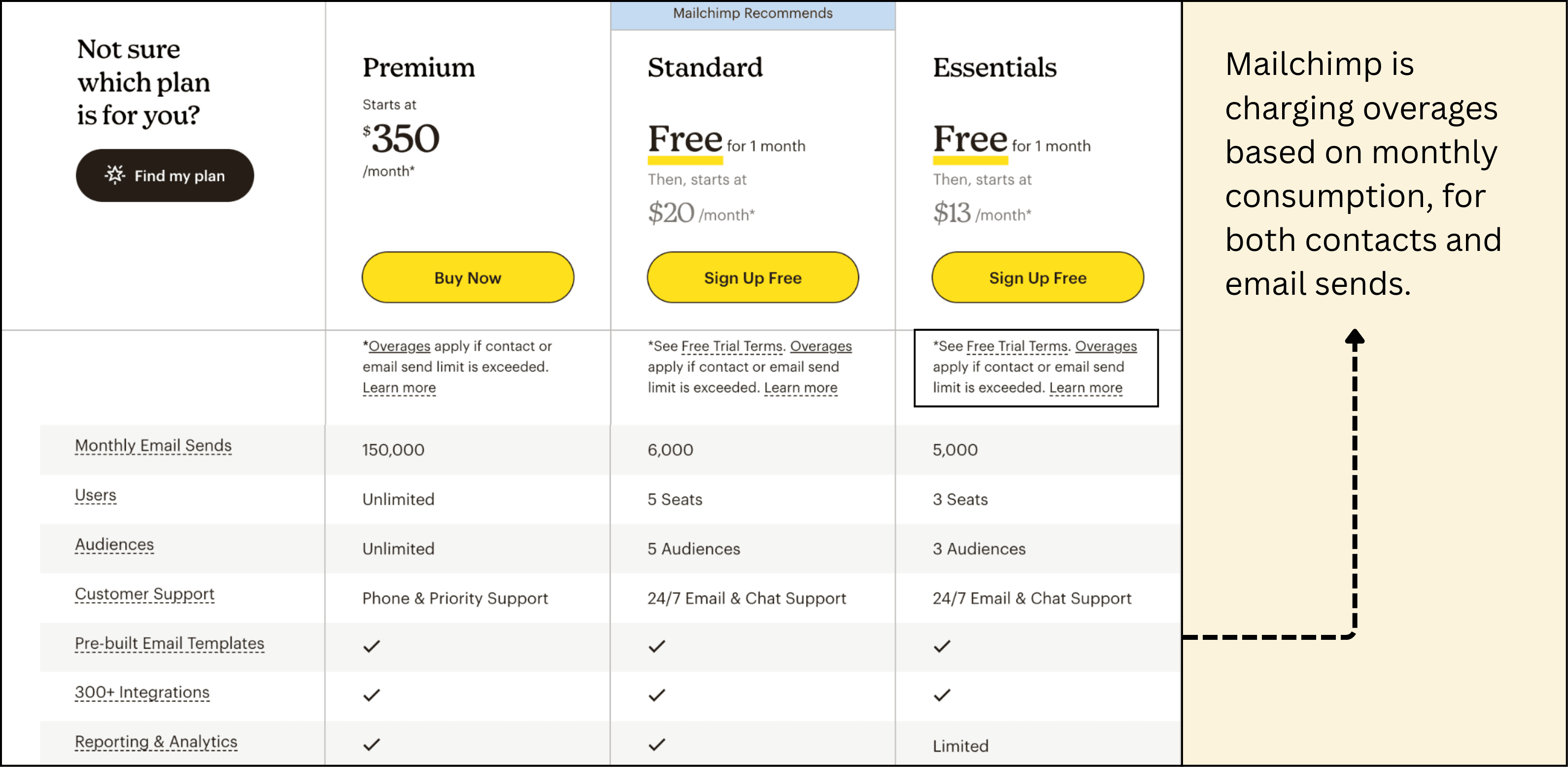
Ex. In this example from Mailchimp, you can see the consumption model in action. Depending on your package, you get a certain number of email sends and contacts. When you exceed those limits, overage charges apply.
Ex. In this example from Mailchimp, you can see the consumption model in action. Depending on your package, you get a certain number of email sends and contacts. When you exceed those limits, overage charges apply.
Ex. In this example from Mailchimp, you can see the consumption model in action. Depending on your package, you get a certain number of email sends and contacts. When you exceed those limits, overage charges apply.
Component 3: Packaging
Packaging is a critical part of your pricing strategy, especially for SaaS companies that typically offer multiple tiers and bundles. Packaging defines how you bundle products and features together — usually displayed as different plans or tiers on your pricing page.
Key questions to ask when determining your packaging:
Which features should be available in which tiers?
Should certain features be available across all tiers?
Should features be offered as part of a package, in usage buckets with overage charges, or both?
Should any features be charged separately on top of the base package, either through usage buckets or consumption-based pricing?
Which features are customers most willing to pay for, and should therefore live in higher-priced tiers?
Determining your packaging can be challenging. Many startups rely on trial and error. But you can take a more data-driven, which is something we'll cover later in this playbook.
Here are a couple of examples of packaging in action:
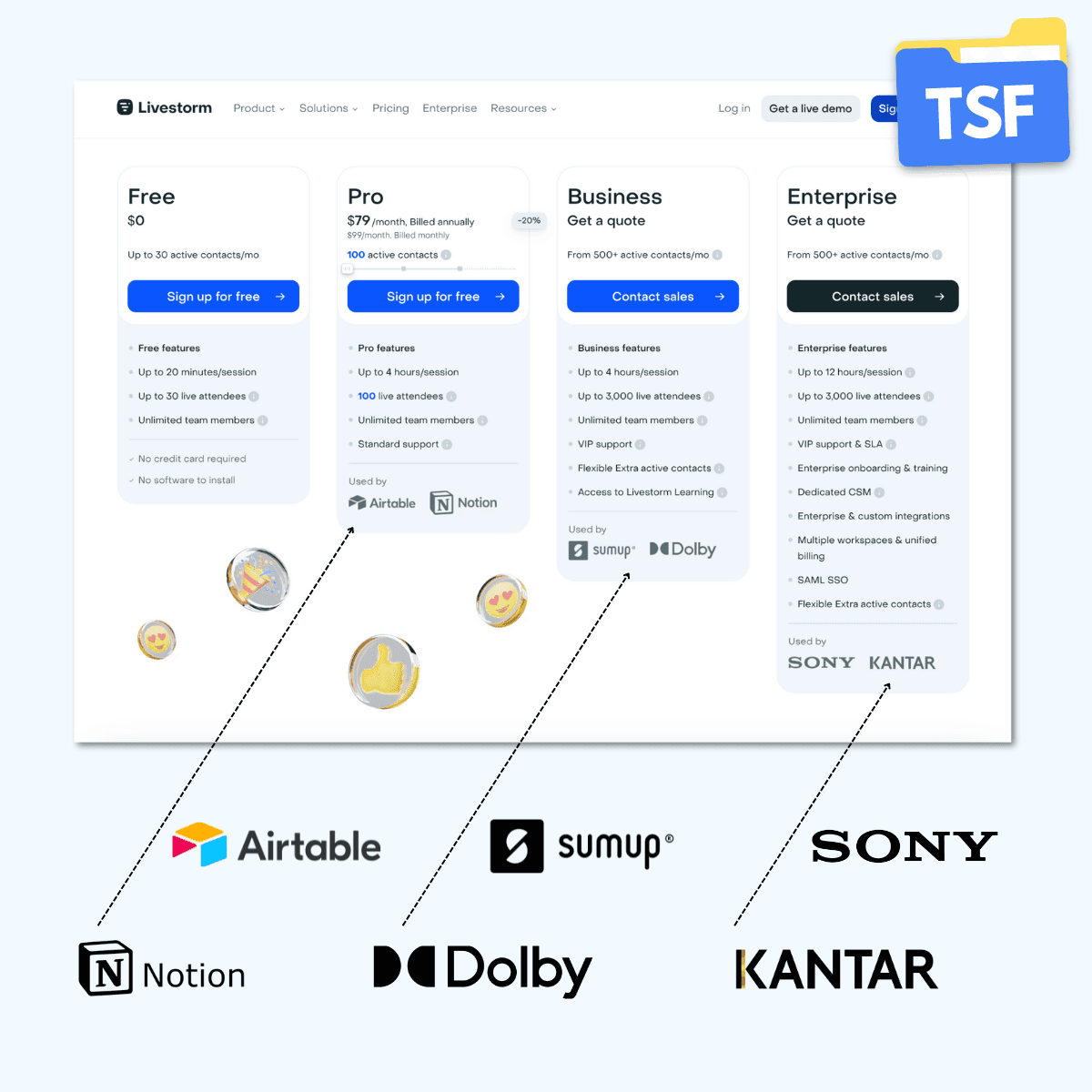
Ex. In this example pricing page from Livestorm, you can see that they've designed each of their premium tiers with a specific type of customer in mind. As a buyer on this page, I can see that their Pro plan is suitable for companies like Notion, whereas their Enterprise plan is used by larger enterprises like Sony. If I'm a start-up and I only run webinars with less than 100 attendees, I'm more likely going to go with the Pro plan and feel in good company with companies like Airtable and Notion.
Component 3: Packaging
Packaging is a critical part of your pricing strategy, especially for SaaS companies that typically offer multiple tiers and bundles. Packaging defines how you bundle products and features together — usually displayed as different plans or tiers on your pricing page.
Key questions to ask when determining your packaging:
Which features should be available in which tiers?
Should certain features be available across all tiers?
Should features be offered as part of a package, in usage buckets with overage charges, or both?
Should any features be charged separately on top of the base package, either through usage buckets or consumption-based pricing?
Which features are customers most willing to pay for, and should therefore live in higher-priced tiers?
Determining your packaging can be challenging. Many startups rely on trial and error. But you can take a more data-driven, which is something we'll cover later in this playbook.
Here are a couple of examples of packaging in action:
Ex. In this example pricing page from Livestorm, you can see that they've designed each of their premium tiers with a specific type of customer in mind. As a buyer on this page, I can see that their Pro plan is suitable for companies like Notion, whereas their Enterprise plan is used by larger enterprises like Sony. If I'm a start-up and I only run webinars with less than 100 attendees, I'm more likely going to go with the Pro plan and feel in good company with companies like Airtable and Notion.
Component 3: Packaging
Packaging is a critical part of your pricing strategy, especially for SaaS companies that typically offer multiple tiers and bundles. Packaging defines how you bundle products and features together — usually displayed as different plans or tiers on your pricing page.
Key questions to ask when determining your packaging:
Which features should be available in which tiers?
Should certain features be available across all tiers?
Should features be offered as part of a package, in usage buckets with overage charges, or both?
Should any features be charged separately on top of the base package, either through usage buckets or consumption-based pricing?
Which features are customers most willing to pay for, and should therefore live in higher-priced tiers?
Determining your packaging can be challenging. Many startups rely on trial and error. But you can take a more data-driven, which is something we'll cover later in this playbook.
Here are a couple of examples of packaging in action:
Ex. In this example pricing page from Livestorm, you can see that they've designed each of their premium tiers with a specific type of customer in mind. As a buyer on this page, I can see that their Pro plan is suitable for companies like Notion, whereas their Enterprise plan is used by larger enterprises like Sony. If I'm a start-up and I only run webinars with less than 100 attendees, I'm more likely going to go with the Pro plan and feel in good company with companies like Airtable and Notion.
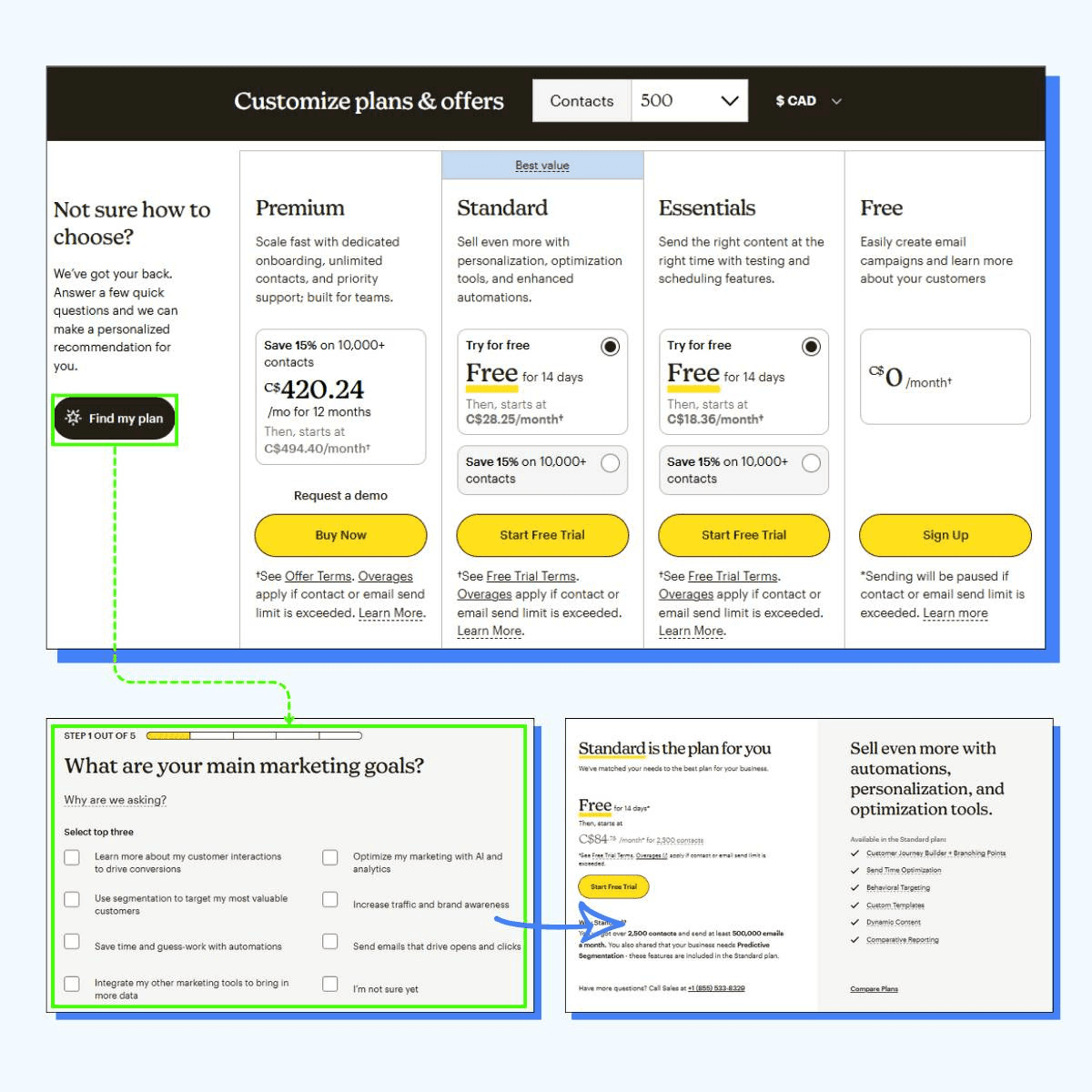
Ex. This is a great example from MailChimp. You can also see in their package descriptions that certain features are gated based on the package. For example, if you want to start using personalization, you need to be on their standard tier.
What I also love about this pricing page is they have a feature called "Find My Plan" where they ask you a few simple questions and then recommend the ideal plan for you based on your needs.
Ex. This is a great example from MailChimp. You can also see in their package descriptions that certain features are gated based on the package. For example, if you want to start using personalization, you need to be on their standard tier.
What I also love about this pricing page is they have a feature called "Find My Plan" where they ask you a few simple questions and then recommend the ideal plan for you based on your needs.
Ex. This is a great example from MailChimp. You can also see in their package descriptions that certain features are gated based on the package. For example, if you want to start using personalization, you need to be on their standard tier.
What I also love about this pricing page is they have a feature called "Find My Plan" where they ask you a few simple questions and then recommend the ideal plan for you based on your needs.
Component 4: Price Point
Your price point is the specific dollar amount you charge for your product, service, or package. This is a critical part of your pricing strategy. It's where you optimize based on your customers' willingness to pay and decide whether to prioritize revenue per customer, or conversion rates and product adoption.
For example, a higher price point is going to increase your revenue per customer, but a lower price point will likely allow you to convert more customers. Or get more of your customers to adopt a certain feature or package. So there is a strategic decision you need to make when trying to find the optimal price point for your product, or product tiers.
Key questions to ask when setting your price point:
What is a customer's willingness to pay for this product, feature, or plan?
Are you optimizing for revenue, conversion rate, or adoption?
For new features: Is this feature valuable enough to justify increasing the price of an existing package?
Three Frameworks To Help You Nail Pricing and Packaging
It's one thing to know the fundamentals of pricing and what goes into your pricing and packaging. But making these critical decisions is another matter entirely.
At most startups today, initial pricing strategy is based on market analysis and competitive positioning. You look at the typical pricing model for your category, then decide whether you want to be a price setter, taker, or fighter — and that determines your price point.
But as your company matures, you’ll want a more strategic approach to pricing. One that moves the needle on revenue, conversion rates, and adoption.
These three frameworks that will help you bring valuable insights into your pricing and packaging conversations — and base those decisions on more than just gut. They are the:
Feature Value Matrix
Feature Preference Analysis
Van Westendorp Pricing Sensitivity Meter
Component 4: Price Point
Your price point is the specific dollar amount you charge for your product, service, or package. This is a critical part of your pricing strategy. It's where you optimize based on your customers' willingness to pay and decide whether to prioritize revenue per customer, or conversion rates and product adoption.
For example, a higher price point is going to increase your revenue per customer, but a lower price point will likely allow you to convert more customers. Or get more of your customers to adopt a certain feature or package. So there is a strategic decision you need to make when trying to find the optimal price point for your product, or product tiers.
Key questions to ask when setting your price point:
What is a customer's willingness to pay for this product, feature, or plan?
Are you optimizing for revenue, conversion rate, or adoption?
For new features: Is this feature valuable enough to justify increasing the price of an existing package?
Three Frameworks To Help You Nail Pricing and Packaging
It's one thing to know the fundamentals of pricing and what goes into your pricing and packaging. But making these critical decisions is another matter entirely.
At most startups today, initial pricing strategy is based on market analysis and competitive positioning. You look at the typical pricing model for your category, then decide whether you want to be a price setter, taker, or fighter — and that determines your price point.
But as your company matures, you’ll want a more strategic approach to pricing. One that moves the needle on revenue, conversion rates, and adoption.
These three frameworks that will help you bring valuable insights into your pricing and packaging conversations — and base those decisions on more than just gut. They are the:
Feature Value Matrix
Feature Preference Analysis
Van Westendorp Pricing Sensitivity Meter
Component 4: Price Point
Your price point is the specific dollar amount you charge for your product, service, or package. This is a critical part of your pricing strategy. It's where you optimize based on your customers' willingness to pay and decide whether to prioritize revenue per customer, or conversion rates and product adoption.
For example, a higher price point is going to increase your revenue per customer, but a lower price point will likely allow you to convert more customers. Or get more of your customers to adopt a certain feature or package. So there is a strategic decision you need to make when trying to find the optimal price point for your product, or product tiers.
Key questions to ask when setting your price point:
What is a customer's willingness to pay for this product, feature, or plan?
Are you optimizing for revenue, conversion rate, or adoption?
For new features: Is this feature valuable enough to justify increasing the price of an existing package?
Three Frameworks To Help You Nail Pricing and Packaging
It's one thing to know the fundamentals of pricing and what goes into your pricing and packaging. But making these critical decisions is another matter entirely.
At most startups today, initial pricing strategy is based on market analysis and competitive positioning. You look at the typical pricing model for your category, then decide whether you want to be a price setter, taker, or fighter — and that determines your price point.
But as your company matures, you’ll want a more strategic approach to pricing. One that moves the needle on revenue, conversion rates, and adoption.
These three frameworks that will help you bring valuable insights into your pricing and packaging conversations — and base those decisions on more than just gut. They are the:
Feature Value Matrix
Feature Preference Analysis
Van Westendorp Pricing Sensitivity Meter
Pricing And Packaging Analysis Template
Before jumping into the next section, click the link below to check out our Pricing And Packaging Analysis Template, created in partnership with Andrew Michael.
This template will make it easy for you to conduct one survey and use the data to automatically generate charts for:
Willingness to Pay (Van Westendorp)
Feature Preference (MaxDiff)
Feature Value Matrix
Get the Pricing And Packaging Analysis Template
Pricing And Packaging Analysis Template
Before jumping into the next section, click the link below to check out our Pricing And Packaging Analysis Template, created in partnership with Andrew Michael.
This template will make it easy for you to conduct one survey and use the data to automatically generate charts for:
Willingness to Pay (Van Westendorp)
Feature Preference (MaxDiff)
Feature Value Matrix
Get the Pricing And Packaging Analysis Template
Pricing And Packaging Analysis Template
Before jumping into the next section, click the link below to check out our Pricing And Packaging Analysis Template, created in partnership with Andrew Michael.
This template will make it easy for you to conduct one survey and use the data to automatically generate charts for:
Willingness to Pay (Van Westendorp)
Feature Preference (MaxDiff)
Feature Value Matrix
Get the Pricing And Packaging Analysis Template
The Feature Value Matrix
This framework helps you understand which features your customers prefer most, alongside their willingness to pay for your product. It gives you a structured way to figure out which features drive revenue, which are considered table stakes, and which don’t motivate your customers at all.
You end up with a scatter chart you can use to make smarter packaging and pricing decisions.
The Y-axis represents your customer's willingness to pay.
The X-axis represents their overall preference for each feature.
Plot your product features on the matrix based on these two factors. This creates a clear map showing which features belong in which packages.
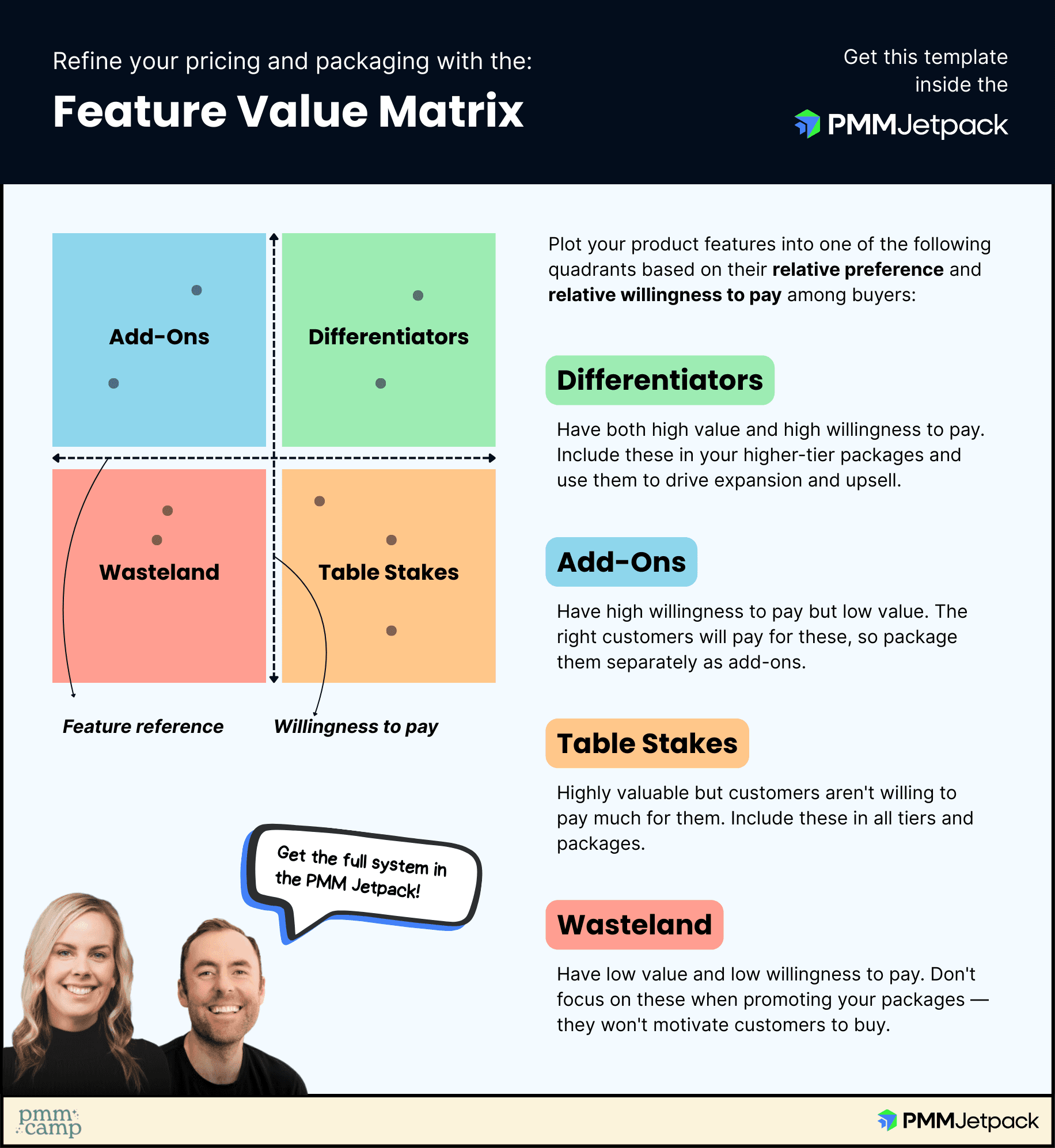
The Feature Value Matrix has four quadrants:
Table Stakes (bottom right) - features are highly valuable but customers aren't willing to pay much for them. Include these in all tiers and packages.
Wasteland (bottom left) - features have low value and low willingness to pay. Don't focus on these when promoting your packages—they won't motivate customers to buy.
Add-ons (top left) - have high willingness to pay but low average value. The right customers will pay for these, so package them separately as add-ons.
Differentiators (top right) - have both high value and high willingness to pay. Include these in your higher-tier packages and use them to drive expansion and upsell.
The Feature Value Matrix
This framework helps you understand which features your customers prefer most, alongside their willingness to pay for your product. It gives you a structured way to figure out which features drive revenue, which are considered table stakes, and which don’t motivate your customers at all.
You end up with a scatter chart you can use to make smarter packaging and pricing decisions.
The Y-axis represents your customer's willingness to pay.
The X-axis represents their overall preference for each feature.
Plot your product features on the matrix based on these two factors. This creates a clear map showing which features belong in which packages.
The Feature Value Matrix has four quadrants:
Table Stakes (bottom right) - features are highly valuable but customers aren't willing to pay much for them. Include these in all tiers and packages.
Wasteland (bottom left) - features have low value and low willingness to pay. Don't focus on these when promoting your packages—they won't motivate customers to buy.
Add-ons (top left) - have high willingness to pay but low average value. The right customers will pay for these, so package them separately as add-ons.
Differentiators (top right) - have both high value and high willingness to pay. Include these in your higher-tier packages and use them to drive expansion and upsell.
The Feature Value Matrix
This framework helps you understand which features your customers prefer most, alongside their willingness to pay for your product. It gives you a structured way to figure out which features drive revenue, which are considered table stakes, and which don’t motivate your customers at all.
You end up with a scatter chart you can use to make smarter packaging and pricing decisions.
The Y-axis represents your customer's willingness to pay.
The X-axis represents their overall preference for each feature.
Plot your product features on the matrix based on these two factors. This creates a clear map showing which features belong in which packages.
The Feature Value Matrix has four quadrants:
Table Stakes (bottom right) - features are highly valuable but customers aren't willing to pay much for them. Include these in all tiers and packages.
Wasteland (bottom left) - features have low value and low willingness to pay. Don't focus on these when promoting your packages—they won't motivate customers to buy.
Add-ons (top left) - have high willingness to pay but low average value. The right customers will pay for these, so package them separately as add-ons.
Differentiators (top right) - have both high value and high willingness to pay. Include these in your higher-tier packages and use them to drive expansion and upsell.
You may be wondering, “but how do I know where to plot my product features on this chart?” Well, that's where the next two frameworks come in.
Feature Preference Analysis Using MaxDiff
A MaxDiff study is an effective tool for determining feature preferences across your customer base, or a specific segment, for pricing research. Unlike traditional surveys that ask customers to rank all features, MaxDiff asks them to select their most and least preferred features from a set of options. It's a much simpler survey.
When creating your survey, provide enough of a description of your product and core features so non-customers can understand each feature and determine which would be most or least valuable to them.
After collecting responses, calculate a Relative Preference Score for each feature using this formula:
You may be wondering, “but how do I know where to plot my product features on this chart?” Well, that's where the next two frameworks come in.
Feature Preference Analysis Using MaxDiff
A MaxDiff study is an effective tool for determining feature preferences across your customer base, or a specific segment, for pricing research. Unlike traditional surveys that ask customers to rank all features, MaxDiff asks them to select their most and least preferred features from a set of options. It's a much simpler survey.
When creating your survey, provide enough of a description of your product and core features so non-customers can understand each feature and determine which would be most or least valuable to them.
After collecting responses, calculate a Relative Preference Score for each feature using this formula:
You may be wondering, “but how do I know where to plot my product features on this chart?” Well, that's where the next two frameworks come in.
Feature Preference Analysis Using MaxDiff
A MaxDiff study is an effective tool for determining feature preferences across your customer base, or a specific segment, for pricing research. Unlike traditional surveys that ask customers to rank all features, MaxDiff asks them to select their most and least preferred features from a set of options. It's a much simpler survey.
When creating your survey, provide enough of a description of your product and core features so non-customers can understand each feature and determine which would be most or least valuable to them.
After collecting responses, calculate a Relative Preference Score for each feature using this formula:
(Number of times most preferred − Number of times least preferred) ÷ Total number of responses = Relative Preference Score
(Number of times most preferred − Number of times least preferred) ÷ Total number of responses = Relative Preference Score
(Number of times most preferred − Number of times least preferred) ÷ Total number of responses = Relative Preference Score
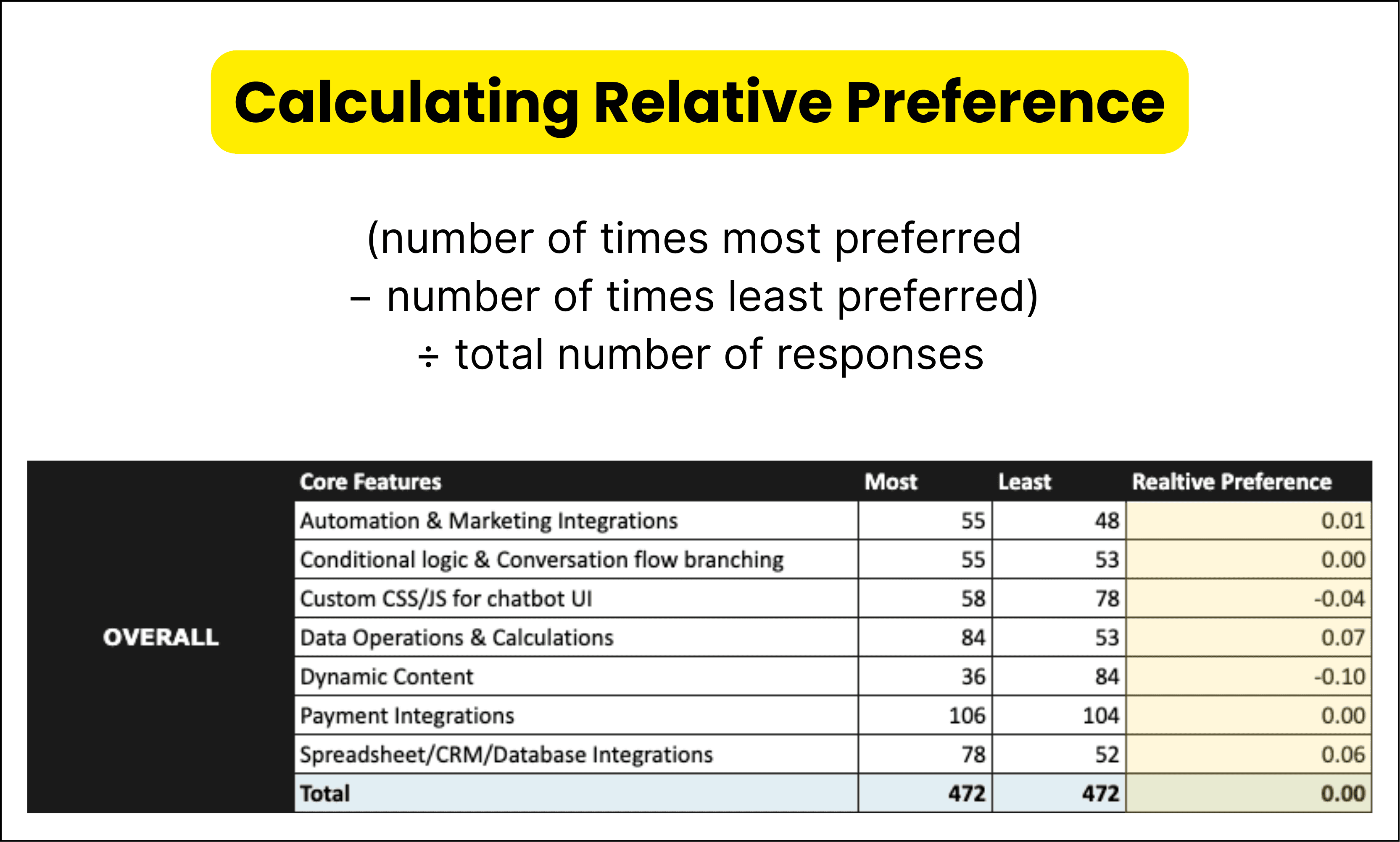
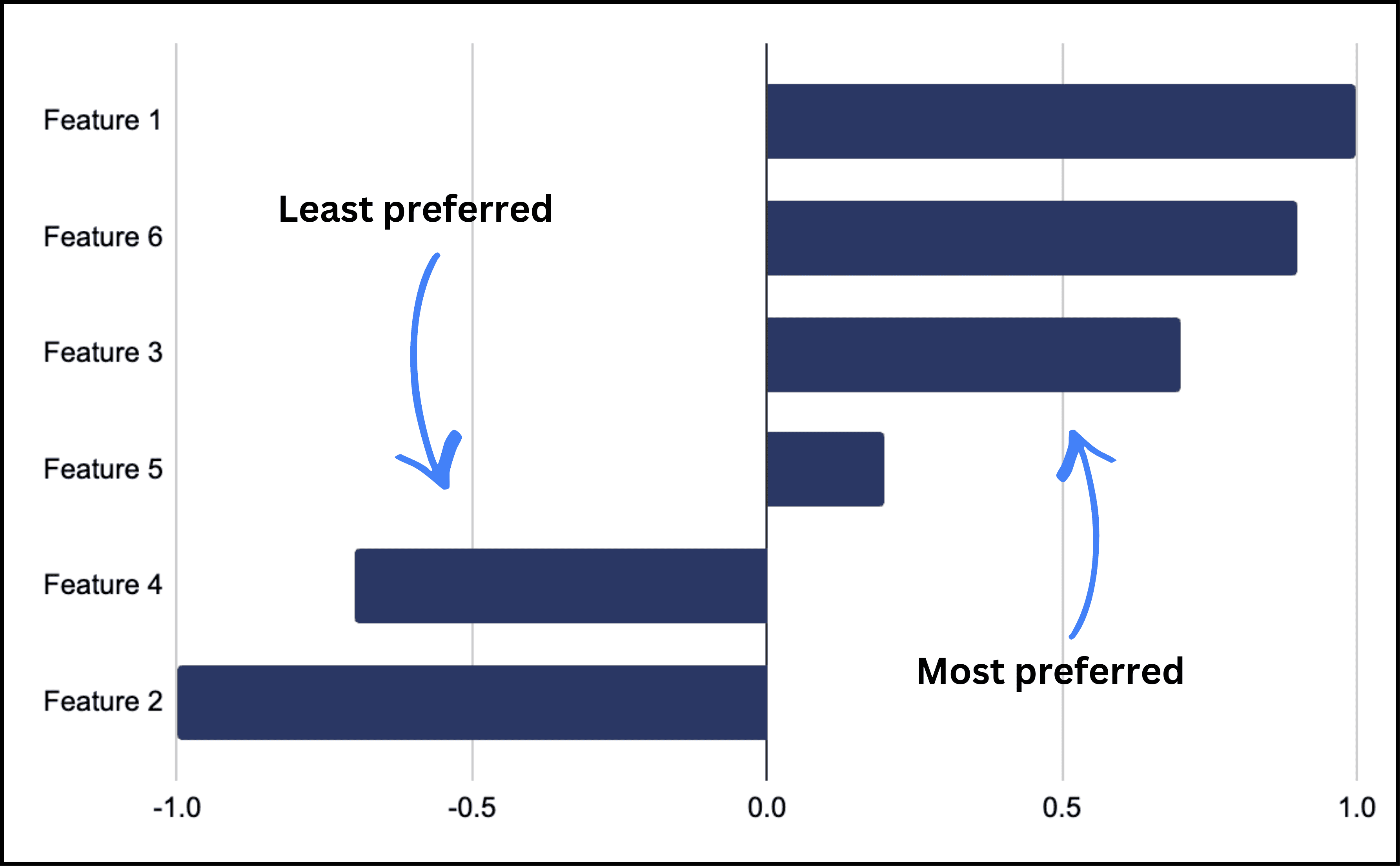
The closer the score is to +1, the more preferred the feature. The closer to −1, the less preferred.
The closer the score is to +1, the more preferred the feature. The closer to −1, the less preferred.
The closer the score is to +1, the more preferred the feature. The closer to −1, the less preferred.
Your Next Steps:
Determine which features to include in your survey, with a description that provides enough context for non-customers unfamiliar with your product to decide which features they'd consider most or least important.
Once you've conducted your survey, add the results to the template below to generate your MaxDiff feature preference graph.
Your Next Steps:
Determine which features to include in your survey, with a description that provides enough context for non-customers unfamiliar with your product to decide which features they'd consider most or least important.
Once you've conducted your survey, add the results to the template below to generate your MaxDiff feature preference graph.
Your Next Steps:
Determine which features to include in your survey, with a description that provides enough context for non-customers unfamiliar with your product to decide which features they'd consider most or least important.
Once you've conducted your survey, add the results to the template below to generate your MaxDiff feature preference graph.
Pricing And Packaging Analysis Template
Click the link below to check out our Pricing And Packaging Analysis Template, created in partnership with Andrew Michael.
This template will make it easy for you to conduct one survey and use the data to automatically generate charts for:
Willingness to Pay (Van Westendorp)
Feature Preference (MaxDiff)
Feature Value Matrix
Get the Pricing And Packaging Analysis Template
Pricing And Packaging Analysis Template
Click the link below to check out our Pricing And Packaging Analysis Template, created in partnership with Andrew Michael.
This template will make it easy for you to conduct one survey and use the data to automatically generate charts for:
Willingness to Pay (Van Westendorp)
Feature Preference (MaxDiff)
Feature Value Matrix
Get the Pricing And Packaging Analysis Template
Pricing And Packaging Analysis Template
Click the link below to check out our Pricing And Packaging Analysis Template, created in partnership with Andrew Michael.
This template will make it easy for you to conduct one survey and use the data to automatically generate charts for:
Willingness to Pay (Van Westendorp)
Feature Preference (MaxDiff)
Feature Value Matrix
Get the Pricing And Packaging Analysis Template
Willingness To Pay Using Van Westendorp
The Van Westendorp Pricing Sensitivity Meter helps you determine your customers' willingness to pay for you product. Like MaxDiff, it requires only a simple survey — just four questions.
After describing your product in enough detail for customers to understand how they'd use it and the value it provides, ask them:
At what price would you consider the product so expensive that you would not consider buying it?
At what price would it be getting expensive, but you would still buy it?
At what price would it be a bargain, a great buy for the money?
At what price would it be so cheap that you'd question the quality?
With These four simple questions can calculate a number of different data points that represent varying levels of willingness to pay, including your Optimum Price Point.
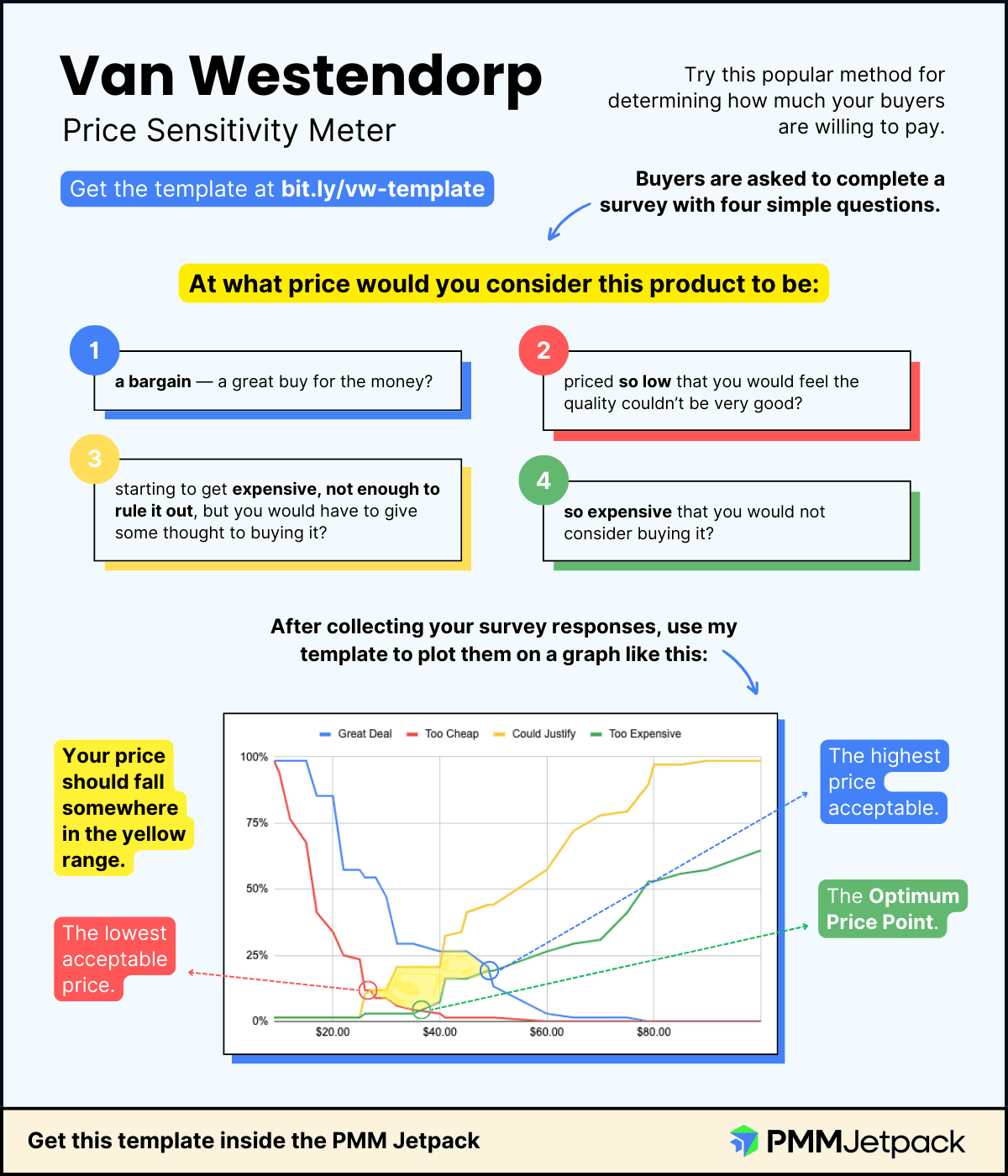
The chart in the infographic below shows a typical output you'd get from a Van Westendorp study. The space highlighted in yellow represents the acceptable price range for your product.
To optimize for the highest conversion rate, select the price point at the leftmost edge of the yellow area. To optimize for the highest revenue per customer, select the price point at the rightmost edge of the yellow area.
Willingness To Pay Using Van Westendorp
The Van Westendorp Pricing Sensitivity Meter helps you determine your customers' willingness to pay for you product. Like MaxDiff, it requires only a simple survey — just four questions.
After describing your product in enough detail for customers to understand how they'd use it and the value it provides, ask them:
At what price would you consider the product so expensive that you would not consider buying it?
At what price would it be getting expensive, but you would still buy it?
At what price would it be a bargain, a great buy for the money?
At what price would it be so cheap that you'd question the quality?
With These four simple questions can calculate a number of different data points that represent varying levels of willingness to pay, including your Optimum Price Point.
The chart in the infographic below shows a typical output you'd get from a Van Westendorp study. The space highlighted in yellow represents the acceptable price range for your product.
To optimize for the highest conversion rate, select the price point at the leftmost edge of the yellow area. To optimize for the highest revenue per customer, select the price point at the rightmost edge of the yellow area.
Willingness To Pay Using Van Westendorp
The Van Westendorp Pricing Sensitivity Meter helps you determine your customers' willingness to pay for you product. Like MaxDiff, it requires only a simple survey — just four questions.
After describing your product in enough detail for customers to understand how they'd use it and the value it provides, ask them:
At what price would you consider the product so expensive that you would not consider buying it?
At what price would it be getting expensive, but you would still buy it?
At what price would it be a bargain, a great buy for the money?
At what price would it be so cheap that you'd question the quality?
With These four simple questions can calculate a number of different data points that represent varying levels of willingness to pay, including your Optimum Price Point.
The chart in the infographic below shows a typical output you'd get from a Van Westendorp study. The space highlighted in yellow represents the acceptable price range for your product.
To optimize for the highest conversion rate, select the price point at the leftmost edge of the yellow area. To optimize for the highest revenue per customer, select the price point at the rightmost edge of the yellow area.
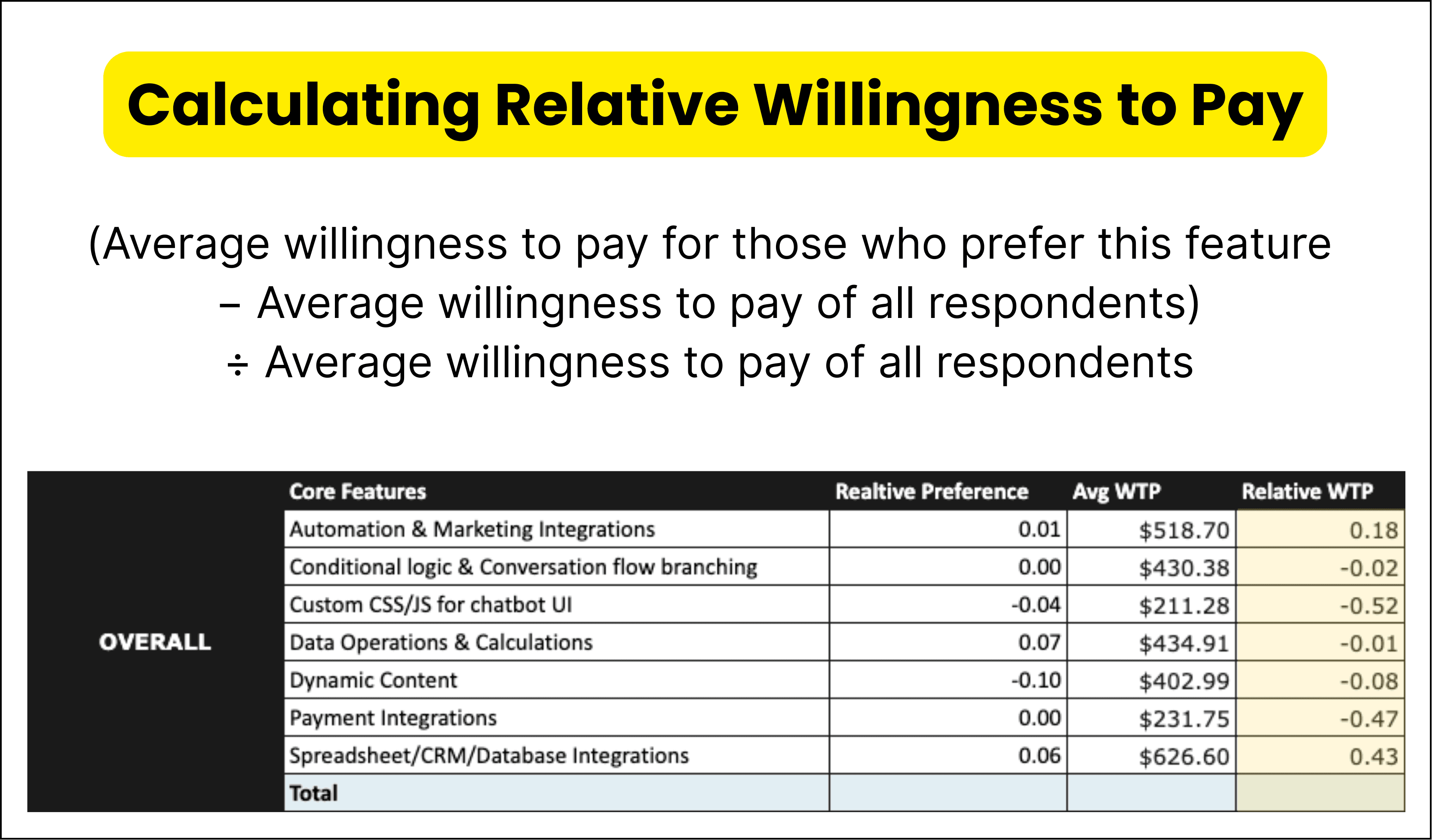
This data also lets you calculate the Relative Willingness to Pay (WTP) for each feature in your feature preference study, using the following formula:
This data also lets you calculate the Relative Willingness to Pay (WTP) for each feature in your feature preference study, using the following formula:
This data also lets you calculate the Relative Willingness to Pay (WTP) for each feature in your feature preference study, using the following formula:
(Average willingness to pay for those who prefer this feature − Average willingness to pay of all respondents) ÷ Average willingness to pay of all respondents
(Average willingness to pay for those who prefer this feature − Average willingness to pay of all respondents) ÷ Average willingness to pay of all respondents
(Average willingness to pay for those who prefer this feature − Average willingness to pay of all respondents) ÷ Average willingness to pay of all respondents
Bringing it all together
Now that you have scores for both Relative Feature Preference and Relative Willingness to Pay, you can complete your feature value matrix.
Plot each key feature from your MaxDiff survey on the matrix using both scores. If you're using the Pricing Study Template linked below, this happens automatically when you upload your MaxDiff and Van Westendorp survey data.
You'll end up with a clear picture of which features are table stakes, wasteland, add-ons, and differentiators. Use this data to determine your packaging and price points.
Here are examples of real feature value matrices from well-known SaaS products:
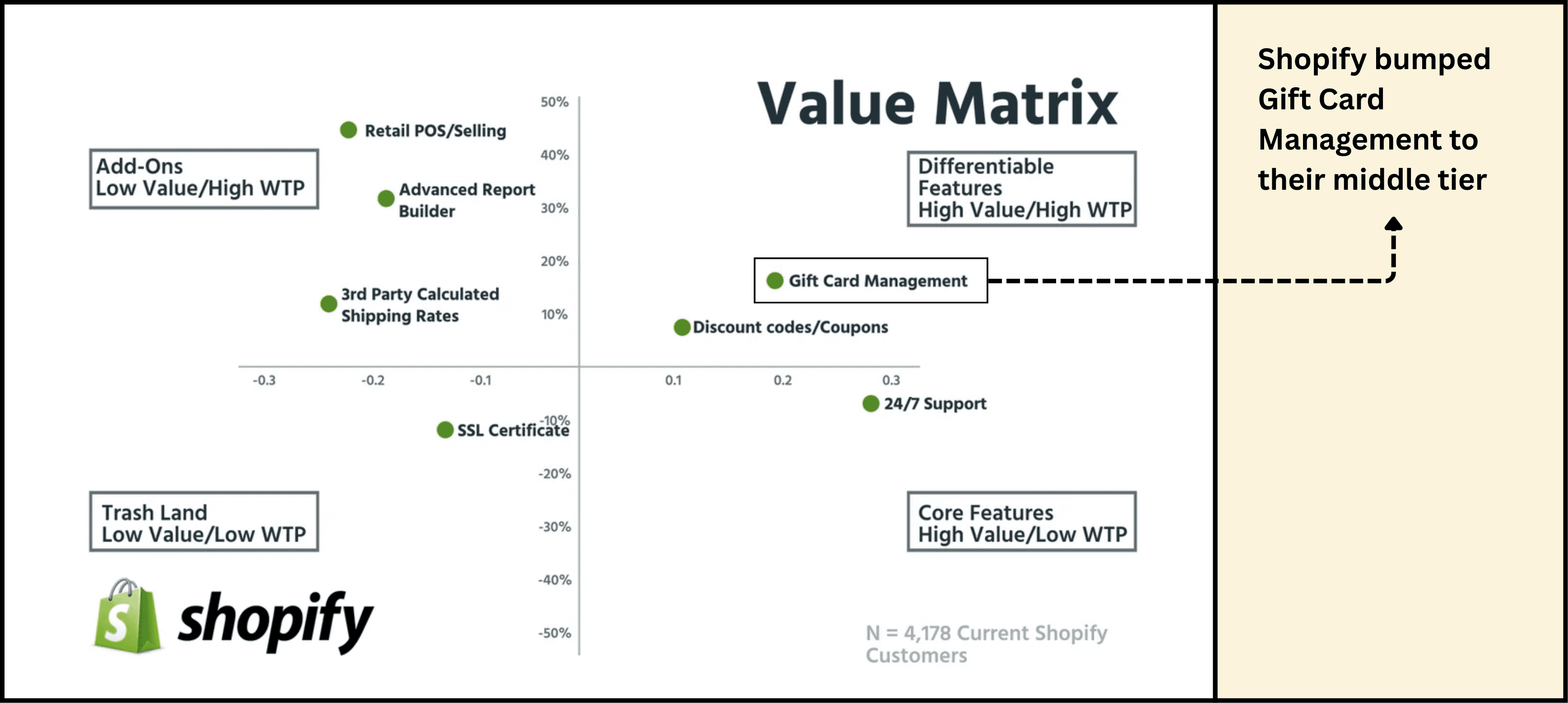
Ex. In this Shopify example, two differentiated features stand out: gift card management and discount codes. After conducting this study, Shopify moved gift card management to their middle tier—recognizing it as a highly valuable feature customers were willing to pay more for. Meanwhile, retail POS/selling showed high value for a specific customer segment, making it a better fit as an add-on.
Bringing it all together
Now that you have scores for both Relative Feature Preference and Relative Willingness to Pay, you can complete your feature value matrix.
Plot each key feature from your MaxDiff survey on the matrix using both scores. If you're using the Pricing Study Template linked below, this happens automatically when you upload your MaxDiff and Van Westendorp survey data.
You'll end up with a clear picture of which features are table stakes, wasteland, add-ons, and differentiators. Use this data to determine your packaging and price points.
Here are examples of real feature value matrices from well-known SaaS products:
Ex. In this Shopify example, two differentiated features stand out: gift card management and discount codes. After conducting this study, Shopify moved gift card management to their middle tier—recognizing it as a highly valuable feature customers were willing to pay more for. Meanwhile, retail POS/selling showed high value for a specific customer segment, making it a better fit as an add-on.
Bringing it all together
Now that you have scores for both Relative Feature Preference and Relative Willingness to Pay, you can complete your feature value matrix.
Plot each key feature from your MaxDiff survey on the matrix using both scores. If you're using the Pricing Study Template linked below, this happens automatically when you upload your MaxDiff and Van Westendorp survey data.
You'll end up with a clear picture of which features are table stakes, wasteland, add-ons, and differentiators. Use this data to determine your packaging and price points.
Here are examples of real feature value matrices from well-known SaaS products:
Ex. In this Shopify example, two differentiated features stand out: gift card management and discount codes. After conducting this study, Shopify moved gift card management to their middle tier—recognizing it as a highly valuable feature customers were willing to pay more for. Meanwhile, retail POS/selling showed high value for a specific customer segment, making it a better fit as an add-on.
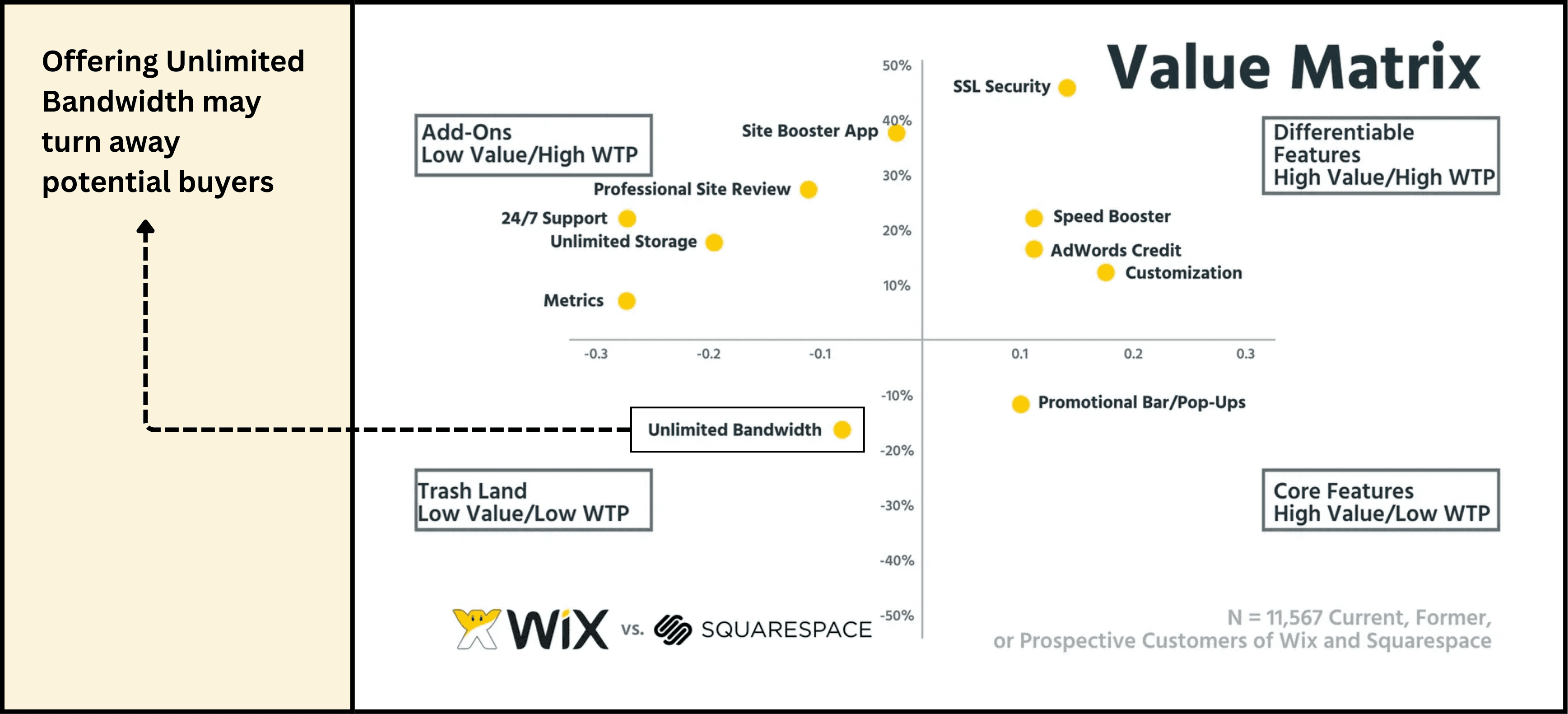
Ex. In this Wix example, SSL security shows high value and extremely high willingness to pay—making it a strong candidate for higher-tier packages. In contrast, unlimited bandwidth isn't considered valuable by customers and could actually weaken the packages if emphasized too heavily.
Ex. In this Wix example, SSL security shows high value and extremely high willingness to pay—making it a strong candidate for higher-tier packages. In contrast, unlimited bandwidth isn't considered valuable by customers and could actually weaken the packages if emphasized too heavily.
Ex. In this Wix example, SSL security shows high value and extremely high willingness to pay—making it a strong candidate for higher-tier packages. In contrast, unlimited bandwidth isn't considered valuable by customers and could actually weaken the packages if emphasized too heavily.
Conclusion
Pricing is one of your most powerful levers for growth. As a product marketer, you're uniquely positioned to bring customer insight and strategic thinking to pricing decisions that often happen in silos.
You don't need to own pricing end-to-end to make an impact. Anchor conversations in customer value. Use frameworks like the Feature Value Matrix, Feature Preference, and Willingness to Pay. Pressure-test your model against real deals.
Start small, test your assumptions, and iterate. You'll quickly see how pricing clarity drives sales confidence and measurable revenue impact.
Conclusion
Pricing is one of your most powerful levers for growth. As a product marketer, you're uniquely positioned to bring customer insight and strategic thinking to pricing decisions that often happen in silos.
You don't need to own pricing end-to-end to make an impact. Anchor conversations in customer value. Use frameworks like the Feature Value Matrix, Feature Preference, and Willingness to Pay. Pressure-test your model against real deals.
Start small, test your assumptions, and iterate. You'll quickly see how pricing clarity drives sales confidence and measurable revenue impact.
Conclusion
Pricing is one of your most powerful levers for growth. As a product marketer, you're uniquely positioned to bring customer insight and strategic thinking to pricing decisions that often happen in silos.
You don't need to own pricing end-to-end to make an impact. Anchor conversations in customer value. Use frameworks like the Feature Value Matrix, Feature Preference, and Willingness to Pay. Pressure-test your model against real deals.
Start small, test your assumptions, and iterate. You'll quickly see how pricing clarity drives sales confidence and measurable revenue impact.
Resources
Resources
Resources
Pricing And Packaging Analysis Template
Click the link below to check out our Pricing And Packaging Analysis Template, created in partnership with Andrew Michael.
This template will make it easy for you to conduct one survey and use the data to automatically generate charts for:
Willingness to Pay (Van Westendorp)
Feature Preference (MaxDiff)
Feature Value Matrix
Get the Pricing And Packaging Analysis Template
Pricing And Packaging Analysis Template
Click the link below to check out our Pricing And Packaging Analysis Template, created in partnership with Andrew Michael.
This template will make it easy for you to conduct one survey and use the data to automatically generate charts for:
Willingness to Pay (Van Westendorp)
Feature Preference (MaxDiff)
Feature Value Matrix
Get the Pricing And Packaging Analysis Template
Pricing And Packaging Analysis Template
Click the link below to check out our Pricing And Packaging Analysis Template, created in partnership with Andrew Michael.
This template will make it easy for you to conduct one survey and use the data to automatically generate charts for:
Willingness to Pay (Van Westendorp)
Feature Preference (MaxDiff)
Feature Value Matrix
Get the Pricing And Packaging Analysis Template


Copyright © 2024 Productive PMM Inc.
Copyright © 2024 Productive PMM Inc.
Copyright © 2024 Productive PMM Inc.