Campaigns
Playbook 16: How to Drive Growth With Product-Focused Campaigns
Playbook 16: How to Drive Growth With Product-Focused Campaigns
Playbook 16: How to Drive Growth With Product-Focused Campaigns
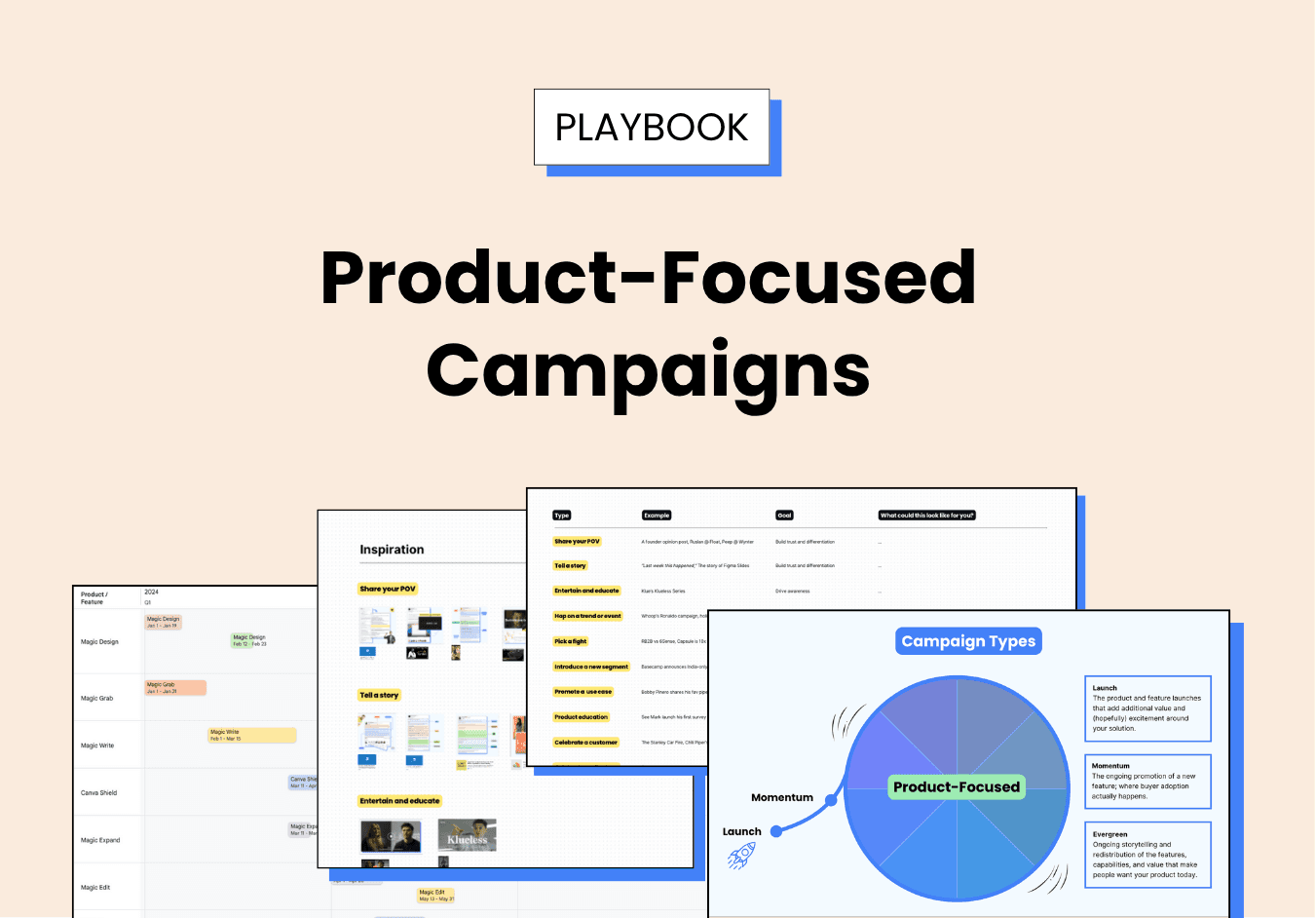
This playbook teaches you how to build ongoing marketing campaigns around your existing product — not just new launches — to drive continuous growth and keep your product visible in the market.
You'll learn:
Why product-focused campaigns matter
How to identify features that deserve attention
10 creative campaign angles
How to balance launches, momentum, and evergreen marketing
Frameworks for campaigns that drive acquisition, adoption, and expansion}
Introduction
When most product marketers think “campaign,” their mind jumps to launches. The new feature, the big announcement, the shiny new thing.
But if you only market what’s new, you’re missing one of your biggest growth levers: the product you already have.
This playbook shows you how to plan and run product-focused campaigns — ongoing marketing efforts that spotlight the features, value, and customer outcomes your product already delivers.
You’ll learn how to identify which parts of your product deserve attention, how to build campaigns that reignite awareness and adoption, and how to drive measurable growth without waiting for the next launch.
Most Teams Over-Index on New Launches
A lot of companies will make a point to announce something new every quarter, sometimes every month. But in between, any marketing about the actual product often goes quiet.
That silence is expensive. It leaves your best differentiators under-marketed, and it conditions your buyers to only pay attention when something new drops.
Every month that goes by without marketing your existing product is a missed opportunity to grow from all the stuff you’ve already built.
When most product marketers think “campaign,” their mind jumps to launches. The new feature, the big announcement, the shiny new thing.
But if you only market what’s new, you’re missing one of your biggest growth levers: the product you already have.
This playbook shows you how to plan and run product-focused campaigns — ongoing marketing efforts that spotlight the features, value, and customer outcomes your product already delivers.
You’ll learn how to identify which parts of your product deserve attention, how to build campaigns that reignite awareness and adoption, and how to drive measurable growth without waiting for the next launch.
Most Teams Over-Index on New Launches
A lot of companies will make a point to announce something new every quarter, sometimes every month. But in between, any marketing about the actual product often goes quiet.
That silence is expensive. It leaves your best differentiators under-marketed, and it conditions your buyers to only pay attention when something new drops.
Every month that goes by without marketing your existing product is a missed opportunity to grow from all the stuff you’ve already built.
When most product marketers think “campaign,” their mind jumps to launches. The new feature, the big announcement, the shiny new thing.
But if you only market what’s new, you’re missing one of your biggest growth levers: the product you already have.
This playbook shows you how to plan and run product-focused campaigns — ongoing marketing efforts that spotlight the features, value, and customer outcomes your product already delivers.
You’ll learn how to identify which parts of your product deserve attention, how to build campaigns that reignite awareness and adoption, and how to drive measurable growth without waiting for the next launch.
Most Teams Over-Index on New Launches
A lot of companies will make a point to announce something new every quarter, sometimes every month. But in between, any marketing about the actual product often goes quiet.
That silence is expensive. It leaves your best differentiators under-marketed, and it conditions your buyers to only pay attention when something new drops.
Every month that goes by without marketing your existing product is a missed opportunity to grow from all the stuff you’ve already built.
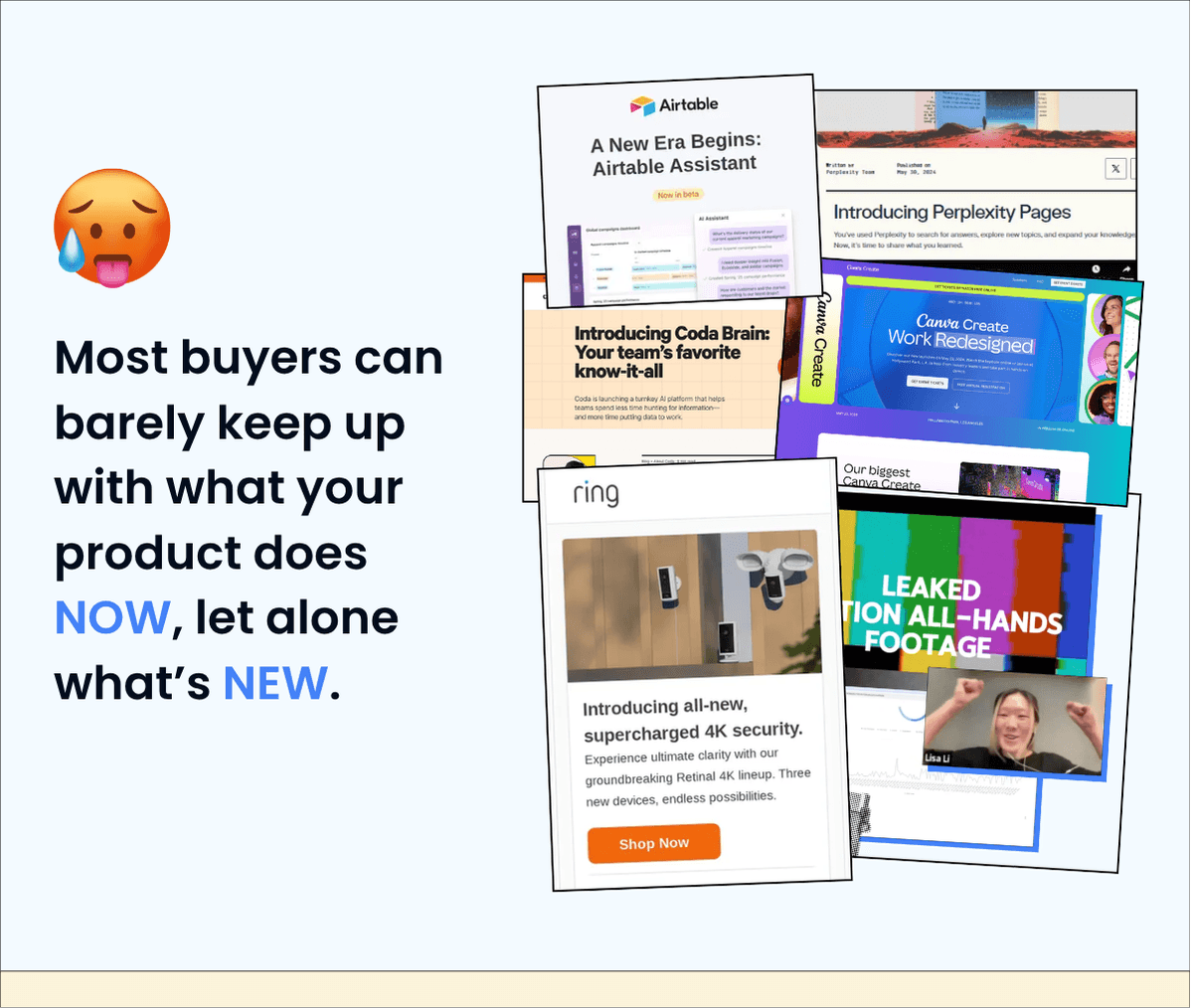
When done well, making the shift to product-focused campaigns can create continuous market presence and momentum by:
Re-surfacing features that drive retention, upsell, or expansion.
Keeping your product’s differentiation visible in the market.
Helping sales tell stronger “why now” stories tied to customer problems.
Think of Your Product Marketing as a Merry-Go-Round
It’s the perfect analogy for your marketing campaigns. And no, I’m not talking about the cute carnival ride with pretty horses.
I’m talking about the dented, wildly spinning metal disk we all dared each other to hop on as kids. It’s noisy, it keeps going once you push it, and if you don’t time your jump right, you’re flat on the ground.
When done well, making the shift to product-focused campaigns can create continuous market presence and momentum by:
Re-surfacing features that drive retention, upsell, or expansion.
Keeping your product’s differentiation visible in the market.
Helping sales tell stronger “why now” stories tied to customer problems.
Think of Your Product Marketing as a Merry-Go-Round
It’s the perfect analogy for your marketing campaigns. And no, I’m not talking about the cute carnival ride with pretty horses.
I’m talking about the dented, wildly spinning metal disk we all dared each other to hop on as kids. It’s noisy, it keeps going once you push it, and if you don’t time your jump right, you’re flat on the ground.
When done well, making the shift to product-focused campaigns can create continuous market presence and momentum by:
Re-surfacing features that drive retention, upsell, or expansion.
Keeping your product’s differentiation visible in the market.
Helping sales tell stronger “why now” stories tied to customer problems.
Think of Your Product Marketing as a Merry-Go-Round
It’s the perfect analogy for your marketing campaigns. And no, I’m not talking about the cute carnival ride with pretty horses.
I’m talking about the dented, wildly spinning metal disk we all dared each other to hop on as kids. It’s noisy, it keeps going once you push it, and if you don’t time your jump right, you’re flat on the ground.

Product-Focused Campaigns: the spin that never stops
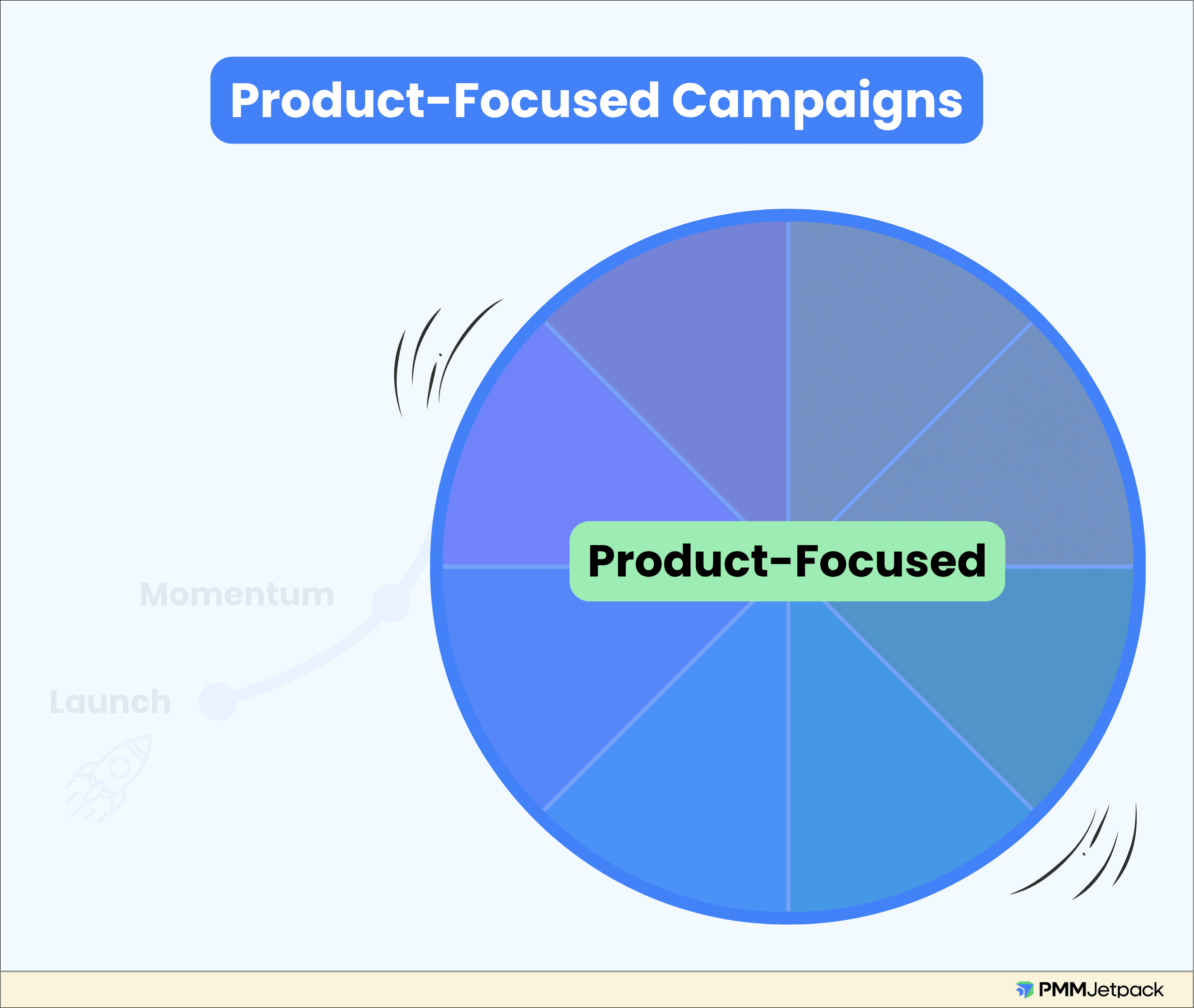
Think of the merry-go-round in motion, consistently turning. That’s your PFC: your Product-Focused Campaign. It’s the steady momentum generated by ongoing storytelling; the redistribution of the features, capabilities, and value that reminds people what your product does best.
This is where most teams leave money on the table. There’s likely a lot of low-hanging fruit here where you can drive pipeline and adoption, simply by creating awareness around your greatest hits. The stuff that actually sells!
Product-Focused Campaigns: the spin that never stops
Think of the merry-go-round in motion, consistently turning. That’s your PFC: your Product-Focused Campaign. It’s the steady momentum generated by ongoing storytelling; the redistribution of the features, capabilities, and value that reminds people what your product does best.
This is where most teams leave money on the table. There’s likely a lot of low-hanging fruit here where you can drive pipeline and adoption, simply by creating awareness around your greatest hits. The stuff that actually sells!
Product-Focused Campaigns: the spin that never stops
Think of the merry-go-round in motion, consistently turning. That’s your PFC: your Product-Focused Campaign. It’s the steady momentum generated by ongoing storytelling; the redistribution of the features, capabilities, and value that reminds people what your product does best.
This is where most teams leave money on the table. There’s likely a lot of low-hanging fruit here where you can drive pipeline and adoption, simply by creating awareness around your greatest hits. The stuff that actually sells!
Launches: the new kid who wants a turn
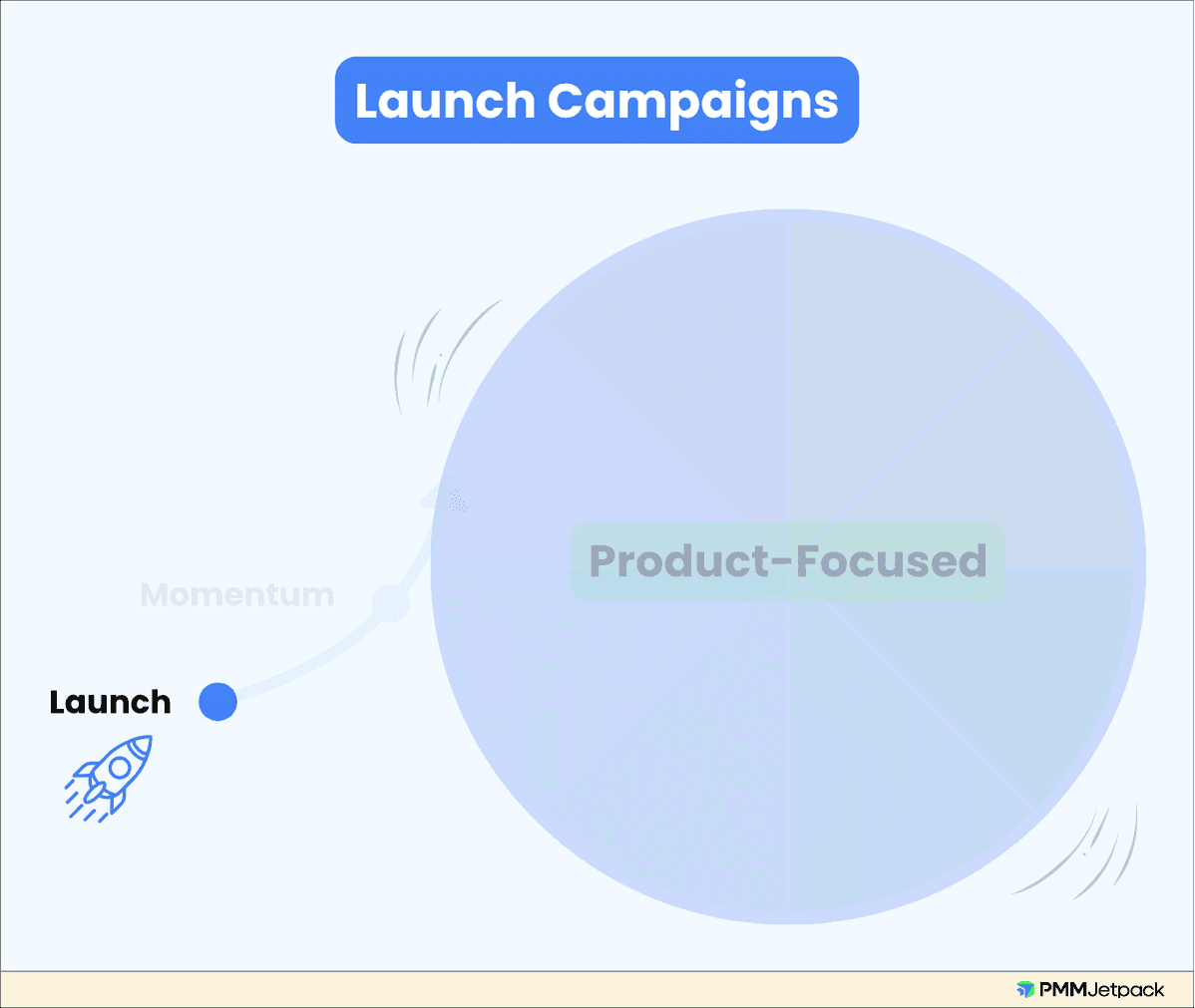
Launches are the exciting new thing sprinting up to the wheel, waving its arms. They deserve a moment in the spotlight! They’re all the new capabilities and fresh features that add additional value and (hopefully) excitement around your solution.
This is where most of your time as a PMM is spent today. Bringing the new stuff to market.
Launches: the new kid who wants a turn
Launches are the exciting new thing sprinting up to the wheel, waving its arms. They deserve a moment in the spotlight! They’re all the new capabilities and fresh features that add additional value and (hopefully) excitement around your solution.
This is where most of your time as a PMM is spent today. Bringing the new stuff to market.
Launches: the new kid who wants a turn
Launches are the exciting new thing sprinting up to the wheel, waving its arms. They deserve a moment in the spotlight! They’re all the new capabilities and fresh features that add additional value and (hopefully) excitement around your solution.
This is where most of your time as a PMM is spent today. Bringing the new stuff to market.
Momentum Campaigns: the well-timed shove
Momentum campaigns are the stuff that gets the launch onto the spinning wheel without sending anyone flying. It’s helping to give your new feature the momentum it needs to safely board become a key part of your positioning and value prop.
Momentum Campaigns: the well-timed shove
Momentum campaigns are the stuff that gets the launch onto the spinning wheel without sending anyone flying. It’s helping to give your new feature the momentum it needs to safely board become a key part of your positioning and value prop.
Momentum Campaigns: the well-timed shove
Momentum campaigns are the stuff that gets the launch onto the spinning wheel without sending anyone flying. It’s helping to give your new feature the momentum it needs to safely board become a key part of your positioning and value prop.
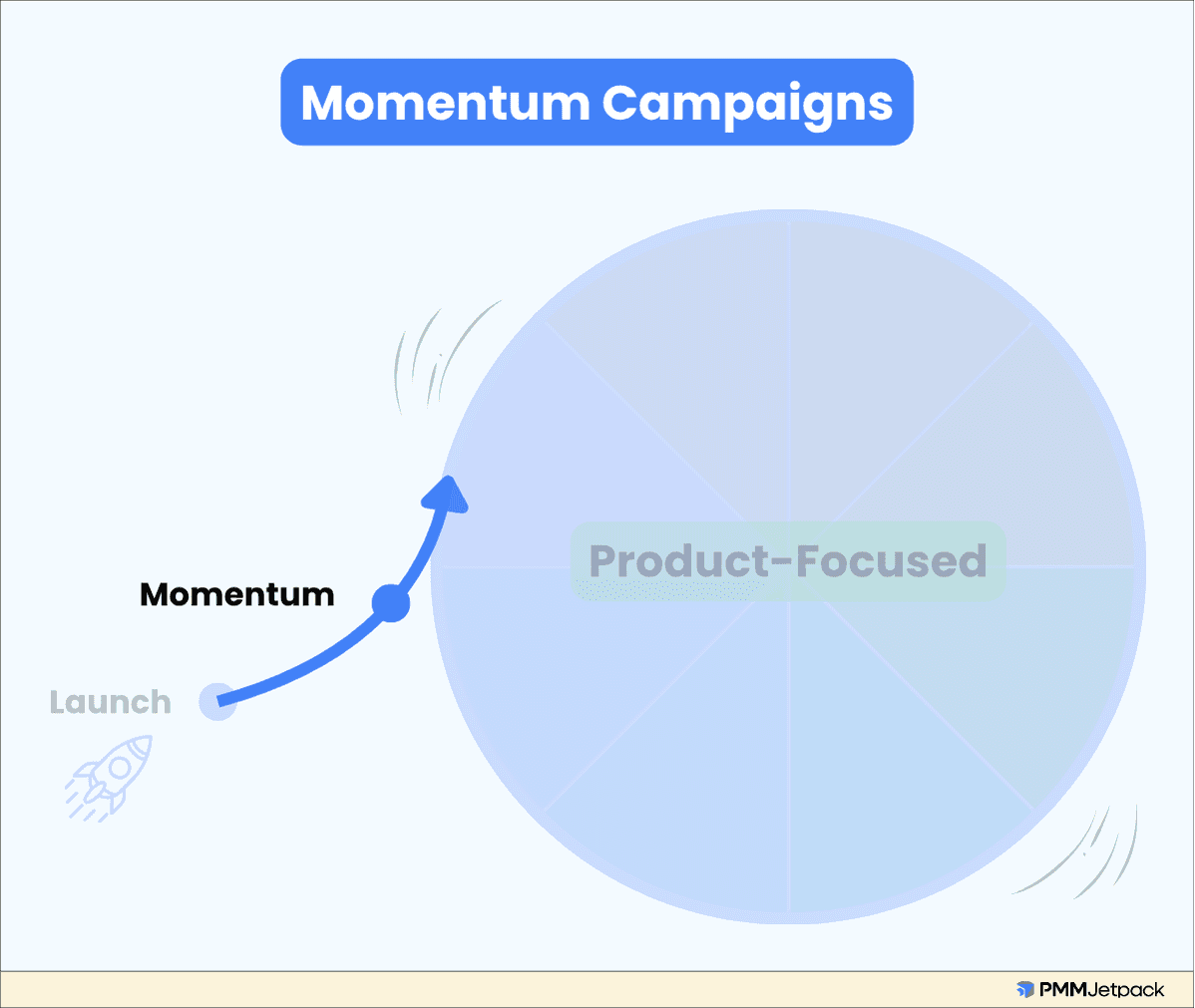
This is another big miss for most product marketing teams. Too many launches fizzle because we celebrate day one and then move on to the next. We need to give a launch enough time and marketing power to gain momentum.
Because we all know what happened to that kid who tried to jump on the merry-go-round without enough momentum. 😣
This is another big miss for most product marketing teams. Too many launches fizzle because we celebrate day one and then move on to the next. We need to give a launch enough time and marketing power to gain momentum.
Because we all know what happened to that kid who tried to jump on the merry-go-round without enough momentum. 😣
This is another big miss for most product marketing teams. Too many launches fizzle because we celebrate day one and then move on to the next. We need to give a launch enough time and marketing power to gain momentum.
Because we all know what happened to that kid who tried to jump on the merry-go-round without enough momentum. 😣

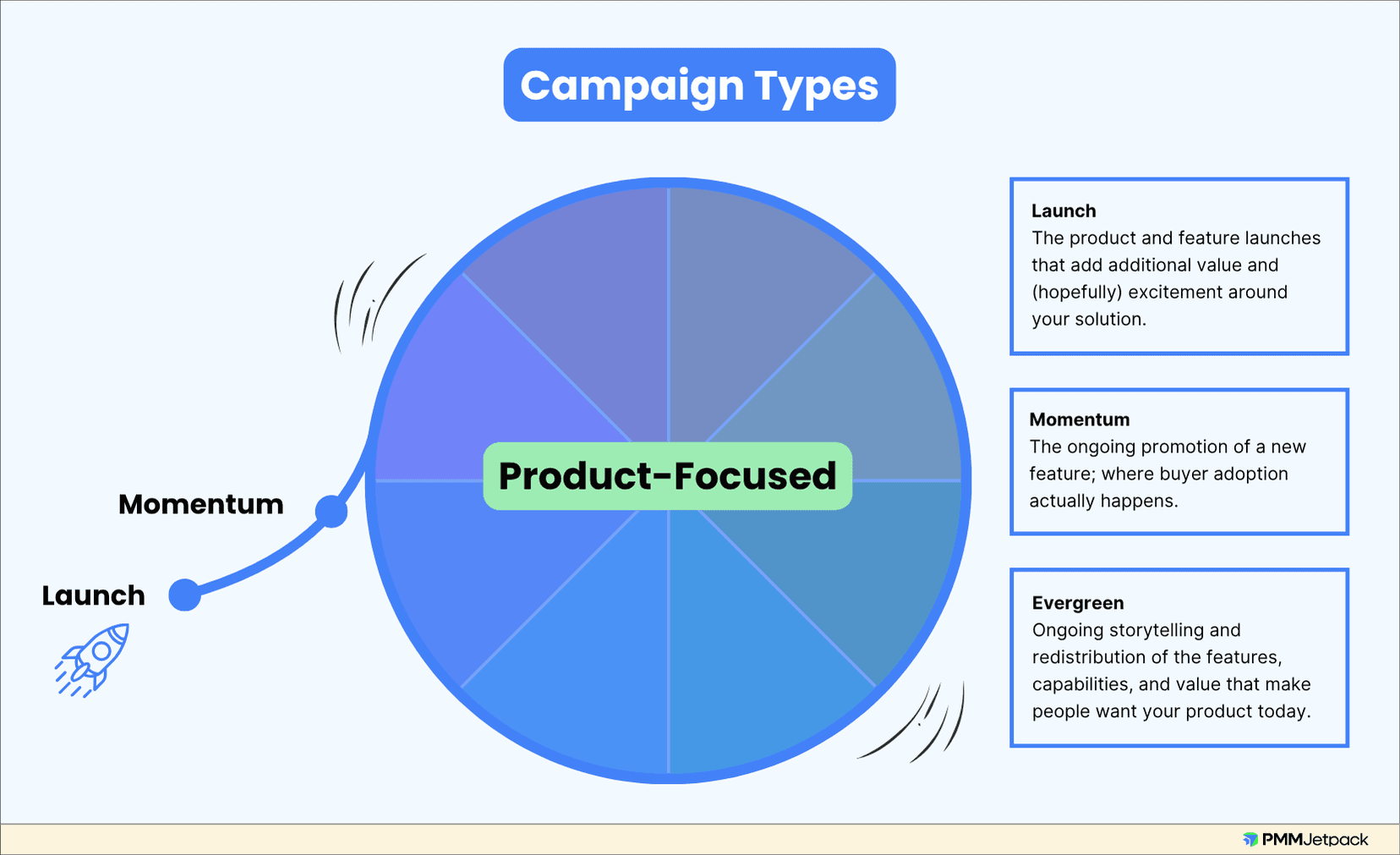
To recap, when you think of your campaigns, you can break them down into three buckets:
Launch - The product and feature launches that add additional value and (hopefully) excitement around your solution.
Momentum - The ongoing promotion of a new feature; where buyer adoption actually happens.
Product-Focused - Ongoing storytelling and redistribution of the features, capabilities, and value that make people want your product today.
When you run all three in concert, you start building a continuous, measurable system. You’re launching new things, giving them the momentum to catch hold, and constantly driving awareness of your product in market. The new stuff, yes, but also the tried and true things that consistently get people to buy your product.
To recap, when you think of your campaigns, you can break them down into three buckets:
Launch - The product and feature launches that add additional value and (hopefully) excitement around your solution.
Momentum - The ongoing promotion of a new feature; where buyer adoption actually happens.
Product-Focused - Ongoing storytelling and redistribution of the features, capabilities, and value that make people want your product today.
When you run all three in concert, you start building a continuous, measurable system. You’re launching new things, giving them the momentum to catch hold, and constantly driving awareness of your product in market. The new stuff, yes, but also the tried and true things that consistently get people to buy your product.
To recap, when you think of your campaigns, you can break them down into three buckets:
Launch - The product and feature launches that add additional value and (hopefully) excitement around your solution.
Momentum - The ongoing promotion of a new feature; where buyer adoption actually happens.
Product-Focused - Ongoing storytelling and redistribution of the features, capabilities, and value that make people want your product today.
When you run all three in concert, you start building a continuous, measurable system. You’re launching new things, giving them the momentum to catch hold, and constantly driving awareness of your product in market. The new stuff, yes, but also the tried and true things that consistently get people to buy your product.
What Should You Talk About?
This is a very important question, especially when you’re considering the Product-Focused category.
Launches and Momentum campaigns are naturally based on your product roadmap, so you can see them coming. But PFCs need deliberate choices: which features, use cases, and stories are worth keeping in rotation so they keep pulling people into the funnel.
Run a quick cross-functional huddle and use these questions to kickstart the brainstorming:
What is a big hairy problem customers solve with our product?
(The kind customers would pay to stop dealing with. Focus on outcomes, not specs.)
What feature makes our customers say “Wow!”
(Not the polished demo line — the real reaction you see in user interviews or NPS comments.)
What’s a customer story that really got our team excited?
What something we can demonstrate in our product that is truly different from the market?
What is our unique POV and how does that shine through in our product?
What features have really strong adoption among a small set of customers?
What capabilities solve a big pain, but aren’t top-of-mind in sales calls?
What features align with our strategic company priorities (e.g., AI, automation, trends).
What other brand or broader marketing campaigns are we planning this quarter?
What Should You Talk About?
This is a very important question, especially when you’re considering the Product-Focused category.
Launches and Momentum campaigns are naturally based on your product roadmap, so you can see them coming. But PFCs need deliberate choices: which features, use cases, and stories are worth keeping in rotation so they keep pulling people into the funnel.
Run a quick cross-functional huddle and use these questions to kickstart the brainstorming:
What is a big hairy problem customers solve with our product?
(The kind customers would pay to stop dealing with. Focus on outcomes, not specs.)
What feature makes our customers say “Wow!”
(Not the polished demo line — the real reaction you see in user interviews or NPS comments.)
What’s a customer story that really got our team excited?
What something we can demonstrate in our product that is truly different from the market?
What is our unique POV and how does that shine through in our product?
What features have really strong adoption among a small set of customers?
What capabilities solve a big pain, but aren’t top-of-mind in sales calls?
What features align with our strategic company priorities (e.g., AI, automation, trends).
What other brand or broader marketing campaigns are we planning this quarter?
What Should You Talk About?
This is a very important question, especially when you’re considering the Product-Focused category.
Launches and Momentum campaigns are naturally based on your product roadmap, so you can see them coming. But PFCs need deliberate choices: which features, use cases, and stories are worth keeping in rotation so they keep pulling people into the funnel.
Run a quick cross-functional huddle and use these questions to kickstart the brainstorming:
What is a big hairy problem customers solve with our product?
(The kind customers would pay to stop dealing with. Focus on outcomes, not specs.)
What feature makes our customers say “Wow!”
(Not the polished demo line — the real reaction you see in user interviews or NPS comments.)
What’s a customer story that really got our team excited?
What something we can demonstrate in our product that is truly different from the market?
What is our unique POV and how does that shine through in our product?
What features have really strong adoption among a small set of customers?
What capabilities solve a big pain, but aren’t top-of-mind in sales calls?
What features align with our strategic company priorities (e.g., AI, automation, trends).
What other brand or broader marketing campaigns are we planning this quarter?
Quick Tip: Like most things in product marketing, this exercise is infinitely more effective if you consistently gather customer feedback and insights. But you can also review your product analytics, NPS responses, and sales calls — they’ll reveal the hidden gems customers already love.
Check out the playbook below if you need to level-up your customer interviews.
Playbook #7: How To Get Insights From Customer Interviews
Quick Tip: Like most things in product marketing, this exercise is infinitely more effective if you consistently gather customer feedback and insights. But you can also review your product analytics, NPS responses, and sales calls — they’ll reveal the hidden gems customers already love.
Check out the playbook below if you need to level-up your customer interviews.
Playbook #7: How To Get Insights From Customer Interviews
Quick Tip: Like most things in product marketing, this exercise is infinitely more effective if you consistently gather customer feedback and insights. But you can also review your product analytics, NPS responses, and sales calls — they’ll reveal the hidden gems customers already love.
Check out the playbook below if you need to level-up your customer interviews.
Playbook #7: How To Get Insights From Customer Interviews
Campaigns Come In Many Shapes And Sizes
If you’ve read our Product Launch Playbook, you already know how to size and prioritize your product launches.
Campaigns Come In Many Shapes And Sizes
If you’ve read our Product Launch Playbook, you already know how to size and prioritize your product launches.
Campaigns Come In Many Shapes And Sizes
If you’ve read our Product Launch Playbook, you already know how to size and prioritize your product launches.
But for PFCs, a traditional campaign isn’t always necessary. The biggest wins in this area are often from steady, small bets: consistent storytelling about your product in market, bit by bit, through channels like LinkedIn and email.
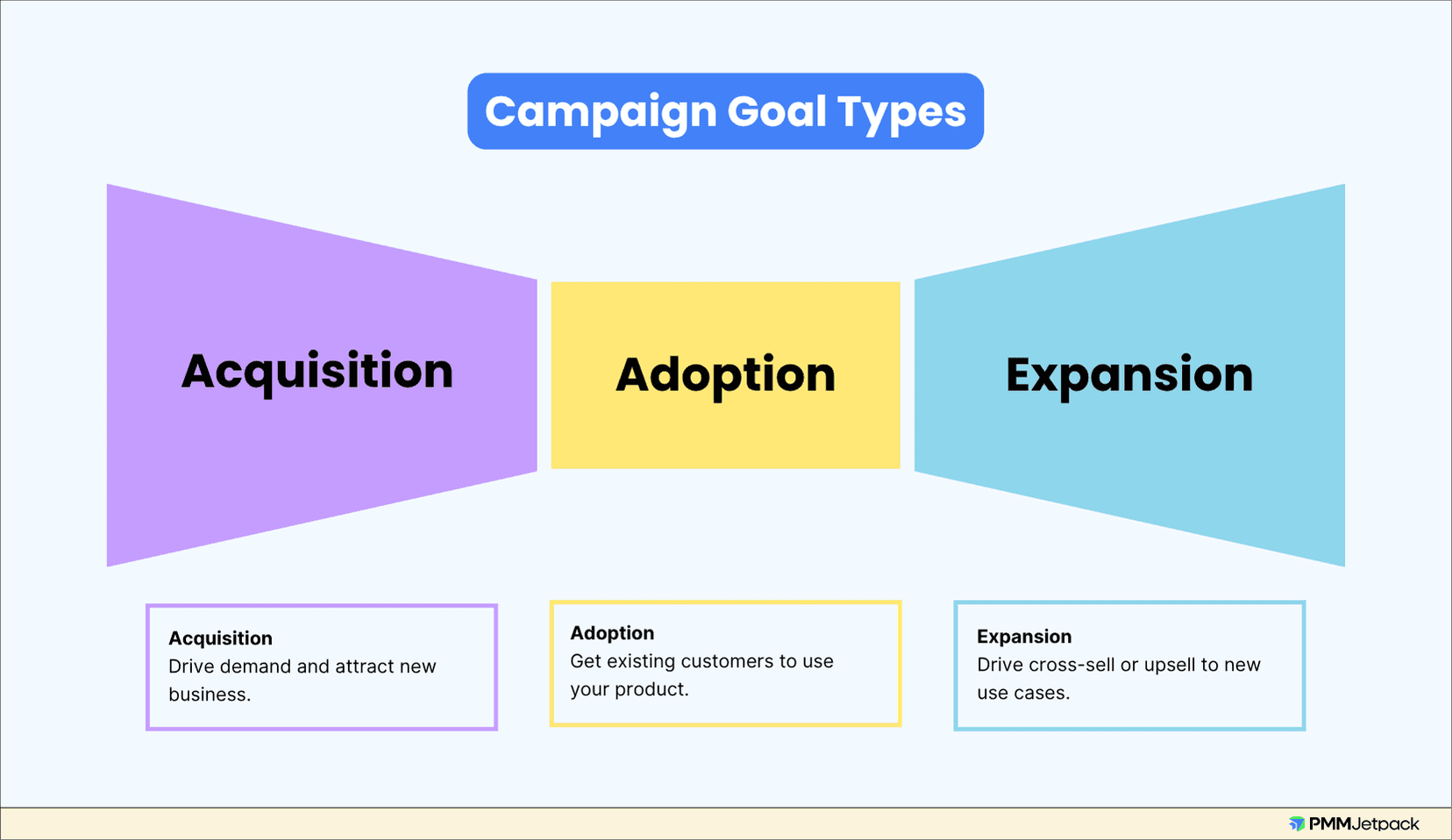
Not every campaign is chasing the same metric, either. Most product-focused efforts land in one of three practical buckets:
Acquisition – Drive demand and attract new business.
Adoption – Get existing customers to use your product.
Expansion – Drive cross-sell or upsell to new use cases.
But for PFCs, a traditional campaign isn’t always necessary. The biggest wins in this area are often from steady, small bets: consistent storytelling about your product in market, bit by bit, through channels like LinkedIn and email.
Not every campaign is chasing the same metric, either. Most product-focused efforts land in one of three practical buckets:
Acquisition – Drive demand and attract new business.
Adoption – Get existing customers to use your product.
Expansion – Drive cross-sell or upsell to new use cases.
But for PFCs, a traditional campaign isn’t always necessary. The biggest wins in this area are often from steady, small bets: consistent storytelling about your product in market, bit by bit, through channels like LinkedIn and email.
Not every campaign is chasing the same metric, either. Most product-focused efforts land in one of three practical buckets:
Acquisition – Drive demand and attract new business.
Adoption – Get existing customers to use your product.
Expansion – Drive cross-sell or upsell to new use cases.
The main thing is to have a clear goal in mind. Use the SMART framework to make sure you’re setting and measuring clear goals around each of your PFC efforts:
(S) Specific - Clearly define what you want to achieve. Avoid vague language.
(M) Measurable - Make the goal quantifiable so you can easily track it.
(A) Achievable - Ensure the goal is realistic given your time, resources, and constraints.
(R) Relevant - Align the goal with your broader business or personal objectives.
(T) Time-bound - Set a specific deadline or timeframe.
For example, a goal for your campaign could be: “Increase demo requests from LinkedIn by 25% over the next 90 days.”
How to Come Up With Campaign Angles
You’ve picked the topic, set the goals, and you’re ready to bring it to life. Now comes the fun part: actually making something people notice.
This is where you need to get creative. Build a campaign with storytelling and content that actually resonates with buyers, grabs their attention, and compels them to take action. This is hard for a lot of product marketers. What you often see is the same blands, boring framing that fades into the scroll. Your job is to break that pattern.
Over the last few years, I've gathered hundreds of real-world examples of product-focused campaigns and content, and I've narrowed them down into 10 categories to help you come up with ideas of your own. Use these buckets to build off the brainstorming session you hosted with your cross functional teams, and see if you can insert some of those ideas into some of these fresh angles.
The main thing is to have a clear goal in mind. Use the SMART framework to make sure you’re setting and measuring clear goals around each of your PFC efforts:
(S) Specific - Clearly define what you want to achieve. Avoid vague language.
(M) Measurable - Make the goal quantifiable so you can easily track it.
(A) Achievable - Ensure the goal is realistic given your time, resources, and constraints.
(R) Relevant - Align the goal with your broader business or personal objectives.
(T) Time-bound - Set a specific deadline or timeframe.
For example, a goal for your campaign could be: “Increase demo requests from LinkedIn by 25% over the next 90 days.”
How to Come Up With Campaign Angles
You’ve picked the topic, set the goals, and you’re ready to bring it to life. Now comes the fun part: actually making something people notice.
This is where you need to get creative. Build a campaign with storytelling and content that actually resonates with buyers, grabs their attention, and compels them to take action. This is hard for a lot of product marketers. What you often see is the same blands, boring framing that fades into the scroll. Your job is to break that pattern.
Over the last few years, I've gathered hundreds of real-world examples of product-focused campaigns and content, and I've narrowed them down into 10 categories to help you come up with ideas of your own. Use these buckets to build off the brainstorming session you hosted with your cross functional teams, and see if you can insert some of those ideas into some of these fresh angles.
The main thing is to have a clear goal in mind. Use the SMART framework to make sure you’re setting and measuring clear goals around each of your PFC efforts:
(S) Specific - Clearly define what you want to achieve. Avoid vague language.
(M) Measurable - Make the goal quantifiable so you can easily track it.
(A) Achievable - Ensure the goal is realistic given your time, resources, and constraints.
(R) Relevant - Align the goal with your broader business or personal objectives.
(T) Time-bound - Set a specific deadline or timeframe.
For example, a goal for your campaign could be: “Increase demo requests from LinkedIn by 25% over the next 90 days.”
How to Come Up With Campaign Angles
You’ve picked the topic, set the goals, and you’re ready to bring it to life. Now comes the fun part: actually making something people notice.
This is where you need to get creative. Build a campaign with storytelling and content that actually resonates with buyers, grabs their attention, and compels them to take action. This is hard for a lot of product marketers. What you often see is the same blands, boring framing that fades into the scroll. Your job is to break that pattern.
Over the last few years, I've gathered hundreds of real-world examples of product-focused campaigns and content, and I've narrowed them down into 10 categories to help you come up with ideas of your own. Use these buckets to build off the brainstorming session you hosted with your cross functional teams, and see if you can insert some of those ideas into some of these fresh angles.
I've also created a simple whiteboard template you can use to run your own internal brainstorming session, complete with real examples I've gathered as part of the Jetpack for each of these campaign categories.
Template: Product-Focused Campaign Worksheet
I've also created a simple whiteboard template you can use to run your own internal brainstorming session, complete with real examples I've gathered as part of the Jetpack for each of these campaign categories.
Template: Product-Focused Campaign Worksheet
I've also created a simple whiteboard template you can use to run your own internal brainstorming session, complete with real examples I've gathered as part of the Jetpack for each of these campaign categories.
Template: Product-Focused Campaign Worksheet
Campaign Categories
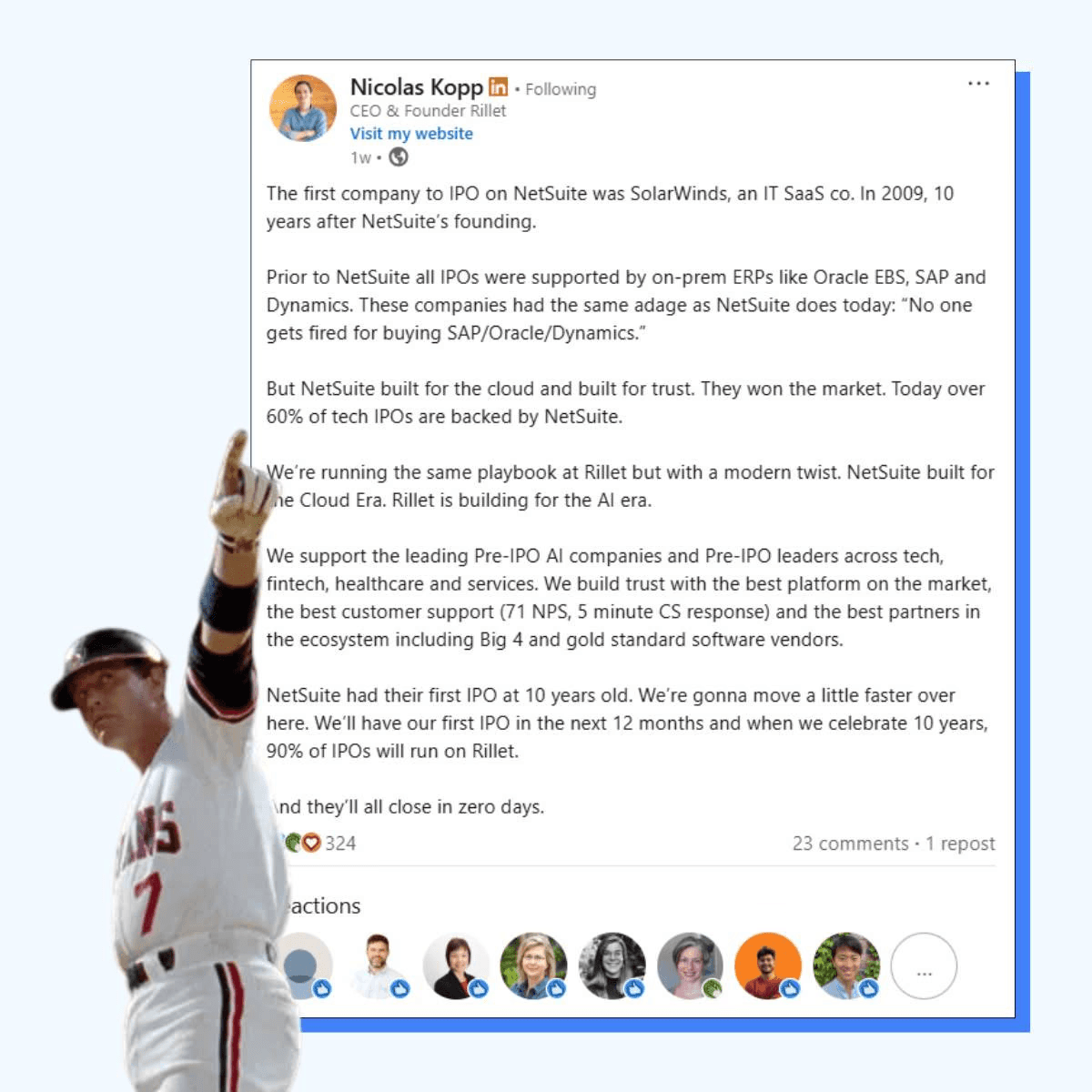
Share Your POV
If your company has a unique point of view on your market and how to solve your buyer's problem (check out this article on the spiky point of view), these types of campaigns work really well. We're seeing more of this with founder-led marketing, where SaaS founders share strong points of view on LinkedIn.
Campaign Categories
Share Your POV
If your company has a unique point of view on your market and how to solve your buyer's problem (check out this article on the spiky point of view), these types of campaigns work really well. We're seeing more of this with founder-led marketing, where SaaS founders share strong points of view on LinkedIn.
Campaign Categories
Share Your POV
If your company has a unique point of view on your market and how to solve your buyer's problem (check out this article on the spiky point of view), these types of campaigns work really well. We're seeing more of this with founder-led marketing, where SaaS founders share strong points of view on LinkedIn.
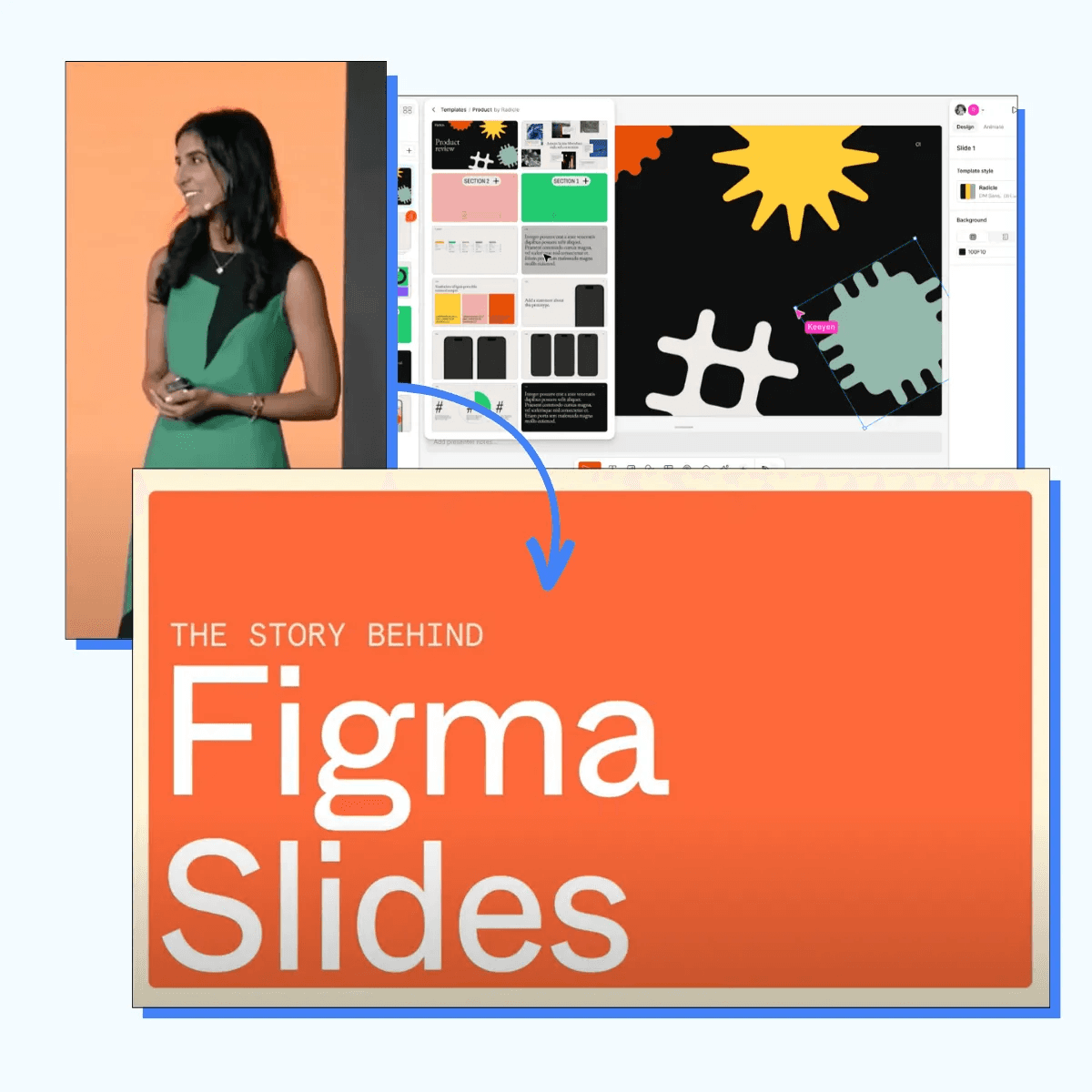
Tell a story
Buyers resonate with stories, and people remember stories more than anything else you talk about in your marketing. In campaigns like this, you can share customer stories or look back on key moments in your company that tie back to customer pains, your product's differentiation, or your unique POV.
Ex. Figma shares the story behind one of their recent launches, Figma Slides.
Tell a story
Buyers resonate with stories, and people remember stories more than anything else you talk about in your marketing. In campaigns like this, you can share customer stories or look back on key moments in your company that tie back to customer pains, your product's differentiation, or your unique POV.
Ex. Figma shares the story behind one of their recent launches, Figma Slides.
Tell a story
Buyers resonate with stories, and people remember stories more than anything else you talk about in your marketing. In campaigns like this, you can share customer stories or look back on key moments in your company that tie back to customer pains, your product's differentiation, or your unique POV.
Ex. Figma shares the story behind one of their recent launches, Figma Slides.
Entertain and educate
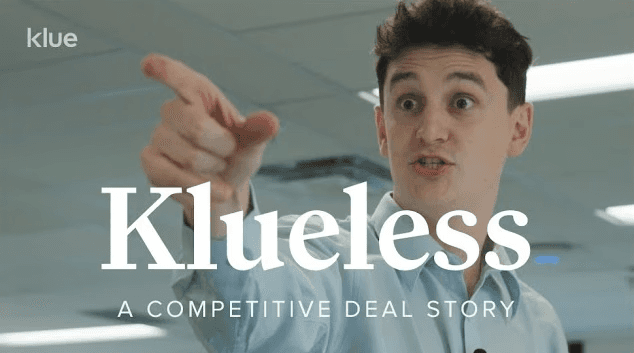
If you have the creative firepower, these campaigns not only help you promote your product but also strengthen your brand. Through entertaining videos and live events, you can make people laugh while communicating your product's value.
Entertain and educate
If you have the creative firepower, these campaigns not only help you promote your product but also strengthen your brand. Through entertaining videos and live events, you can make people laugh while communicating your product's value.
Entertain and educate
If you have the creative firepower, these campaigns not only help you promote your product but also strengthen your brand. Through entertaining videos and live events, you can make people laugh while communicating your product's value.
Hop on a trend or event
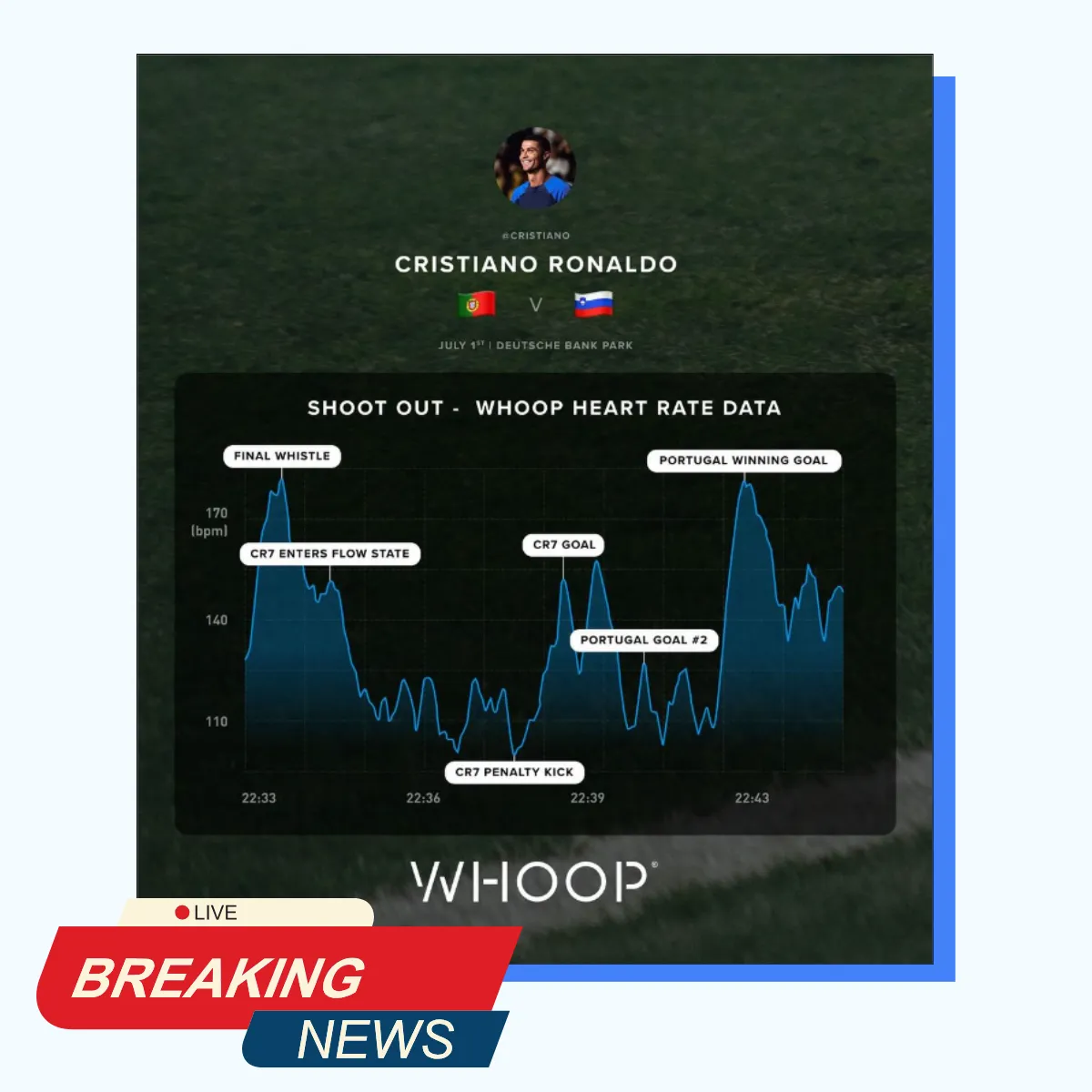
Is it a special time of year like a holiday, or is there a global event that's top-of-mind for everyone? These are great opportunities to piggyback off newsworthy events and trends and insert your product into the story.
Hop on a trend or event
Is it a special time of year like a holiday, or is there a global event that's top-of-mind for everyone? These are great opportunities to piggyback off newsworthy events and trends and insert your product into the story.
Hop on a trend or event
Is it a special time of year like a holiday, or is there a global event that's top-of-mind for everyone? These are great opportunities to piggyback off newsworthy events and trends and insert your product into the story.
Pick a fight
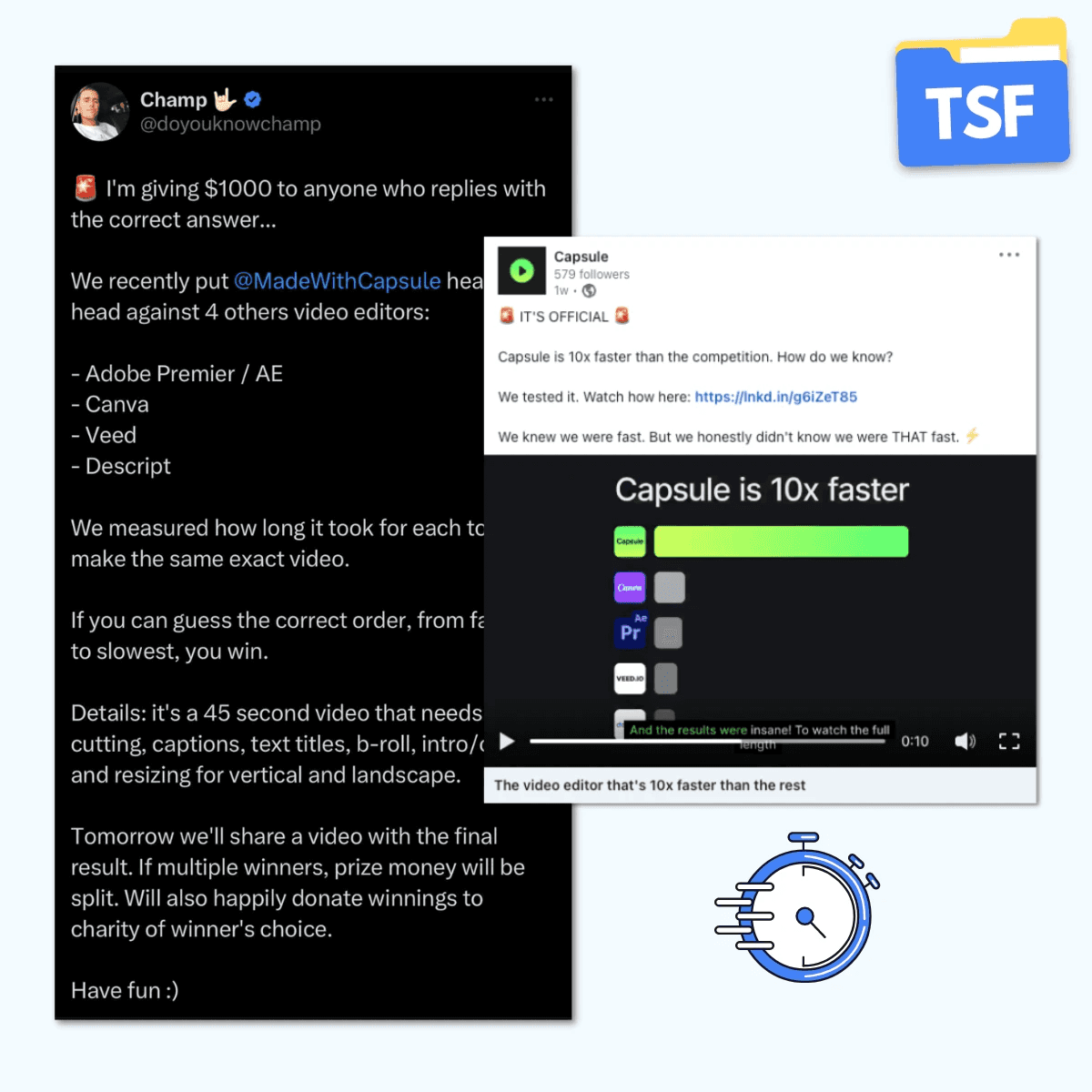
These campaigns can be risky, but people are always drawn to vendor battles. If you have a strong competitor and don't mind taking a polarizing stance or potentially turning away some of your audience, these campaigns present an opportunity to clearly differentiate in the market.
Pick a fight
These campaigns can be risky, but people are always drawn to vendor battles. If you have a strong competitor and don't mind taking a polarizing stance or potentially turning away some of your audience, these campaigns present an opportunity to clearly differentiate in the market.
Pick a fight
These campaigns can be risky, but people are always drawn to vendor battles. If you have a strong competitor and don't mind taking a polarizing stance or potentially turning away some of your audience, these campaigns present an opportunity to clearly differentiate in the market.
Quick tip: With campaigns like this, make sure you never punch down—always focus on a competitor that's bigger than you. You want to be the underdog.
Quick tip: With campaigns like this, make sure you never punch down—always focus on a competitor that's bigger than you. You want to be the underdog.
Quick tip: With campaigns like this, make sure you never punch down—always focus on a competitor that's bigger than you. You want to be the underdog.
Introduce a new segment
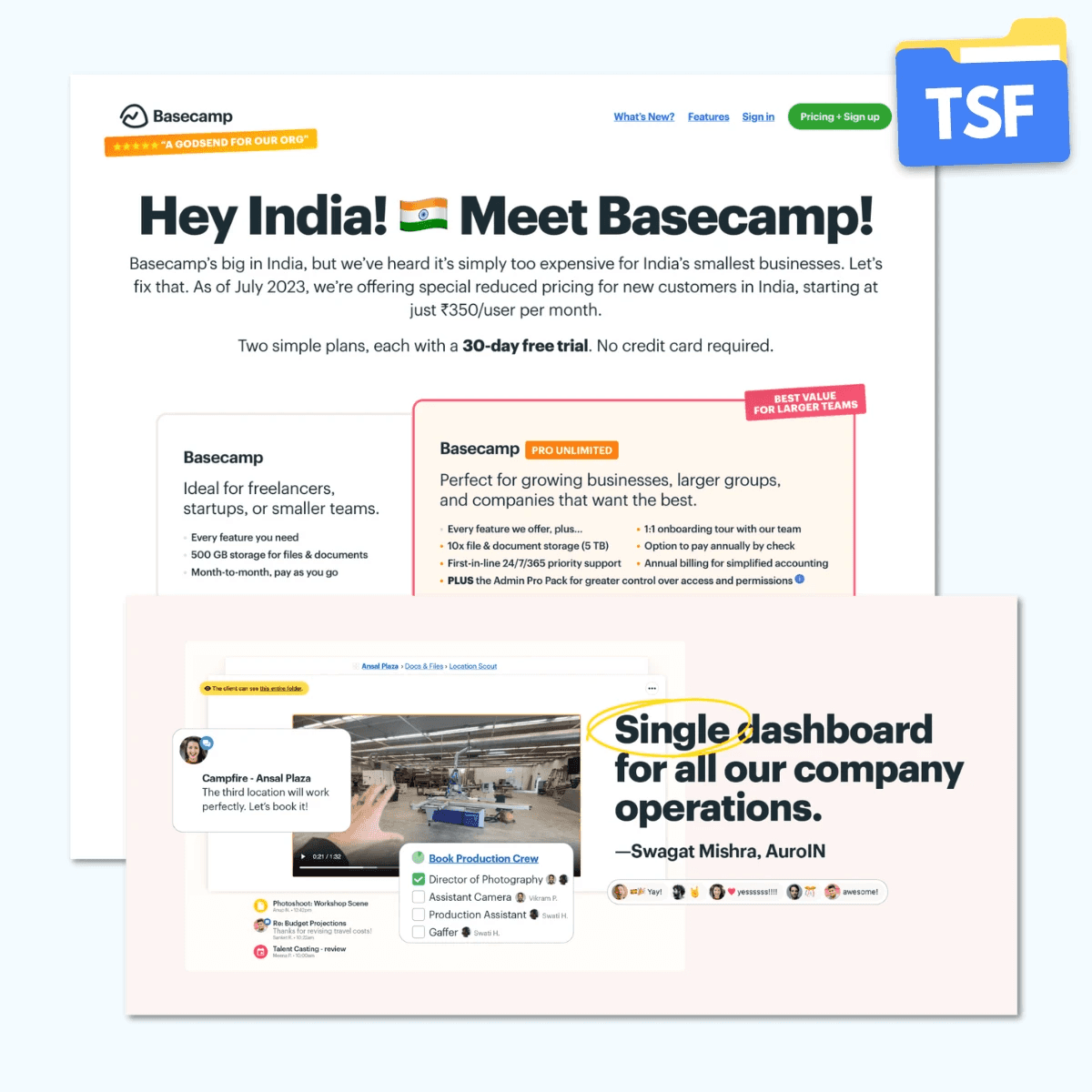
Are you breaking into a new market segment, targeting a new industry, or entering a new vertical? These are great opportunities to run campaigns for that specific audience—introducing them to the problem you solve, your product, and your value prop.
Ex. Basecamp ran this campaign to announce their introduction of India-only pricing.
Introduce a new segment
Are you breaking into a new market segment, targeting a new industry, or entering a new vertical? These are great opportunities to run campaigns for that specific audience—introducing them to the problem you solve, your product, and your value prop.
Ex. Basecamp ran this campaign to announce their introduction of India-only pricing.
Introduce a new segment
Are you breaking into a new market segment, targeting a new industry, or entering a new vertical? These are great opportunities to run campaigns for that specific audience—introducing them to the problem you solve, your product, and your value prop.
Ex. Basecamp ran this campaign to announce their introduction of India-only pricing.
Promote a use case
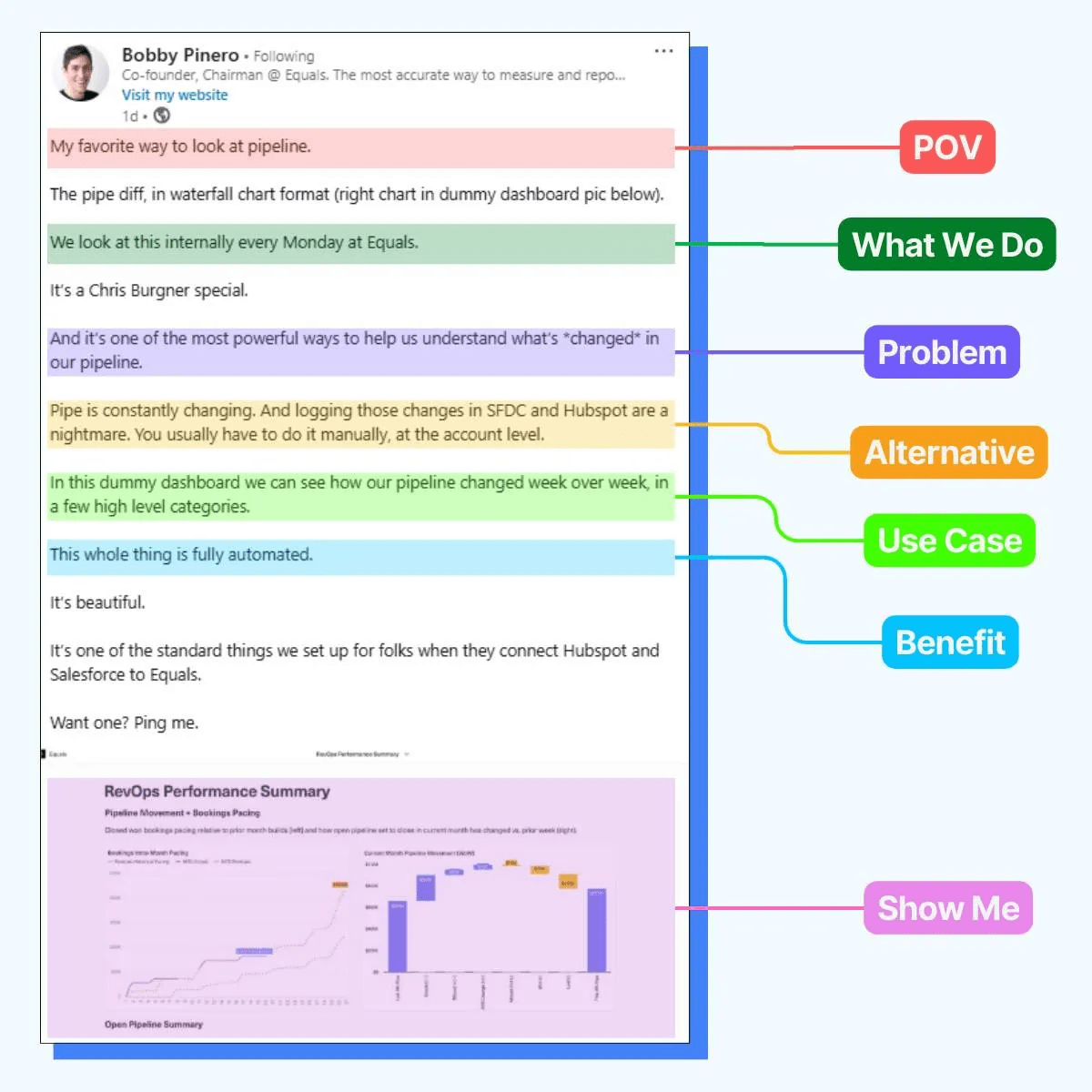
Do you have a compelling use case that not enough people know about? Or is there a strong use case that's the perfect introduction to your product? These campaigns can show people how to immediately get value from your product or bring awareness to a use case that's highly valuable but flying under the radar.
Ex. Bobby Pinero, the founder of Equals, shares his favorite pipeline report.
Promote a use case
Do you have a compelling use case that not enough people know about? Or is there a strong use case that's the perfect introduction to your product? These campaigns can show people how to immediately get value from your product or bring awareness to a use case that's highly valuable but flying under the radar.
Ex. Bobby Pinero, the founder of Equals, shares his favorite pipeline report.
Promote a use case
Do you have a compelling use case that not enough people know about? Or is there a strong use case that's the perfect introduction to your product? These campaigns can show people how to immediately get value from your product or bring awareness to a use case that's highly valuable but flying under the radar.
Ex. Bobby Pinero, the founder of Equals, shares his favorite pipeline report.
Product education
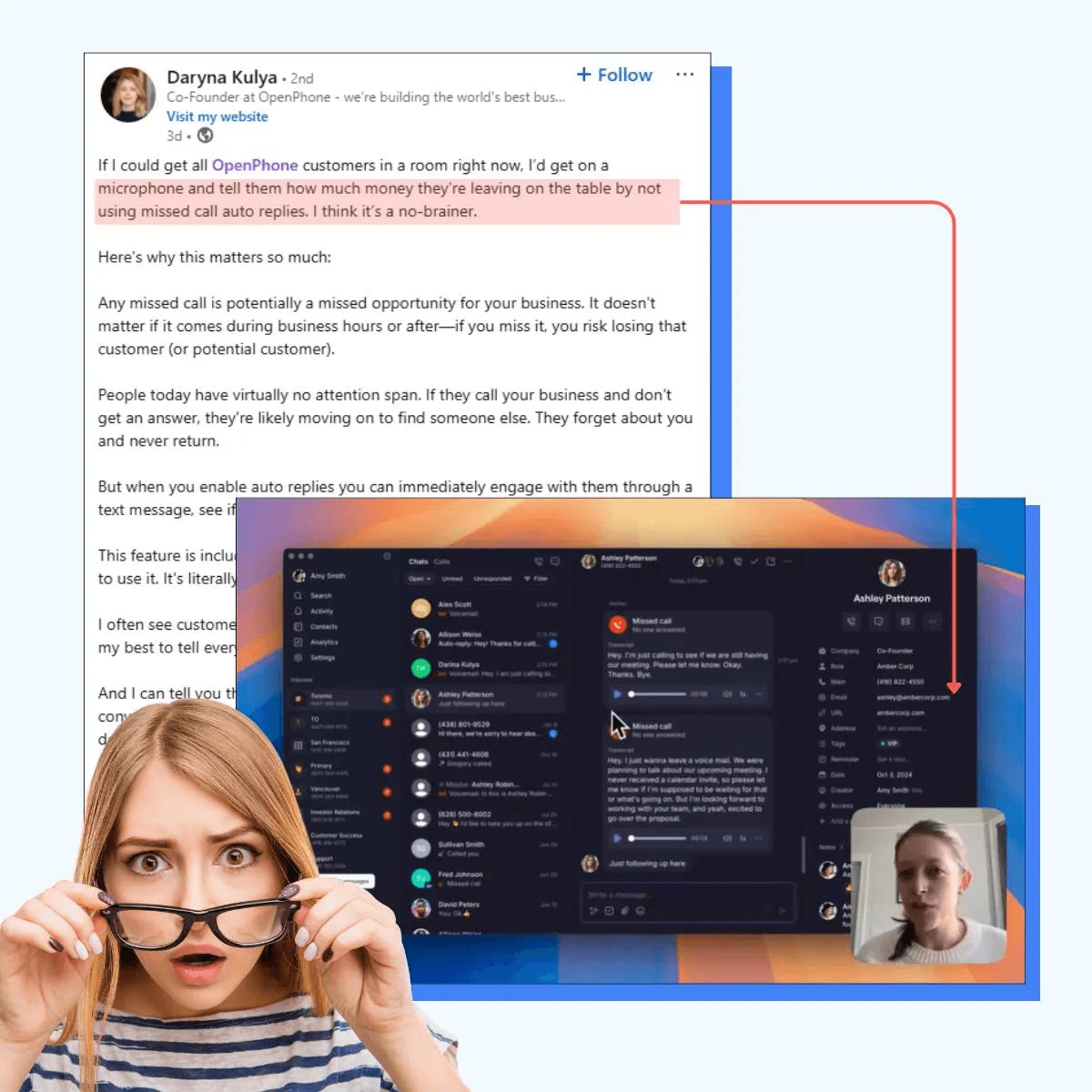
Is there a feature in your product that's under-utilized because people don't understand how to use it, or does it require a skill that some people don't have? With campaigns like this, you can educate people on how to get the most out of your product or help them level up on a skill that makes your product more sticky.
Ex. OpenPhone’s founder highlights an existing feature that many customers love, but most aren't using.
Product education
Is there a feature in your product that's under-utilized because people don't understand how to use it, or does it require a skill that some people don't have? With campaigns like this, you can educate people on how to get the most out of your product or help them level up on a skill that makes your product more sticky.
Ex. OpenPhone’s founder highlights an existing feature that many customers love, but most aren't using.
Product education
Is there a feature in your product that's under-utilized because people don't understand how to use it, or does it require a skill that some people don't have? With campaigns like this, you can educate people on how to get the most out of your product or help them level up on a skill that makes your product more sticky.
Ex. OpenPhone’s founder highlights an existing feature that many customers love, but most aren't using.
Celebrate a customer
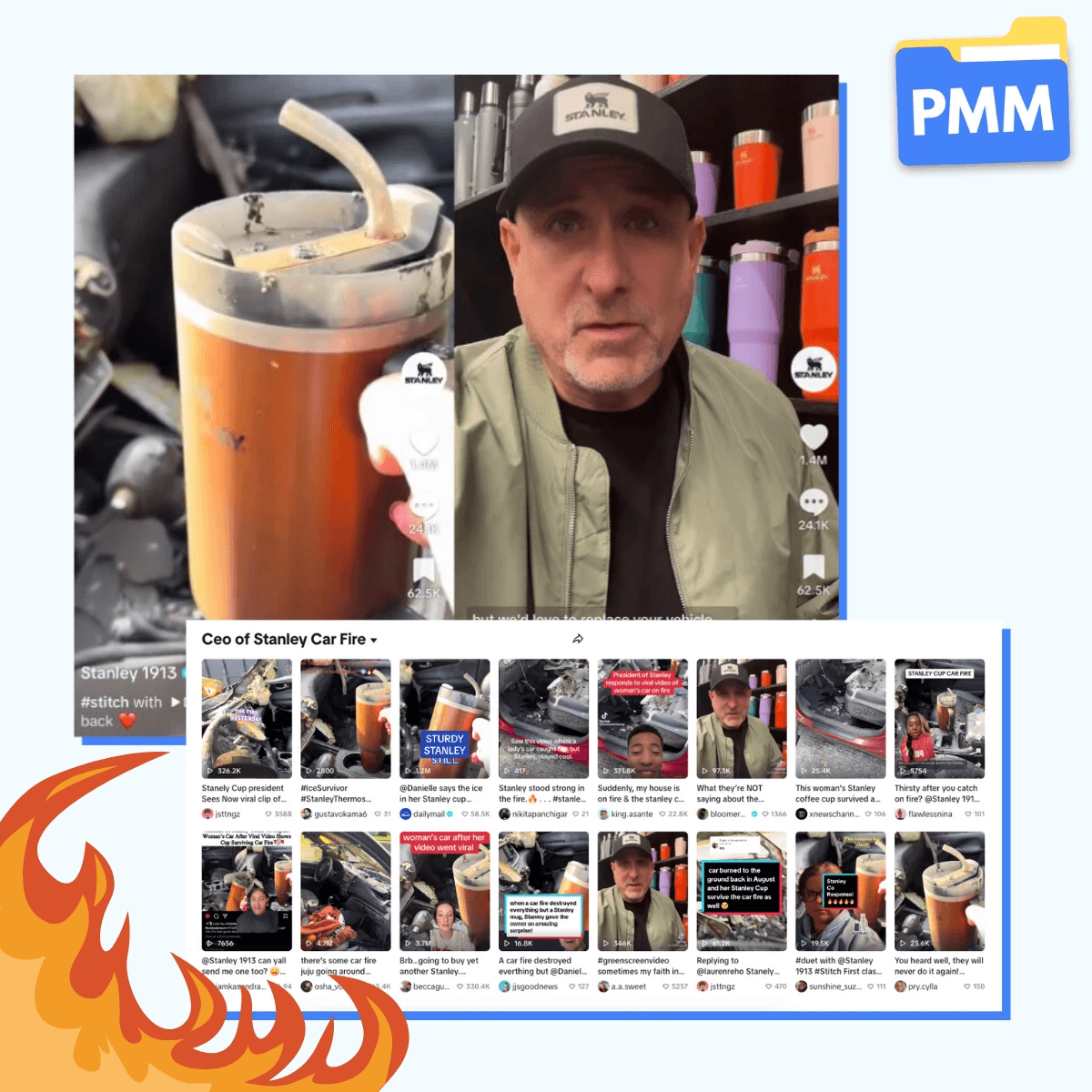
We often see customer wins on a regular basis but fail to seize the opportunity to share them. These campaigns not only resonate with like-minded buyers who are considering your product, but they also become incredible content for your sales and customer success teams and build trust with buyers.
Celebrate a customer
We often see customer wins on a regular basis but fail to seize the opportunity to share them. These campaigns not only resonate with like-minded buyers who are considering your product, but they also become incredible content for your sales and customer success teams and build trust with buyers.
Celebrate a customer
We often see customer wins on a regular basis but fail to seize the opportunity to share them. These campaigns not only resonate with like-minded buyers who are considering your product, but they also become incredible content for your sales and customer success teams and build trust with buyers.
Celebrate a milestone or win
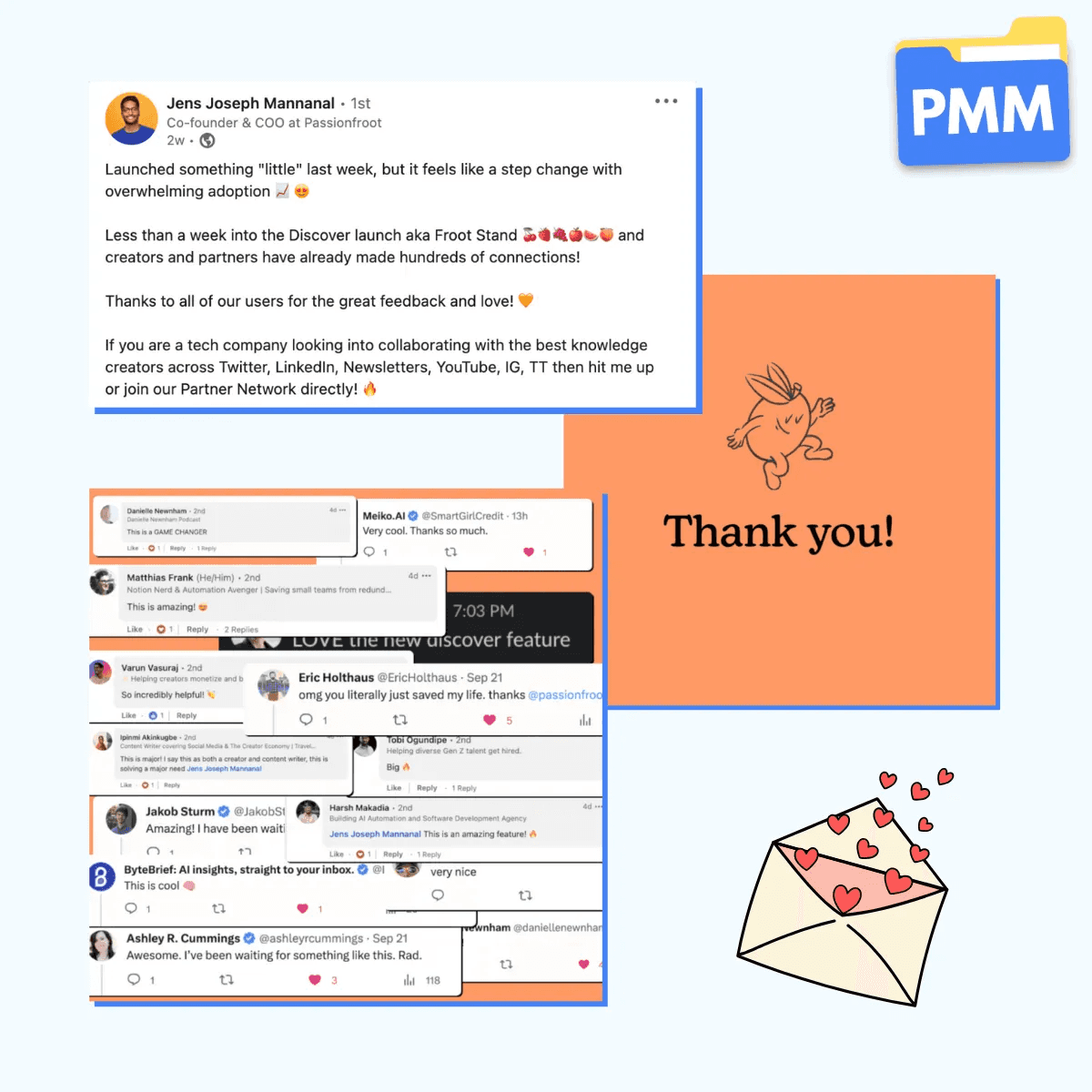
Have you hit any major milestones or had big wins in your company recently? Don't miss the opportunity to share these. It could be adoption milestones or wins with a recent product launch that give your product credibility.
Celebrate a milestone or win
Have you hit any major milestones or had big wins in your company recently? Don't miss the opportunity to share these. It could be adoption milestones or wins with a recent product launch that give your product credibility.
Celebrate a milestone or win
Have you hit any major milestones or had big wins in your company recently? Don't miss the opportunity to share these. It could be adoption milestones or wins with a recent product launch that give your product credibility.
Planning Your Campaign & Content Calendar
Now that you have a system for generating campaign and content ideas, it's time to establish a process for coordinating and planning each campaign. Campaigns live and die on execution, and that means working closely with marketing — especially demand and content — from day one.
Product-focused campaigns aren’t chained to release dates, which gives you breathing room to plan farther out and iterate. But that freedom is only useful if you coordinate: shared calendars, clear owners, and giving space to the timed launches already in your roadmap.
Practical steps:
Build a shared campaign calendar with your demand & content teams: centralize launch dates, feature pushes, channel plans, and content deadlines so nothing conflicts and nothing slips.
Sync quarterly: align product-focused campaigns with the broader marketing calendar (brand pushes, events, seasonal themes) to amplify reach.
Lock down owners: assign a single owner for creative, another for distribution, and one for measurement — fewer cooks, fewer last-minute pivots.
Create reusable asset templates: one-pagers, demo clips, micro case studies, and email templates that let you scale your product storytelling without reinventing the wheel.
Plan a 90-day momentum window for new features: schedule targeted promotion and enablement to help adoption take hold.
Planning Your Campaign & Content Calendar
Now that you have a system for generating campaign and content ideas, it's time to establish a process for coordinating and planning each campaign. Campaigns live and die on execution, and that means working closely with marketing — especially demand and content — from day one.
Product-focused campaigns aren’t chained to release dates, which gives you breathing room to plan farther out and iterate. But that freedom is only useful if you coordinate: shared calendars, clear owners, and giving space to the timed launches already in your roadmap.
Practical steps:
Build a shared campaign calendar with your demand & content teams: centralize launch dates, feature pushes, channel plans, and content deadlines so nothing conflicts and nothing slips.
Sync quarterly: align product-focused campaigns with the broader marketing calendar (brand pushes, events, seasonal themes) to amplify reach.
Lock down owners: assign a single owner for creative, another for distribution, and one for measurement — fewer cooks, fewer last-minute pivots.
Create reusable asset templates: one-pagers, demo clips, micro case studies, and email templates that let you scale your product storytelling without reinventing the wheel.
Plan a 90-day momentum window for new features: schedule targeted promotion and enablement to help adoption take hold.
Planning Your Campaign & Content Calendar
Now that you have a system for generating campaign and content ideas, it's time to establish a process for coordinating and planning each campaign. Campaigns live and die on execution, and that means working closely with marketing — especially demand and content — from day one.
Product-focused campaigns aren’t chained to release dates, which gives you breathing room to plan farther out and iterate. But that freedom is only useful if you coordinate: shared calendars, clear owners, and giving space to the timed launches already in your roadmap.
Practical steps:
Build a shared campaign calendar with your demand & content teams: centralize launch dates, feature pushes, channel plans, and content deadlines so nothing conflicts and nothing slips.
Sync quarterly: align product-focused campaigns with the broader marketing calendar (brand pushes, events, seasonal themes) to amplify reach.
Lock down owners: assign a single owner for creative, another for distribution, and one for measurement — fewer cooks, fewer last-minute pivots.
Create reusable asset templates: one-pagers, demo clips, micro case studies, and email templates that let you scale your product storytelling without reinventing the wheel.
Plan a 90-day momentum window for new features: schedule targeted promotion and enablement to help adoption take hold.
I've created a simple Google sheets template. You can use to create the shared roadmap.
Template: Product-Focused Campaign Planner
I've created a simple Google sheets template. You can use to create the shared roadmap.
Template: Product-Focused Campaign Planner
I've created a simple Google sheets template. You can use to create the shared roadmap.
Template: Product-Focused Campaign Planner
Share Your Campaigns Internally
The beauty of product-focused campaigns (PFCs) is that your internal teams usually already get the features and their value. That doesn’t mean you can skip communication, it just means your job is simpler: drive awareness and make it ridiculously easy for GTM teams to use your work.
Think about it — that video your creating about a differentiating feature, that activation email you’re sending, that LinkedIn post explaining a powerful, but unknown use case — it’s all GOLD for sales, marketing, and CS. They want that stuff.
Make sure you are adding this content to your content library and sharing it with everybody. And if you don’t have a content library, consider using the PMM Content OS App.
Share Your Campaigns Internally
The beauty of product-focused campaigns (PFCs) is that your internal teams usually already get the features and their value. That doesn’t mean you can skip communication, it just means your job is simpler: drive awareness and make it ridiculously easy for GTM teams to use your work.
Think about it — that video your creating about a differentiating feature, that activation email you’re sending, that LinkedIn post explaining a powerful, but unknown use case — it’s all GOLD for sales, marketing, and CS. They want that stuff.
Make sure you are adding this content to your content library and sharing it with everybody. And if you don’t have a content library, consider using the PMM Content OS App.
Share Your Campaigns Internally
The beauty of product-focused campaigns (PFCs) is that your internal teams usually already get the features and their value. That doesn’t mean you can skip communication, it just means your job is simpler: drive awareness and make it ridiculously easy for GTM teams to use your work.
Think about it — that video your creating about a differentiating feature, that activation email you’re sending, that LinkedIn post explaining a powerful, but unknown use case — it’s all GOLD for sales, marketing, and CS. They want that stuff.
Make sure you are adding this content to your content library and sharing it with everybody. And if you don’t have a content library, consider using the PMM Content OS App.
This is also the type of content that your sales and CS reps are excited to get behind and help promote. Consider using the Launch Social Enablement Guide to help with this part of your campaign.
Template: Launch Social Enablement Guide
This is also the type of content that your sales and CS reps are excited to get behind and help promote. Consider using the Launch Social Enablement Guide to help with this part of your campaign.
Template: Launch Social Enablement Guide
This is also the type of content that your sales and CS reps are excited to get behind and help promote. Consider using the Launch Social Enablement Guide to help with this part of your campaign.
Template: Launch Social Enablement Guide
Measure, Celebrate, and Iterate - and tell everyone about it
This step gets skipped more than it should. After the push, pause and answer three questions: Did we hit the goal? What moved the needle? What would we change next time?
Measure, Celebrate, and Iterate - and tell everyone about it
This step gets skipped more than it should. After the push, pause and answer three questions: Did we hit the goal? What moved the needle? What would we change next time?
Measure, Celebrate, and Iterate - and tell everyone about it
This step gets skipped more than it should. After the push, pause and answer three questions: Did we hit the goal? What moved the needle? What would we change next time?
A great template for you to use here is the Launch Retrospective Deck. It’ll give you a simple framework for tracking your goals, channel metrics, and learnings.
Template: Launch Retrospective Deck
A great template for you to use here is the Launch Retrospective Deck. It’ll give you a simple framework for tracking your goals, channel metrics, and learnings.
Template: Launch Retrospective Deck
A great template for you to use here is the Launch Retrospective Deck. It’ll give you a simple framework for tracking your goals, channel metrics, and learnings.
Template: Launch Retrospective Deck
Make measurement practical
Tie each campaign to 1–2 clear KPIs up front (e.g., activation rate, feature DAU, MQLs, expansion bookings).
Track channel-level metrics (open/click, CTR, demo requests, landing page conversion) and product signals (feature adoption, time-to-value, retention lift).
Use simple dashboards or a shared retrospective slide so anyone can see the outcome without hunting for data.
Share your wins!
Share results broadly: Slack highlights, a 1-slide update in the weekly GTM sync, and a short post in all-hands when it’s material.
Don’t be shy with specifics. “12% uplift in adoption from a two-week activation email” is the kind of stat that gets leadership attention and budget.
Call out contributors by name — reps, CS owners, content partners — to build momentum and good will for the next campaign.
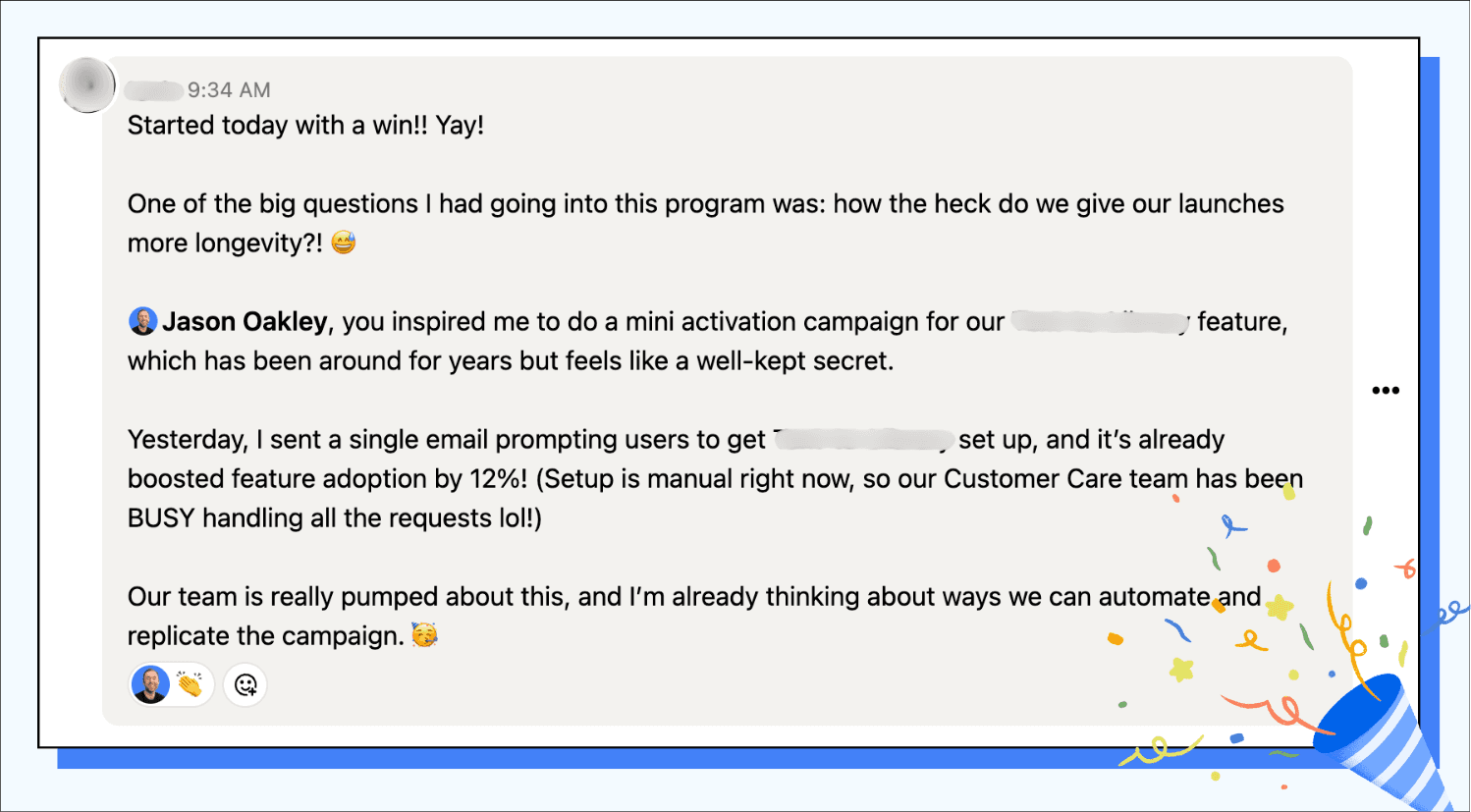
As an example, here’s a message one of our group coaching members shared in our private chat for The Foundry. This is the type of message that can easily be dropped in Slack or shared in a company all hands.
Make measurement practical
Tie each campaign to 1–2 clear KPIs up front (e.g., activation rate, feature DAU, MQLs, expansion bookings).
Track channel-level metrics (open/click, CTR, demo requests, landing page conversion) and product signals (feature adoption, time-to-value, retention lift).
Use simple dashboards or a shared retrospective slide so anyone can see the outcome without hunting for data.
Share your wins!
Share results broadly: Slack highlights, a 1-slide update in the weekly GTM sync, and a short post in all-hands when it’s material.
Don’t be shy with specifics. “12% uplift in adoption from a two-week activation email” is the kind of stat that gets leadership attention and budget.
Call out contributors by name — reps, CS owners, content partners — to build momentum and good will for the next campaign.
As an example, here’s a message one of our group coaching members shared in our private chat for The Foundry. This is the type of message that can easily be dropped in Slack or shared in a company all hands.
Make measurement practical
Tie each campaign to 1–2 clear KPIs up front (e.g., activation rate, feature DAU, MQLs, expansion bookings).
Track channel-level metrics (open/click, CTR, demo requests, landing page conversion) and product signals (feature adoption, time-to-value, retention lift).
Use simple dashboards or a shared retrospective slide so anyone can see the outcome without hunting for data.
Share your wins!
Share results broadly: Slack highlights, a 1-slide update in the weekly GTM sync, and a short post in all-hands when it’s material.
Don’t be shy with specifics. “12% uplift in adoption from a two-week activation email” is the kind of stat that gets leadership attention and budget.
Call out contributors by name — reps, CS owners, content partners — to build momentum and good will for the next campaign.
As an example, here’s a message one of our group coaching members shared in our private chat for The Foundry. This is the type of message that can easily be dropped in Slack or shared in a company all hands.
Iterate with purpose
Run a quick retro using the Launch Retrospective Deck: goal vs. outcome, top channel winners, what surprised us, and 3 concrete experiments for the next campaign.
Double down on what worked: scale high-impact assets and channels. Kill or rework the weak stuff quickly.
Plan a follow-up cadence: a 30/60/90 day check on adoption and expansion to see if early gains stick.
Measure, celebrate, and iterate; rinse and repeat. Do it consistently and you turn one-off wins into a steady drumbeat of product-led growth.
Wrap-Up
Most product marketers spend their time chasing what’s next — the next launch, the next feature, the next big thing. That energy matters — but it’s not the only engine of growth.
Real, repeatable growth comes from staying loud about what already works. The best teams can run a balanced system where launches feed momentum and proven features keep selling. Like a well-timed merry-go-round: new things get a shove, and everything keeps spinning.
If you take one thing from this playbook, let it be this: Don’t wait for the next launch to market your product.
Start building small, repeatable rhythms of storytelling and campaigns that spotlight the tools and outcomes you already have.
Do that, and you’ll find a surprising amount of growth hiding in plain sight.
Iterate with purpose
Run a quick retro using the Launch Retrospective Deck: goal vs. outcome, top channel winners, what surprised us, and 3 concrete experiments for the next campaign.
Double down on what worked: scale high-impact assets and channels. Kill or rework the weak stuff quickly.
Plan a follow-up cadence: a 30/60/90 day check on adoption and expansion to see if early gains stick.
Measure, celebrate, and iterate; rinse and repeat. Do it consistently and you turn one-off wins into a steady drumbeat of product-led growth.
Wrap-Up
Most product marketers spend their time chasing what’s next — the next launch, the next feature, the next big thing. That energy matters — but it’s not the only engine of growth.
Real, repeatable growth comes from staying loud about what already works. The best teams can run a balanced system where launches feed momentum and proven features keep selling. Like a well-timed merry-go-round: new things get a shove, and everything keeps spinning.
If you take one thing from this playbook, let it be this: Don’t wait for the next launch to market your product.
Start building small, repeatable rhythms of storytelling and campaigns that spotlight the tools and outcomes you already have.
Do that, and you’ll find a surprising amount of growth hiding in plain sight.
Iterate with purpose
Run a quick retro using the Launch Retrospective Deck: goal vs. outcome, top channel winners, what surprised us, and 3 concrete experiments for the next campaign.
Double down on what worked: scale high-impact assets and channels. Kill or rework the weak stuff quickly.
Plan a follow-up cadence: a 30/60/90 day check on adoption and expansion to see if early gains stick.
Measure, celebrate, and iterate; rinse and repeat. Do it consistently and you turn one-off wins into a steady drumbeat of product-led growth.
Wrap-Up
Most product marketers spend their time chasing what’s next — the next launch, the next feature, the next big thing. That energy matters — but it’s not the only engine of growth.
Real, repeatable growth comes from staying loud about what already works. The best teams can run a balanced system where launches feed momentum and proven features keep selling. Like a well-timed merry-go-round: new things get a shove, and everything keeps spinning.
If you take one thing from this playbook, let it be this: Don’t wait for the next launch to market your product.
Start building small, repeatable rhythms of storytelling and campaigns that spotlight the tools and outcomes you already have.
Do that, and you’ll find a surprising amount of growth hiding in plain sight.
Resources
Resources
Resources


Copyright © 2024 Productive PMM Inc.
Copyright © 2024 Productive PMM Inc.
Copyright © 2024 Productive PMM Inc.