Revenue Enablement
Confidence Surveys
Playbook #14: How To Run a PMM Confidence Survey
Playbook #14: How To Run a PMM Confidence Survey
Playbook #14: How To Run a PMM Confidence Survey
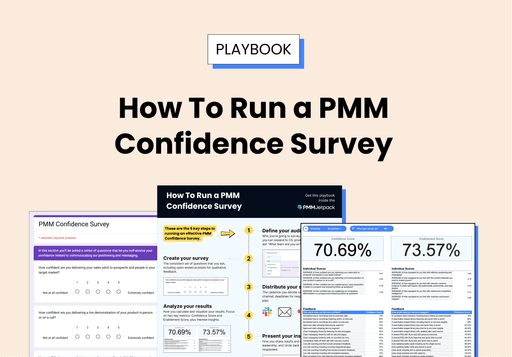
Most PMMs struggle to prove their impact — especially when enablement work feels invisible to leadership. A confidence survey changes that. This playbook gives you a repeatable system for running quick, insightful surveys that measure sales confidence and equip you with the proof points you need to show progress.
What’s inside:
✅ A ready-to-use survey template
✅ Best practices for distribution, response rates, and manager buy-in
✅ A simple scoring system you can track quarter over quarter
✅ Tips for turning qualitative feedback into actionable insights
✅ Guidance on presenting results to sales, leadership, and execs
Introduction
Why Confidence Surveys Matter
As a founding PMM, I know you’re juggling a ton: crafting decks, running trainings, supporting deals, and always thinking one step ahead. It’s a lot to manage, and sometimes, it’s tough to see the direct impact of all your hard work.
After all that effort, how do you really prove that you’re making a difference when the quarter comes to a close?
Why Confidence Surveys Matter
As a founding PMM, I know you’re juggling a ton: crafting decks, running trainings, supporting deals, and always thinking one step ahead. It’s a lot to manage, and sometimes, it’s tough to see the direct impact of all your hard work.
After all that effort, how do you really prove that you’re making a difference when the quarter comes to a close?
Why Confidence Surveys Matter
As a founding PMM, I know you’re juggling a ton: crafting decks, running trainings, supporting deals, and always thinking one step ahead. It’s a lot to manage, and sometimes, it’s tough to see the direct impact of all your hard work.
After all that effort, how do you really prove that you’re making a difference when the quarter comes to a close?

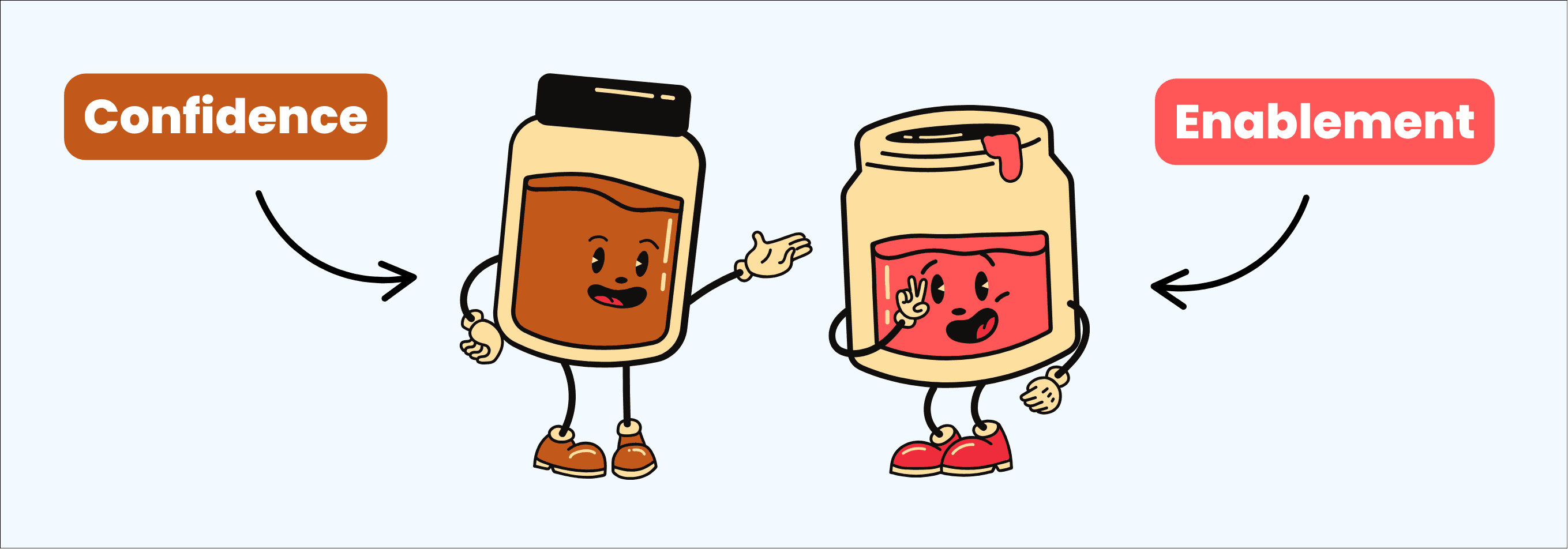
That’s where **sales confidence surveys** come into play. Think of them as quick, punchy questionnaires you can send to sales and other frontline teams. These surveys are designed to tap into two key areas:
Confidence: How comfortable do your reps feel when pitching, demoing, or positioning your product? Do they believe in what they’re selling?
Enablement: How well-equipped do they feel? Do they have the right collateral, training, tools, and resources to succeed?
That’s where **sales confidence surveys** come into play. Think of them as quick, punchy questionnaires you can send to sales and other frontline teams. These surveys are designed to tap into two key areas:
Confidence: How comfortable do your reps feel when pitching, demoing, or positioning your product? Do they believe in what they’re selling?
Enablement: How well-equipped do they feel? Do they have the right collateral, training, tools, and resources to succeed?
That’s where **sales confidence surveys** come into play. Think of them as quick, punchy questionnaires you can send to sales and other frontline teams. These surveys are designed to tap into two key areas:
Confidence: How comfortable do your reps feel when pitching, demoing, or positioning your product? Do they believe in what they’re selling?
Enablement: How well-equipped do they feel? Do they have the right collateral, training, tools, and resources to succeed?
The insights you gather give you a blend of hard data ****that you can track from quarter to quarter, and rich, qualitative feedback that will help shape your enablement roadmap.
This playbook is your guide to designing, running, analyzing, and sharing the results from your PMM confidence survey.
You’ll walk away with a solid, repeatable framework, ready-made templates, and best practices to help you build credibility, demonstrate your impact, and keep empowering your go-to-market teams to do their best work.
Why You Should Considering Doing a Confidence Survey
I hear this all the time from founding PMMs: these core challenges keep popping up, no matter the company or the product.
The insights you gather give you a blend of hard data ****that you can track from quarter to quarter, and rich, qualitative feedback that will help shape your enablement roadmap.
This playbook is your guide to designing, running, analyzing, and sharing the results from your PMM confidence survey.
You’ll walk away with a solid, repeatable framework, ready-made templates, and best practices to help you build credibility, demonstrate your impact, and keep empowering your go-to-market teams to do their best work.
Why You Should Considering Doing a Confidence Survey
I hear this all the time from founding PMMs: these core challenges keep popping up, no matter the company or the product.
The insights you gather give you a blend of hard data ****that you can track from quarter to quarter, and rich, qualitative feedback that will help shape your enablement roadmap.
This playbook is your guide to designing, running, analyzing, and sharing the results from your PMM confidence survey.
You’ll walk away with a solid, repeatable framework, ready-made templates, and best practices to help you build credibility, demonstrate your impact, and keep empowering your go-to-market teams to do their best work.
Why You Should Considering Doing a Confidence Survey
I hear this all the time from founding PMMs: these core challenges keep popping up, no matter the company or the product.
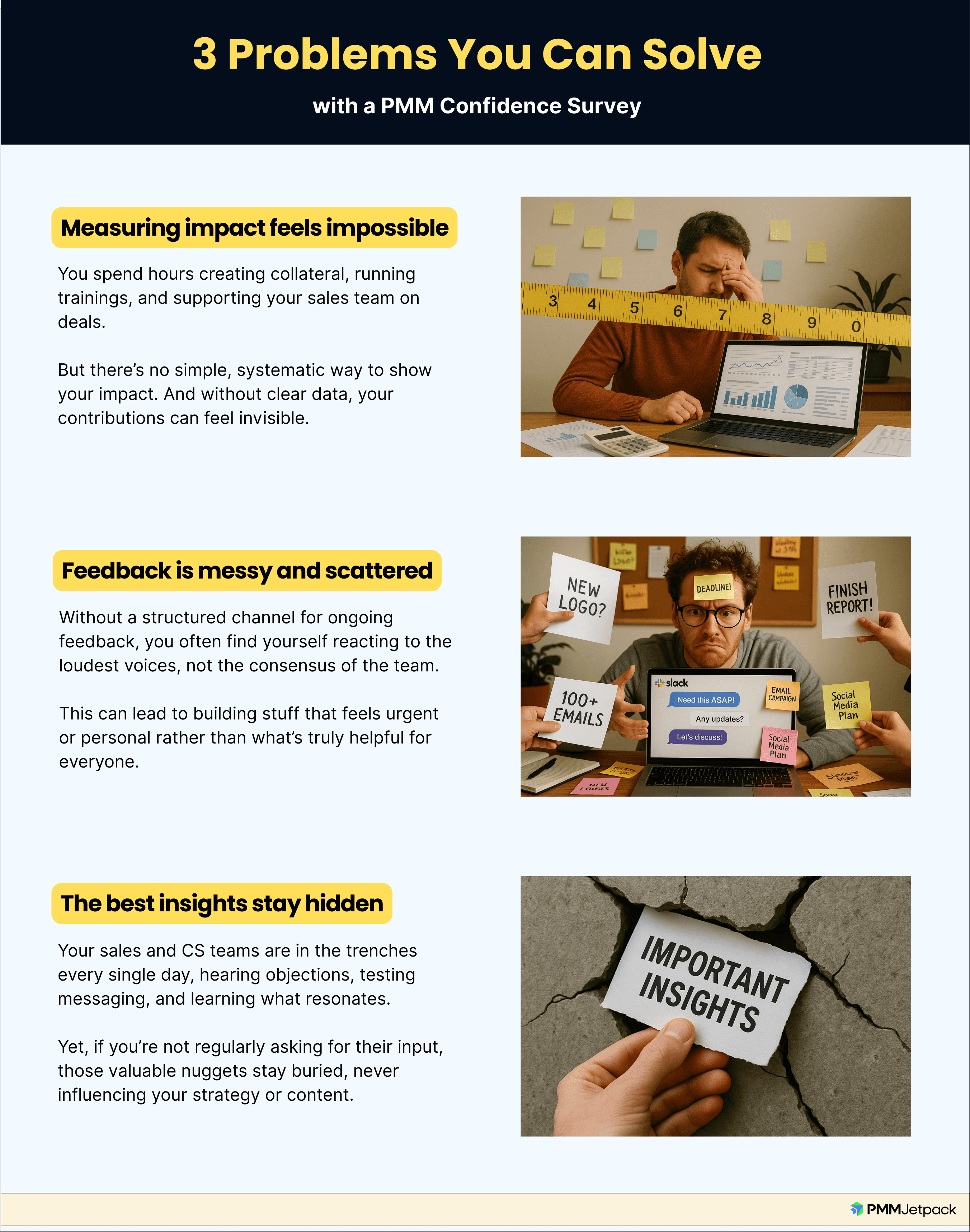
Measuring impact feels impossible: You spend hours creating collateral, running trainings, and supporting your sales team on deals. But there’s no simple, systematic way to show your impact. And without clear data, your contributions can feel invisible.
Feedback is messy and scattered: Without a structured channel for ongoing feedback, you often find yourself reacting to the loudest voices, not the consensus of the team. This can lead to building stuff that feels urgent or personal rather than what’s truly helpful for everyone.
The best insights stay hidden: Your sales and CS teams are in the trenches every single day, hearing objections, testing messaging, and learning what resonates. Yet, if you’re not regularly asking for their input, those valuable nuggets stay buried, never influencing your strategy or content.
Enter the confidence survey.
When companies don’t run confidence surveys, enablement decisions are based on assumptions, gut feel, or a few squeaky-wheel reps. Adoption doesn’t grow as fast as it should, valuable time gets wasted chasing the wrong leads, and there’s no real way to see if what you’re doing is actually working. Here’s how confidence surveys can transform your impact:
Measuring impact feels impossible: You spend hours creating collateral, running trainings, and supporting your sales team on deals. But there’s no simple, systematic way to show your impact. And without clear data, your contributions can feel invisible.
Feedback is messy and scattered: Without a structured channel for ongoing feedback, you often find yourself reacting to the loudest voices, not the consensus of the team. This can lead to building stuff that feels urgent or personal rather than what’s truly helpful for everyone.
The best insights stay hidden: Your sales and CS teams are in the trenches every single day, hearing objections, testing messaging, and learning what resonates. Yet, if you’re not regularly asking for their input, those valuable nuggets stay buried, never influencing your strategy or content.
Enter the confidence survey.
When companies don’t run confidence surveys, enablement decisions are based on assumptions, gut feel, or a few squeaky-wheel reps. Adoption doesn’t grow as fast as it should, valuable time gets wasted chasing the wrong leads, and there’s no real way to see if what you’re doing is actually working. Here’s how confidence surveys can transform your impact:
Measuring impact feels impossible: You spend hours creating collateral, running trainings, and supporting your sales team on deals. But there’s no simple, systematic way to show your impact. And without clear data, your contributions can feel invisible.
Feedback is messy and scattered: Without a structured channel for ongoing feedback, you often find yourself reacting to the loudest voices, not the consensus of the team. This can lead to building stuff that feels urgent or personal rather than what’s truly helpful for everyone.
The best insights stay hidden: Your sales and CS teams are in the trenches every single day, hearing objections, testing messaging, and learning what resonates. Yet, if you’re not regularly asking for their input, those valuable nuggets stay buried, never influencing your strategy or content.
Enter the confidence survey.
When companies don’t run confidence surveys, enablement decisions are based on assumptions, gut feel, or a few squeaky-wheel reps. Adoption doesn’t grow as fast as it should, valuable time gets wasted chasing the wrong leads, and there’s no real way to see if what you’re doing is actually working. Here’s how confidence surveys can transform your impact:
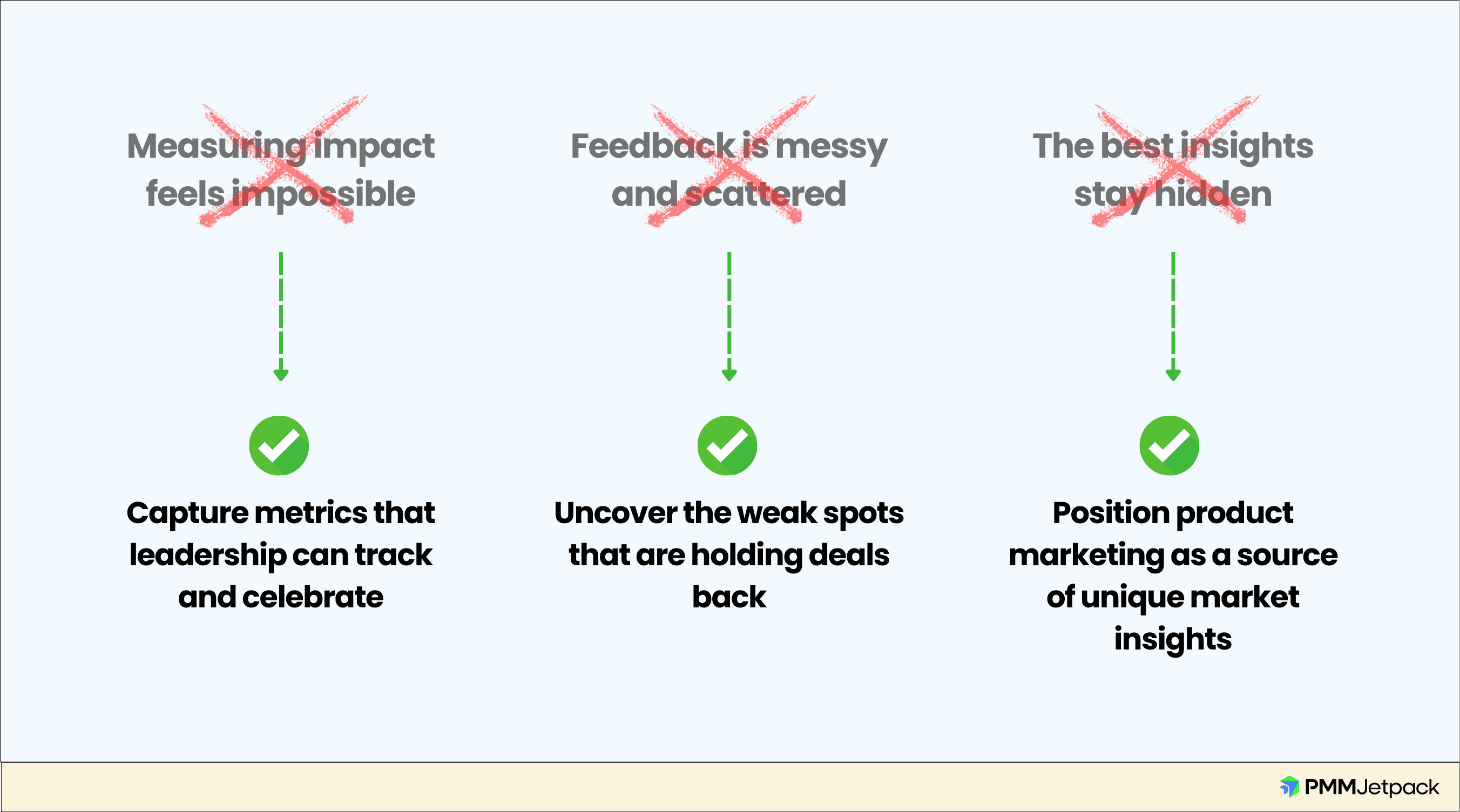
Show what’s working (and what’s not): You get meaningful metrics that leadership can track and celebrate—things like confidence levels, readiness, and engagement. Plus, it’s easy to point to actual data when talking about success.
Identify the weak spots: Maybe reps don’t feel comfortable demoing certain features, or they’re missing key collateral—whatever it is, it’s more obvious and easier to fix.
Gather ideas from the field: Your team on the ground often has the best insights on what could help them close more deals. These surveys create a direct line for collecting their enablement ideas.
Position yourself as a valued insider: By capturing fresh, real-world insights, you can shine a light on market-facing observations that make product marketing and leadership sit up and take notice.
Get this right, and you’re the hero: the person bringing clarity, tracking progress, and building a smarter, more confident team. Miss out on it, and you might find yourself wading through the murky waters of indecision, struggling to prove your worth, and risk being relegated to merely the “help desk” of sales.
How to Run a PMM Confidence Survey
We’ve talked about why confidence surveys matter, so now let’s dive into how to actually make it happen. Think of the survey process as five connected stages.
Show what’s working (and what’s not): You get meaningful metrics that leadership can track and celebrate—things like confidence levels, readiness, and engagement. Plus, it’s easy to point to actual data when talking about success.
Identify the weak spots: Maybe reps don’t feel comfortable demoing certain features, or they’re missing key collateral—whatever it is, it’s more obvious and easier to fix.
Gather ideas from the field: Your team on the ground often has the best insights on what could help them close more deals. These surveys create a direct line for collecting their enablement ideas.
Position yourself as a valued insider: By capturing fresh, real-world insights, you can shine a light on market-facing observations that make product marketing and leadership sit up and take notice.
Get this right, and you’re the hero: the person bringing clarity, tracking progress, and building a smarter, more confident team. Miss out on it, and you might find yourself wading through the murky waters of indecision, struggling to prove your worth, and risk being relegated to merely the “help desk” of sales.
How to Run a PMM Confidence Survey
We’ve talked about why confidence surveys matter, so now let’s dive into how to actually make it happen. Think of the survey process as five connected stages.
Show what’s working (and what’s not): You get meaningful metrics that leadership can track and celebrate—things like confidence levels, readiness, and engagement. Plus, it’s easy to point to actual data when talking about success.
Identify the weak spots: Maybe reps don’t feel comfortable demoing certain features, or they’re missing key collateral—whatever it is, it’s more obvious and easier to fix.
Gather ideas from the field: Your team on the ground often has the best insights on what could help them close more deals. These surveys create a direct line for collecting their enablement ideas.
Position yourself as a valued insider: By capturing fresh, real-world insights, you can shine a light on market-facing observations that make product marketing and leadership sit up and take notice.
Get this right, and you’re the hero: the person bringing clarity, tracking progress, and building a smarter, more confident team. Miss out on it, and you might find yourself wading through the murky waters of indecision, struggling to prove your worth, and risk being relegated to merely the “help desk” of sales.
How to Run a PMM Confidence Survey
We’ve talked about why confidence surveys matter, so now let’s dive into how to actually make it happen. Think of the survey process as five connected stages.
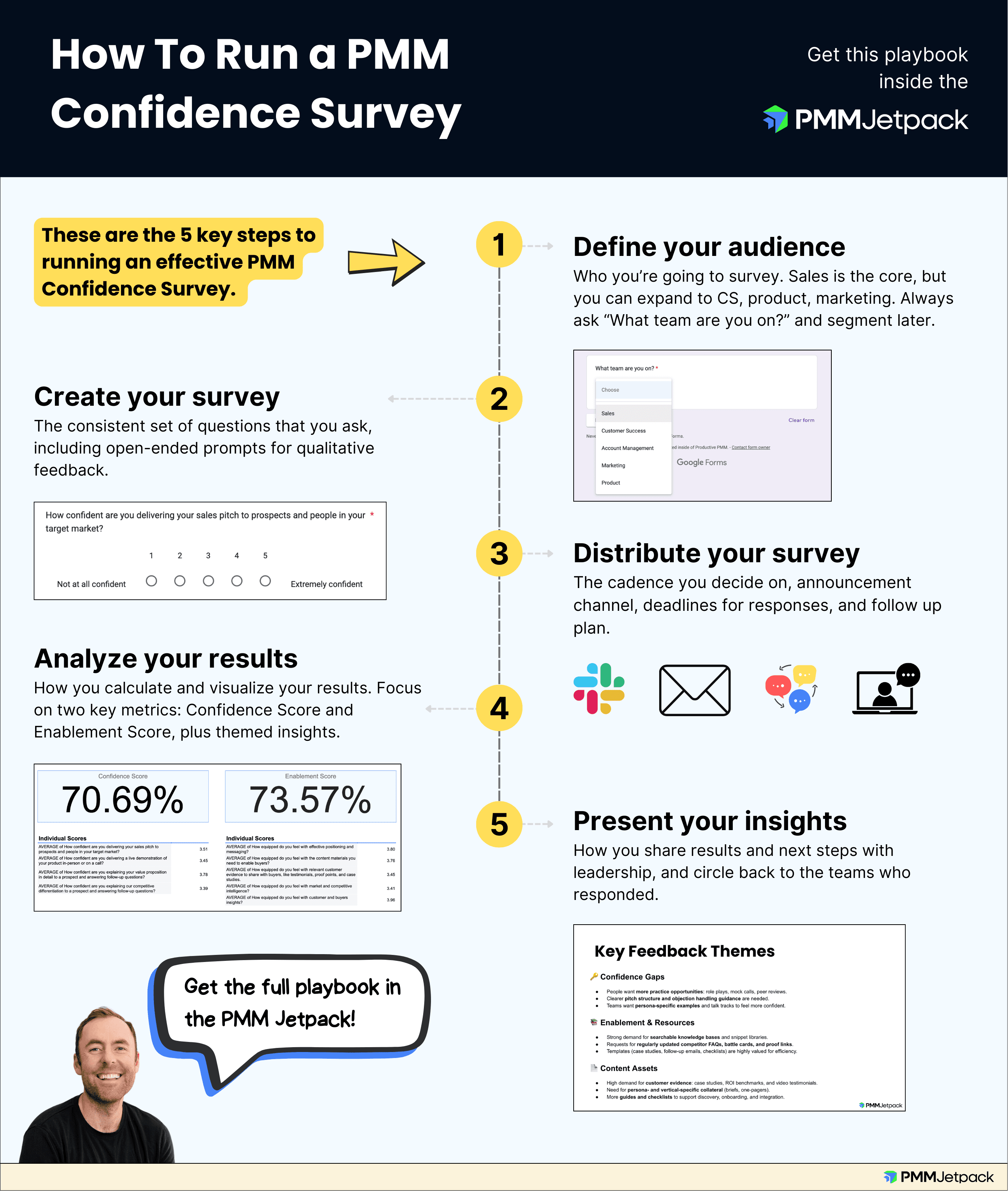
Audience — Who you’re going to survey. Sales is the core, but you can expand to CS, product, marketing. Always ask “What team are you on?” and segment later.
Survey — This is your set of questions, including open-ended prompts for qualitative feedback.
Distribution — The cadence you decide on, announcement channel, deadlines for responses, and follow up plan.
Analysis — How you calculate and visualize your results. Focus on two key metrics: Confidence Score and Enablement Score, plus themed insights.
Presentation — How you share results and next steps with leadership, and circle back to the teams who responded.
Pretty straightforward so far, right? Let’s dig even deeper into each step to make sure you’re ready to go.
Step 1: Define Your Audience
Start with sales, because their confidence has a direct line to revenue and deals closing. If you’ve got the bandwidth, extend it to Customer Success, support teams, or any other customer-facing groups. After all, they’re also talking to clients, explaining value, and helping position your product, so their confidence is also critical.
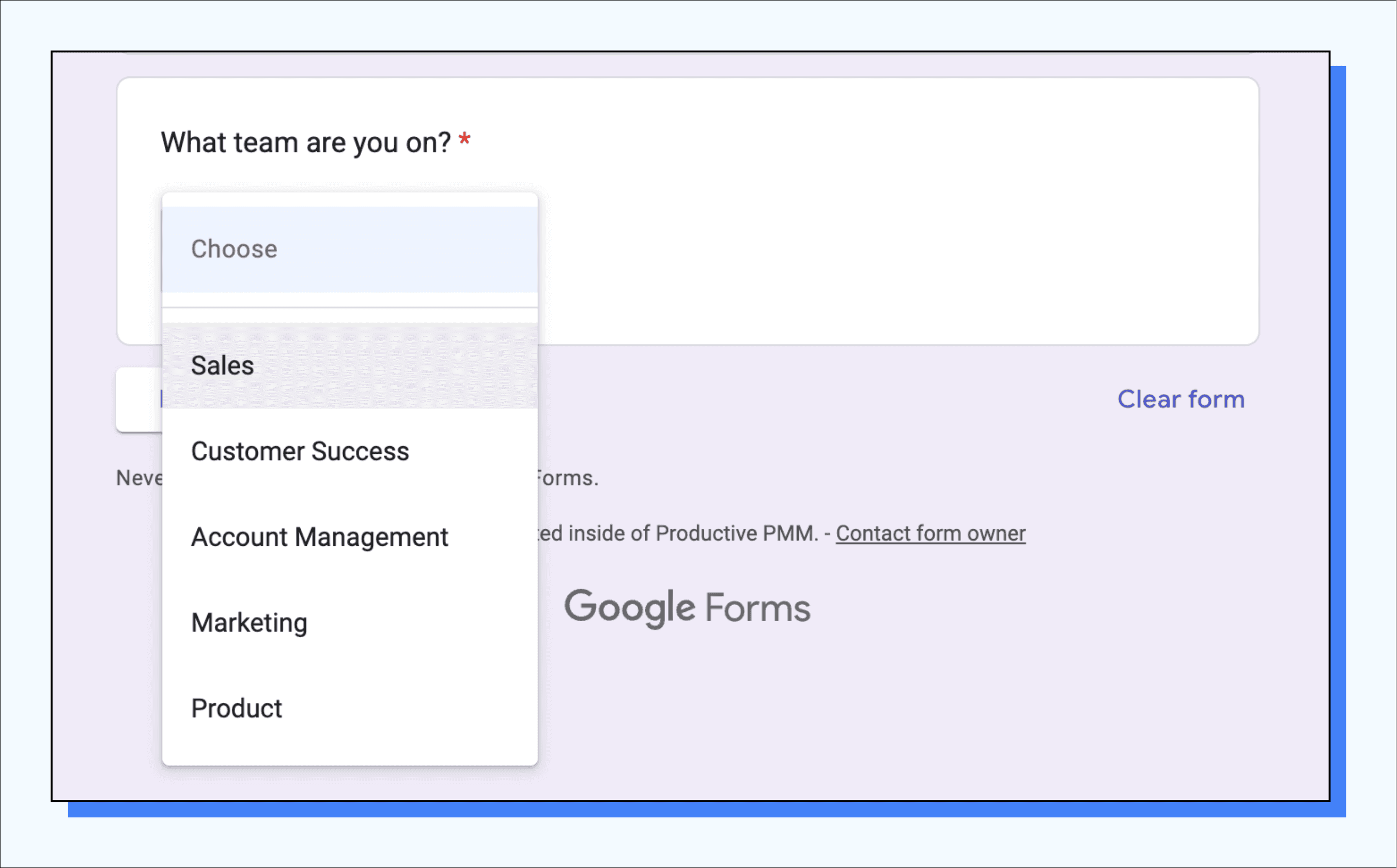
Audience — Who you’re going to survey. Sales is the core, but you can expand to CS, product, marketing. Always ask “What team are you on?” and segment later.
Survey — This is your set of questions, including open-ended prompts for qualitative feedback.
Distribution — The cadence you decide on, announcement channel, deadlines for responses, and follow up plan.
Analysis — How you calculate and visualize your results. Focus on two key metrics: Confidence Score and Enablement Score, plus themed insights.
Presentation — How you share results and next steps with leadership, and circle back to the teams who responded.
Pretty straightforward so far, right? Let’s dig even deeper into each step to make sure you’re ready to go.
Step 1: Define Your Audience
Start with sales, because their confidence has a direct line to revenue and deals closing. If you’ve got the bandwidth, extend it to Customer Success, support teams, or any other customer-facing groups. After all, they’re also talking to clients, explaining value, and helping position your product, so their confidence is also critical.
Show what’s working (and what’s not): You get meaningful metrics that leadership can track and celebrate—things like confidence levels, readiness, and engagement. Plus, it’s easy to point to actual data when talking about success.
Identify the weak spots: Maybe reps don’t feel comfortable demoing certain features, or they’re missing key collateral—whatever it is, it’s more obvious and easier to fix.
Gather ideas from the field: Your team on the ground often has the best insights on what could help them close more deals. These surveys create a direct line for collecting their enablement ideas.
Position yourself as a valued insider: By capturing fresh, real-world insights, you can shine a light on market-facing observations that make product marketing and leadership sit up and take notice.
Get this right, and you’re the hero: the person bringing clarity, tracking progress, and building a smarter, more confident team. Miss out on it, and you might find yourself wading through the murky waters of indecision, struggling to prove your worth, and risk being relegated to merely the “help desk” of sales.
How to Run a PMM Confidence Survey
We’ve talked about why confidence surveys matter, so now let’s dive into how to actually make it happen. Think of the survey process as five connected stages.
Pro tip: Always include a question like “What team are you on?” right at the start. It allows you to segment the responses later, so you can see if confidence levels are different between account executives, SDRs, CS reps, or support staff. Without that, you’re treating the whole organization as one big, uniform group—which can hide important nuances and make your insights less actionable.
Pro tip: Always include a question like “What team are you on?” right at the start. It allows you to segment the responses later, so you can see if confidence levels are different between account executives, SDRs, CS reps, or support staff. Without that, you’re treating the whole organization as one big, uniform group—which can hide important nuances and make your insights less actionable.
Pro tip: Always include a question like “What team are you on?” right at the start. It allows you to segment the responses later, so you can see if confidence levels are different between account executives, SDRs, CS reps, or support staff. Without that, you’re treating the whole organization as one big, uniform group—which can hide important nuances and make your insights less actionable.
Step 2: Create the Survey
Keep it short — 3 to 5 minutes max. You’re asking busy people for their time.
For simplicity, I recommend using Google Forms. It’s straightforward to set up, and you can easily export responses into a spreadsheet for analysis later. But honestly, any tool that lets you collect responses and export data works as long as it’s easy to analyze.
If you want a simple template you can start using right now, click the link below.
Step 2: Create the Survey
Keep it short — 3 to 5 minutes max. You’re asking busy people for their time.
For simplicity, I recommend using Google Forms. It’s straightforward to set up, and you can easily export responses into a spreadsheet for analysis later. But honestly, any tool that lets you collect responses and export data works as long as it’s easy to analyze.
If you want a simple template you can start using right now, click the link below.
Show what’s working (and what’s not): You get meaningful metrics that leadership can track and celebrate—things like confidence levels, readiness, and engagement. Plus, it’s easy to point to actual data when talking about success.
Identify the weak spots: Maybe reps don’t feel comfortable demoing certain features, or they’re missing key collateral—whatever it is, it’s more obvious and easier to fix.
Gather ideas from the field: Your team on the ground often has the best insights on what could help them close more deals. These surveys create a direct line for collecting their enablement ideas.
Position yourself as a valued insider: By capturing fresh, real-world insights, you can shine a light on market-facing observations that make product marketing and leadership sit up and take notice.
Get this right, and you’re the hero: the person bringing clarity, tracking progress, and building a smarter, more confident team. Miss out on it, and you might find yourself wading through the murky waters of indecision, struggling to prove your worth, and risk being relegated to merely the “help desk” of sales.
How to Run a PMM Confidence Survey
We’ve talked about why confidence surveys matter, so now let’s dive into how to actually make it happen. Think of the survey process as five connected stages.
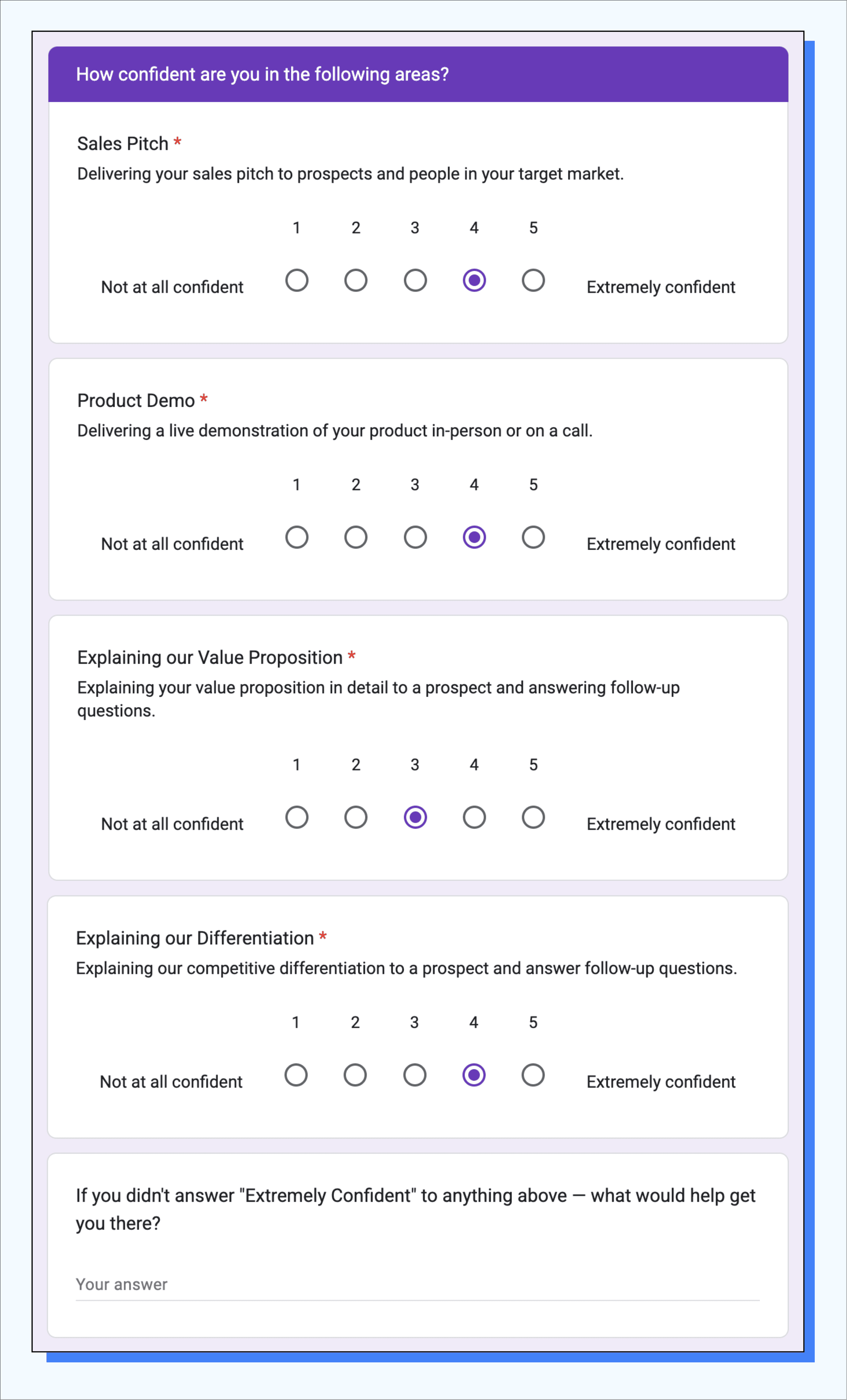
Here's the exact survey structure I've used:
Confidence (1–5 scale)
Sales pitch: How confident are you delivering your sales pitch to prospects and people in your target market?
Product demo: How confident are you delivering a live demonstration of your product in-person or on a call?
Value prop: How confident are you explaining your value proposition in detail to a prospect and answering follow-up questions?
Differentiation: How confident are you explaining our competitive differentiation to a prospect and answering follow-up questions?
Open-ended follow-up: If you didn’t answer “extremely confident” on any of the above, what would help you get there?
This is where the gold is. Reps will share insights on what content, training, or support they’re missing. It can unveil hidden pain points, weak spots in your enablement, or areas that need a boost.
Here's the exact survey structure I've used:
Confidence (1–5 scale)
Sales pitch: How confident are you delivering your sales pitch to prospects and people in your target market?
Product demo: How confident are you delivering a live demonstration of your product in-person or on a call?
Value prop: How confident are you explaining your value proposition in detail to a prospect and answering follow-up questions?
Differentiation: How confident are you explaining our competitive differentiation to a prospect and answering follow-up questions?
Open-ended follow-up: If you didn’t answer “extremely confident” on any of the above, what would help you get there?
This is where the gold is. Reps will share insights on what content, training, or support they’re missing. It can unveil hidden pain points, weak spots in your enablement, or areas that need a boost.
Show what’s working (and what’s not): You get meaningful metrics that leadership can track and celebrate—things like confidence levels, readiness, and engagement. Plus, it’s easy to point to actual data when talking about success.
Identify the weak spots: Maybe reps don’t feel comfortable demoing certain features, or they’re missing key collateral—whatever it is, it’s more obvious and easier to fix.
Gather ideas from the field: Your team on the ground often has the best insights on what could help them close more deals. These surveys create a direct line for collecting their enablement ideas.
Position yourself as a valued insider: By capturing fresh, real-world insights, you can shine a light on market-facing observations that make product marketing and leadership sit up and take notice.
Get this right, and you’re the hero: the person bringing clarity, tracking progress, and building a smarter, more confident team. Miss out on it, and you might find yourself wading through the murky waters of indecision, struggling to prove your worth, and risk being relegated to merely the “help desk” of sales.
How to Run a PMM Confidence Survey
We’ve talked about why confidence surveys matter, so now let’s dive into how to actually make it happen. Think of the survey process as five connected stages.
Why these questions matter: They hit the core skills reps use every day on the front lines. If confidence is low here, it’s a sign that your messaging, training, or content isn’t quite landing how you want it.
Why these questions matter: They hit the core skills reps use every day on the front lines. If confidence is low here, it’s a sign that your messaging, training, or content isn’t quite landing how you want it.
Pro tip: Always include a question like “What team are you on?” right at the start. It allows you to segment the responses later, so you can see if confidence levels are different between account executives, SDRs, CS reps, or support staff. Without that, you’re treating the whole organization as one big, uniform group—which can hide important nuances and make your insights less actionable.
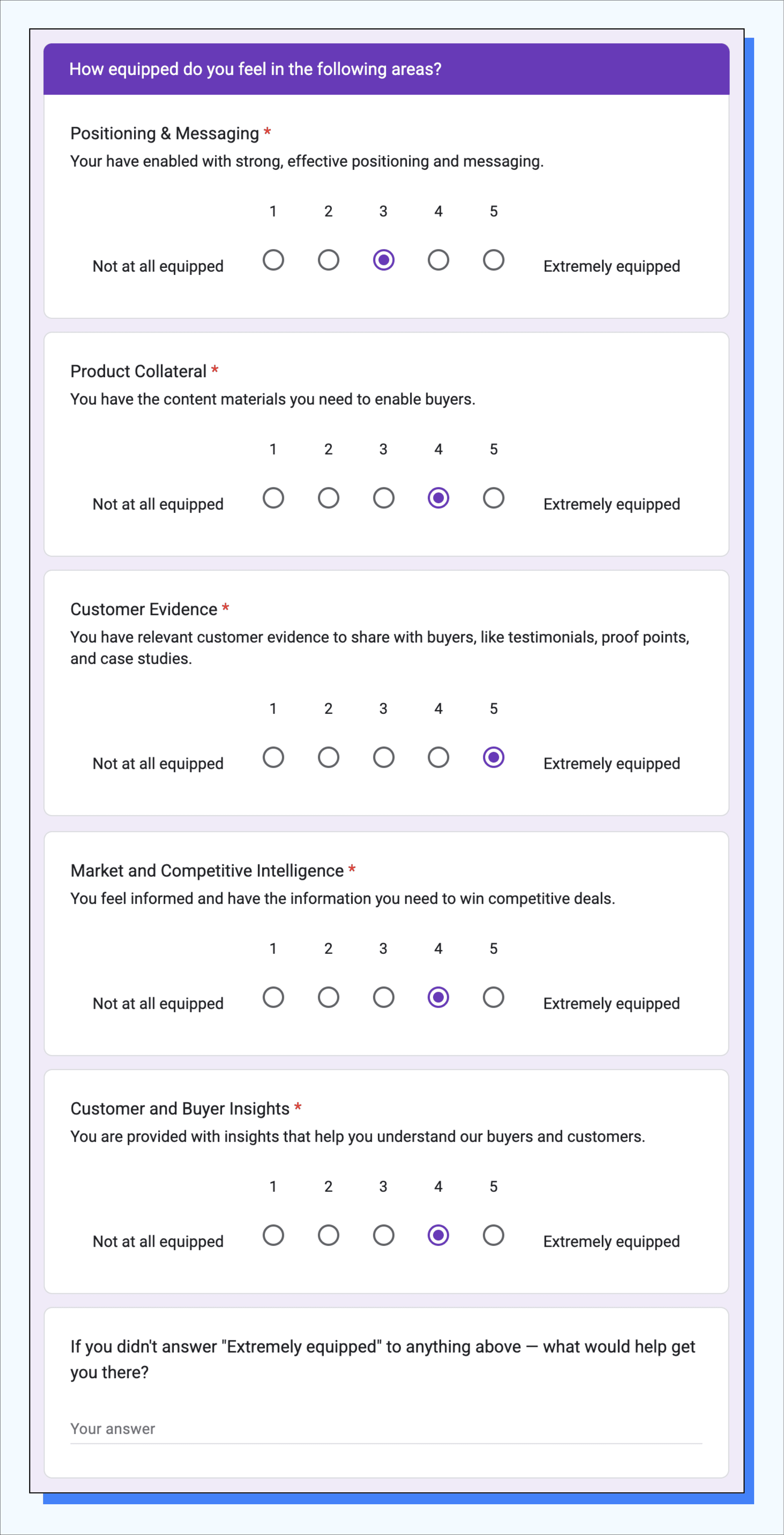
Equipped/Enabled (1–5 scale)
How equipped do you feel in each of the following areas?
Positioning & messaging: How equipped do you feel with effective positioning and messaging?
Product collateral: How equipped do you feel with the content materials you need to enable buyers?
Customer evidence: How equipped do you feel with relevant customer evidence to share with buyers, like testimonials, proof points, and case studies.
Market & competitive intelligence: How equipped do you feel with market and competitive intelligence?
Customer insights: How equipped do you feel with customer and buyers insights?
Open-ended follow-up: If you didn’t answer “extremely equipped,” what would help you get there?
Equipped/Enabled (1–5 scale)
How equipped do you feel in each of the following areas?
Positioning & messaging: How equipped do you feel with effective positioning and messaging?
Product collateral: How equipped do you feel with the content materials you need to enable buyers?
Customer evidence: How equipped do you feel with relevant customer evidence to share with buyers, like testimonials, proof points, and case studies.
Market & competitive intelligence: How equipped do you feel with market and competitive intelligence?
Customer insights: How equipped do you feel with customer and buyers insights?
Open-ended follow-up: If you didn’t answer “extremely equipped,” what would help you get there?
Show what’s working (and what’s not): You get meaningful metrics that leadership can track and celebrate—things like confidence levels, readiness, and engagement. Plus, it’s easy to point to actual data when talking about success.
Identify the weak spots: Maybe reps don’t feel comfortable demoing certain features, or they’re missing key collateral—whatever it is, it’s more obvious and easier to fix.
Gather ideas from the field: Your team on the ground often has the best insights on what could help them close more deals. These surveys create a direct line for collecting their enablement ideas.
Position yourself as a valued insider: By capturing fresh, real-world insights, you can shine a light on market-facing observations that make product marketing and leadership sit up and take notice.
Get this right, and you’re the hero: the person bringing clarity, tracking progress, and building a smarter, more confident team. Miss out on it, and you might find yourself wading through the murky waters of indecision, struggling to prove your worth, and risk being relegated to merely the “help desk” of sales.
How to Run a PMM Confidence Survey
We’ve talked about why confidence surveys matter, so now let’s dive into how to actually make it happen. Think of the survey process as five connected stages.
Why these questions matter: Confidence isn’t just about skill—it’s also about having the right resources at your fingertips. If reps don’t feel equipped, their confidence will suffer, even if they have the skills.
Why these questions matter: Confidence isn’t just about skill—it’s also about having the right resources at your fingertips. If reps don’t feel equipped, their confidence will suffer, even if they have the skills.
Pro tip: Always include a question like “What team are you on?” right at the start. It allows you to segment the responses later, so you can see if confidence levels are different between account executives, SDRs, CS reps, or support staff. Without that, you’re treating the whole organization as one big, uniform group—which can hide important nuances and make your insights less actionable.
Open-ended section (rotating prompts)
Mix it up each quarter with questions like:
What content are we missing that would help you close more deals?
What objections do you hear most often?
What questions can’t you confidently answer today?
What product areas need more training?
Anything else we should know?
Open-ended section (rotating prompts)
Mix it up each quarter with questions like:
What content are we missing that would help you close more deals?
What objections do you hear most often?
What questions can’t you confidently answer today?
What product areas need more training?
Anything else we should know?
Show what’s working (and what’s not): You get meaningful metrics that leadership can track and celebrate—things like confidence levels, readiness, and engagement. Plus, it’s easy to point to actual data when talking about success.
Identify the weak spots: Maybe reps don’t feel comfortable demoing certain features, or they’re missing key collateral—whatever it is, it’s more obvious and easier to fix.
Gather ideas from the field: Your team on the ground often has the best insights on what could help them close more deals. These surveys create a direct line for collecting their enablement ideas.
Position yourself as a valued insider: By capturing fresh, real-world insights, you can shine a light on market-facing observations that make product marketing and leadership sit up and take notice.
Get this right, and you’re the hero: the person bringing clarity, tracking progress, and building a smarter, more confident team. Miss out on it, and you might find yourself wading through the murky waters of indecision, struggling to prove your worth, and risk being relegated to merely the “help desk” of sales.
How to Run a PMM Confidence Survey
We’ve talked about why confidence surveys matter, so now let’s dive into how to actually make it happen. Think of the survey process as five connected stages.
Tip: Rotate these open-ended questions each quarter. Keep your core scaled questions the same so you can track trends, but swap out the open-ended prompts to focus on what’s most relevant at the moment.
Tip: Rotate these open-ended questions each quarter. Keep your core scaled questions the same so you can track trends, but swap out the open-ended prompts to focus on what’s most relevant at the moment.
Pro tip: Always include a question like “What team are you on?” right at the start. It allows you to segment the responses later, so you can see if confidence levels are different between account executives, SDRs, CS reps, or support staff. Without that, you’re treating the whole organization as one big, uniform group—which can hide important nuances and make your insights less actionable.
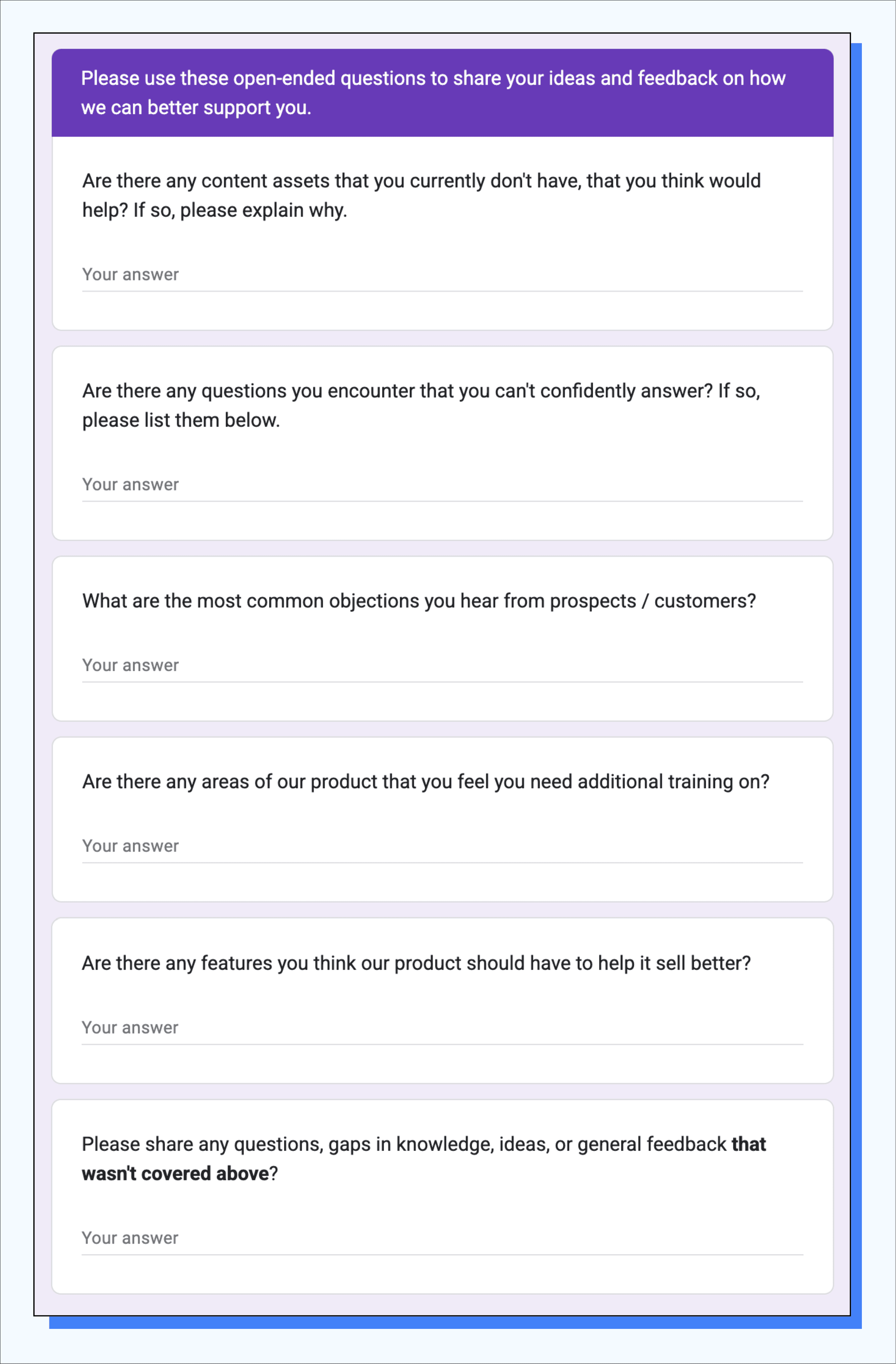
The idea is to keep the survey impactful, quick, and focused — so you get honest answers that truly help you improve your enablement game.
Step 3: Distribute the Survey
This is the moment where everything comes together. How you roll out the survey can make or break your response rate and the quality of feedback you get. Let’s talk about some best practices:
The idea is to keep the survey impactful, quick, and focused — so you get honest answers that truly help you improve your enablement game.
Step 3: Distribute the Survey
This is the moment where everything comes together. How you roll out the survey can make or break your response rate and the quality of feedback you get. Let’s talk about some best practices:
Show what’s working (and what’s not): You get meaningful metrics that leadership can track and celebrate—things like confidence levels, readiness, and engagement. Plus, it’s easy to point to actual data when talking about success.
Identify the weak spots: Maybe reps don’t feel comfortable demoing certain features, or they’re missing key collateral—whatever it is, it’s more obvious and easier to fix.
Gather ideas from the field: Your team on the ground often has the best insights on what could help them close more deals. These surveys create a direct line for collecting their enablement ideas.
Position yourself as a valued insider: By capturing fresh, real-world insights, you can shine a light on market-facing observations that make product marketing and leadership sit up and take notice.
Get this right, and you’re the hero: the person bringing clarity, tracking progress, and building a smarter, more confident team. Miss out on it, and you might find yourself wading through the murky waters of indecision, struggling to prove your worth, and risk being relegated to merely the “help desk” of sales.
How to Run a PMM Confidence Survey
We’ve talked about why confidence surveys matter, so now let’s dive into how to actually make it happen. Think of the survey process as five connected stages.
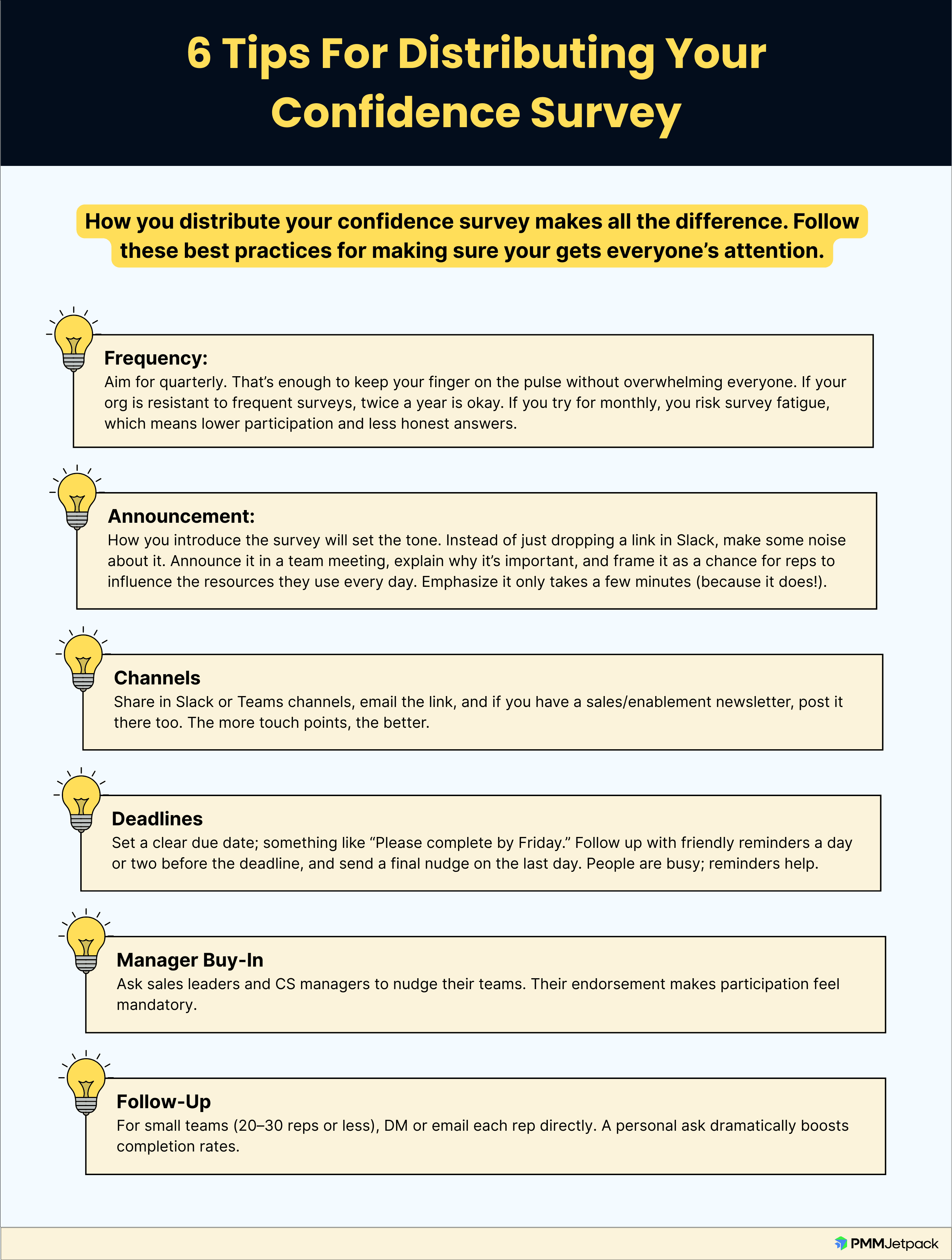
Frequency: Aim for quarterly. That’s enough to keep your finger on the pulse without overwhelming everyone. If your org is resistant to frequent surveys, twice a year is okay. If you try for monthly, you risk survey fatigue, which means lower participation and less honest answers.
Announcement: How you introduce the survey will set the tone. Instead of just dropping a link in Slack or sending an email and hoping for the best, make some noise about it. Announce it in a team meeting, explain why it’s important, and frame it as a quick chance for reps to share their voice and influence the resources they use every day. Emphasize it only takes a few minutes (because it does!).
Channels: Share in Slack or Teams channels, email the link, and if you have a sales/enablement newsletter, post it there too. The more touch points, the better.
Deadlines: Set a clear due date; something like “Please complete by Friday.” Follow up with friendly reminders a day or two before the deadline, and send a final nudge on the last day. People are busy, and reminders help.
Manager buy-in: Ask sales leaders and CS managers to nudge their teams. When reps see their managers endorsing the survey, they’re more likely to prioritize it.
1:1 Follow-up: For smaller teams (20–30 reps or less), DM or email each rep directly. A personal ask can dramatically boost completion rates.
Frequency: Aim for quarterly. That’s enough to keep your finger on the pulse without overwhelming everyone. If your org is resistant to frequent surveys, twice a year is okay. If you try for monthly, you risk survey fatigue, which means lower participation and less honest answers.
Announcement: How you introduce the survey will set the tone. Instead of just dropping a link in Slack or sending an email and hoping for the best, make some noise about it. Announce it in a team meeting, explain why it’s important, and frame it as a quick chance for reps to share their voice and influence the resources they use every day. Emphasize it only takes a few minutes (because it does!).
Channels: Share in Slack or Teams channels, email the link, and if you have a sales/enablement newsletter, post it there too. The more touch points, the better.
Deadlines: Set a clear due date; something like “Please complete by Friday.” Follow up with friendly reminders a day or two before the deadline, and send a final nudge on the last day. People are busy, and reminders help.
Manager buy-in: Ask sales leaders and CS managers to nudge their teams. When reps see their managers endorsing the survey, they’re more likely to prioritize it.
1:1 Follow-up: For smaller teams (20–30 reps or less), DM or email each rep directly. A personal ask can dramatically boost completion rates.
Show what’s working (and what’s not): You get meaningful metrics that leadership can track and celebrate—things like confidence levels, readiness, and engagement. Plus, it’s easy to point to actual data when talking about success.
Identify the weak spots: Maybe reps don’t feel comfortable demoing certain features, or they’re missing key collateral—whatever it is, it’s more obvious and easier to fix.
Gather ideas from the field: Your team on the ground often has the best insights on what could help them close more deals. These surveys create a direct line for collecting their enablement ideas.
Position yourself as a valued insider: By capturing fresh, real-world insights, you can shine a light on market-facing observations that make product marketing and leadership sit up and take notice.
Get this right, and you’re the hero: the person bringing clarity, tracking progress, and building a smarter, more confident team. Miss out on it, and you might find yourself wading through the murky waters of indecision, struggling to prove your worth, and risk being relegated to merely the “help desk” of sales.
How to Run a PMM Confidence Survey
We’ve talked about why confidence surveys matter, so now let’s dive into how to actually make it happen. Think of the survey process as five connected stages.
Tip: When you first announce the survey, highlight what’s in it for them: “This is your chance to shape the resources and training you get. If you want better collateral or new messaging, this is where to ask for it.”
Tip: When you first announce the survey, highlight what’s in it for them: “This is your chance to shape the resources and training you get. If you want better collateral or new messaging, this is where to ask for it.”
Pro tip: Always include a question like “What team are you on?” right at the start. It allows you to segment the responses later, so you can see if confidence levels are different between account executives, SDRs, CS reps, or support staff. Without that, you’re treating the whole organization as one big, uniform group—which can hide important nuances and make your insights less actionable.
Step 4: Analyze the Data
Once you’ve collected responses, it’s time to dig into the data and turn those numbers and comments into meaningful insights.
Quantitative data
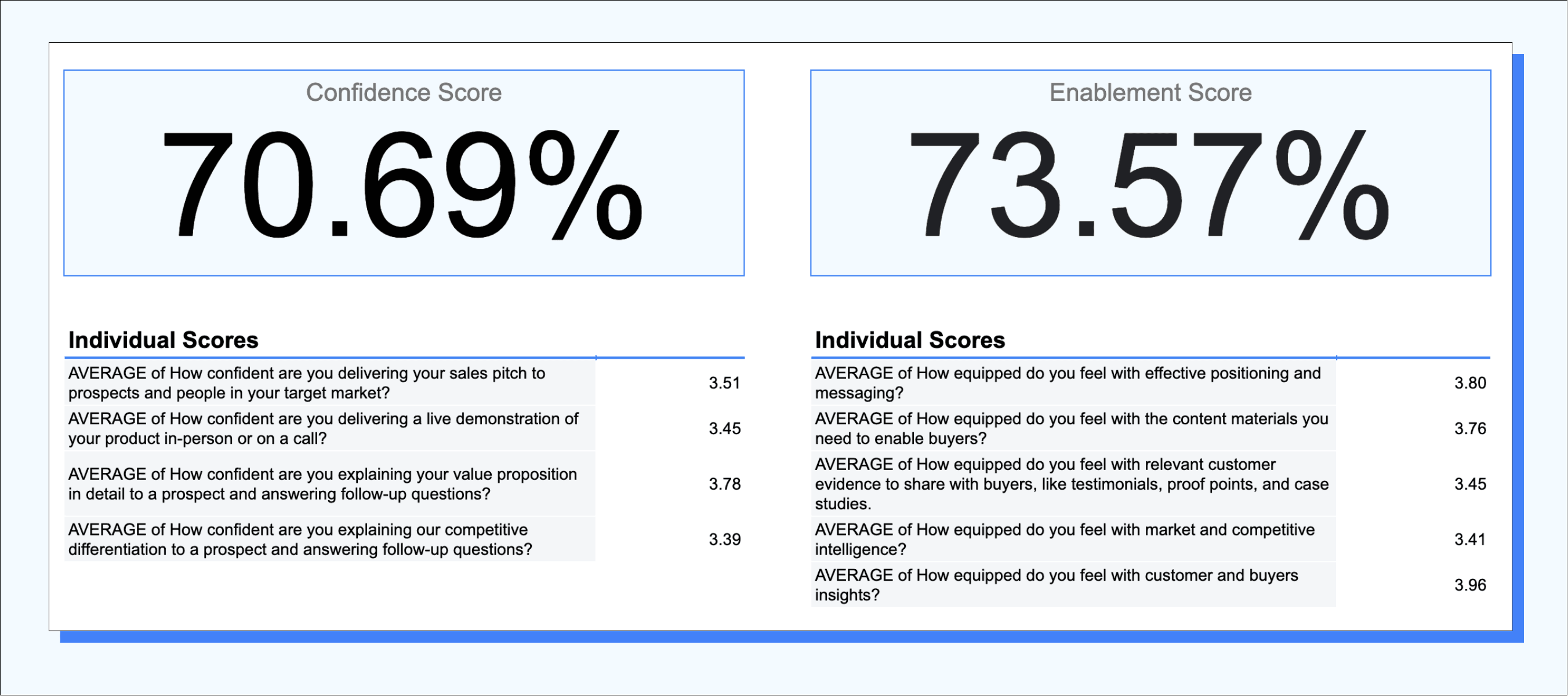
Start by calculating two key scores:
Confidence Score: Take all the confidence-related questions and find their average. This gives you a quick snapshot of how confident your team feels overall.
Enablement Score: Do the same for the questions about how equipped they feel.
Now, track these quarter over quarter. If your scores are climbing, you have proof your work is moving the needle.
Drill down into each question, too. If confidence in the sales pitch rises but differentiation stays flat, you know where to focus next.
Step 4: Analyze the Data
Once you’ve collected responses, it’s time to dig into the data and turn those numbers and comments into meaningful insights.
Quantitative data
Start by calculating two key scores:
Confidence Score: Take all the confidence-related questions and find their average. This gives you a quick snapshot of how confident your team feels overall.
Enablement Score: Do the same for the questions about how equipped they feel.
Now, track these quarter over quarter. If your scores are climbing, you have proof your work is moving the needle.
Drill down into each question, too. If confidence in the sales pitch rises but differentiation stays flat, you know where to focus next.
Show what’s working (and what’s not): You get meaningful metrics that leadership can track and celebrate—things like confidence levels, readiness, and engagement. Plus, it’s easy to point to actual data when talking about success.
Identify the weak spots: Maybe reps don’t feel comfortable demoing certain features, or they’re missing key collateral—whatever it is, it’s more obvious and easier to fix.
Gather ideas from the field: Your team on the ground often has the best insights on what could help them close more deals. These surveys create a direct line for collecting their enablement ideas.
Position yourself as a valued insider: By capturing fresh, real-world insights, you can shine a light on market-facing observations that make product marketing and leadership sit up and take notice.
Get this right, and you’re the hero: the person bringing clarity, tracking progress, and building a smarter, more confident team. Miss out on it, and you might find yourself wading through the murky waters of indecision, struggling to prove your worth, and risk being relegated to merely the “help desk” of sales.
How to Run a PMM Confidence Survey
We’ve talked about why confidence surveys matter, so now let’s dive into how to actually make it happen. Think of the survey process as five connected stages.
Example: Your first survey shows Confidence at 70% and Enablement at 73%. A year later, if those scores rise to 80%+, you can point to tangible progress driven by your work.
Example: Your first survey shows Confidence at 70% and Enablement at 73%. A year later, if those scores rise to 80%+, you can point to tangible progress driven by your work.
Pro tip: Always include a question like “What team are you on?” right at the start. It allows you to segment the responses later, so you can see if confidence levels are different between account executives, SDRs, CS reps, or support staff. Without that, you’re treating the whole organization as one big, uniform group—which can hide important nuances and make your insights less actionable.
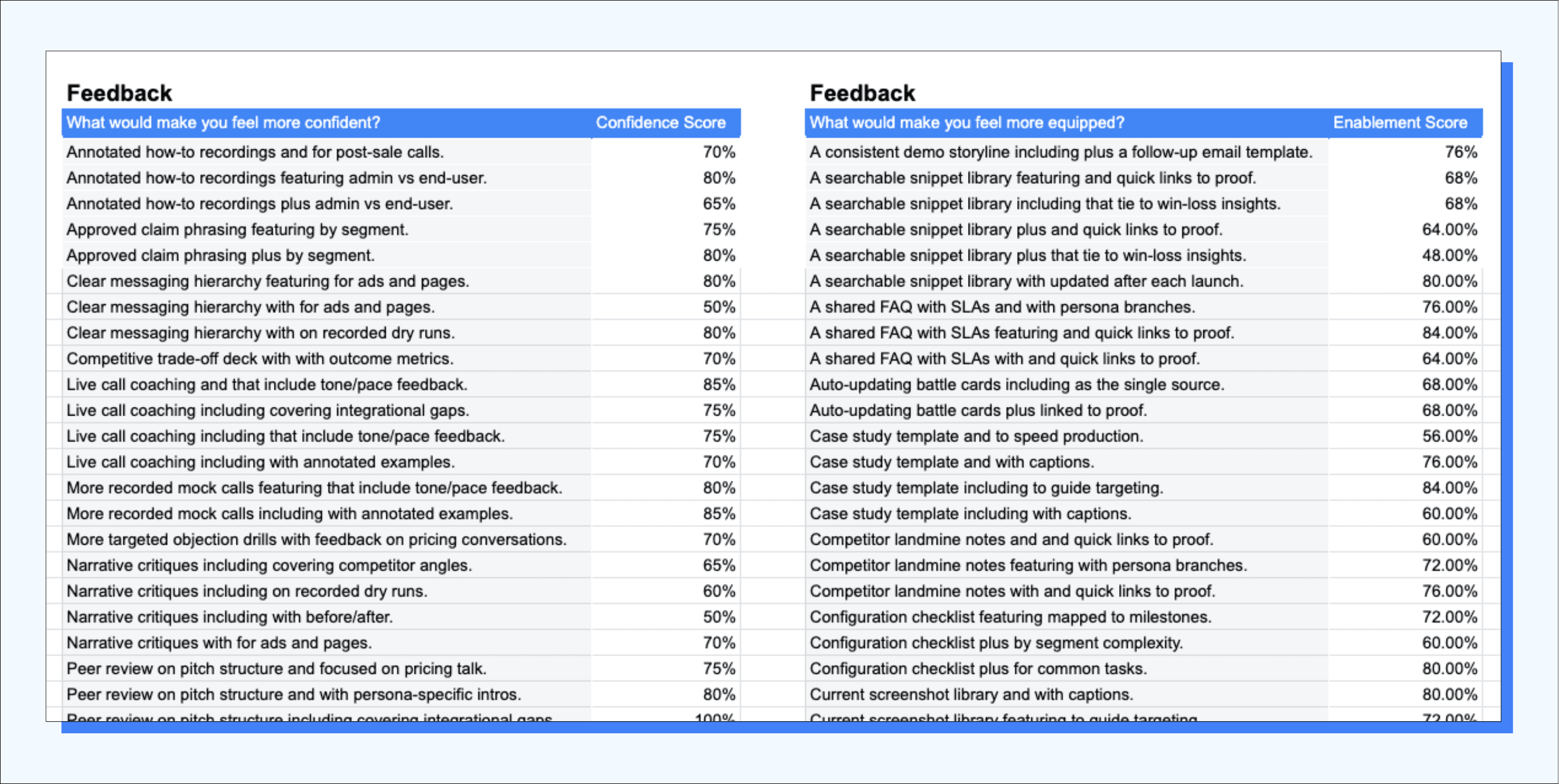
Qualitative data
Next, gather all those open-ended responses into a single document or spreadsheet. Look for common patterns: are reps consistently asking for more customer stories? Are they mentioning a lack of competitive intel? A need for a clearer demo script?
Summarize these themes into the top 3–5 key insights. These nuggets are often where the real opportunities hide.
Qualitative data
Next, gather all those open-ended responses into a single document or spreadsheet. Look for common patterns: are reps consistently asking for more customer stories? Are they mentioning a lack of competitive intel? A need for a clearer demo script?
Summarize these themes into the top 3–5 key insights. These nuggets are often where the real opportunities hide.
Show what’s working (and what’s not): You get meaningful metrics that leadership can track and celebrate—things like confidence levels, readiness, and engagement. Plus, it’s easy to point to actual data when talking about success.
Identify the weak spots: Maybe reps don’t feel comfortable demoing certain features, or they’re missing key collateral—whatever it is, it’s more obvious and easier to fix.
Gather ideas from the field: Your team on the ground often has the best insights on what could help them close more deals. These surveys create a direct line for collecting their enablement ideas.
Position yourself as a valued insider: By capturing fresh, real-world insights, you can shine a light on market-facing observations that make product marketing and leadership sit up and take notice.
Get this right, and you’re the hero: the person bringing clarity, tracking progress, and building a smarter, more confident team. Miss out on it, and you might find yourself wading through the murky waters of indecision, struggling to prove your worth, and risk being relegated to merely the “help desk” of sales.
How to Run a PMM Confidence Survey
We’ve talked about why confidence surveys matter, so now let’s dive into how to actually make it happen. Think of the survey process as five connected stages.
Tip: You can even feed responses into an AI tool to cluster them into themes. But don’t skip the human read-through! Direct quotes from reps can be incredibly powerful when shared with leadership.
Tip: You can even feed responses into an AI tool to cluster them into themes. But don’t skip the human read-through! Direct quotes from reps can be incredibly powerful when shared with leadership.
Pro tip: Always include a question like “What team are you on?” right at the start. It allows you to segment the responses later, so you can see if confidence levels are different between account executives, SDRs, CS reps, or support staff. Without that, you’re treating the whole organization as one big, uniform group—which can hide important nuances and make your insights less actionable.
To make the analysis even easier, use your spreadsheet (included in the Jetpack!) to automatically calculate scores and generate charts. Visuals help communicate progress clearly and make it easier for everyone to understand the story the data is telling.
To make the analysis even easier, use your spreadsheet (included in the Jetpack!) to automatically calculate scores and generate charts. Visuals help communicate progress clearly and make it easier for everyone to understand the story the data is telling.
Show what’s working (and what’s not): You get meaningful metrics that leadership can track and celebrate—things like confidence levels, readiness, and engagement. Plus, it’s easy to point to actual data when talking about success.
Identify the weak spots: Maybe reps don’t feel comfortable demoing certain features, or they’re missing key collateral—whatever it is, it’s more obvious and easier to fix.
Gather ideas from the field: Your team on the ground often has the best insights on what could help them close more deals. These surveys create a direct line for collecting their enablement ideas.
Position yourself as a valued insider: By capturing fresh, real-world insights, you can shine a light on market-facing observations that make product marketing and leadership sit up and take notice.
Get this right, and you’re the hero: the person bringing clarity, tracking progress, and building a smarter, more confident team. Miss out on it, and you might find yourself wading through the murky waters of indecision, struggling to prove your worth, and risk being relegated to merely the “help desk” of sales.
How to Run a PMM Confidence Survey
We’ve talked about why confidence surveys matter, so now let’s dive into how to actually make it happen. Think of the survey process as five connected stages.
Step 5: Present the Results
The survey’s great, but sharing the insights is where the real magic happens—and where you turn data into action.
Step 5: Present the Results
The survey’s great, but sharing the insights is where the real magic happens—and where you turn data into action.
Show what’s working (and what’s not): You get meaningful metrics that leadership can track and celebrate—things like confidence levels, readiness, and engagement. Plus, it’s easy to point to actual data when talking about success.
Identify the weak spots: Maybe reps don’t feel comfortable demoing certain features, or they’re missing key collateral—whatever it is, it’s more obvious and easier to fix.
Gather ideas from the field: Your team on the ground often has the best insights on what could help them close more deals. These surveys create a direct line for collecting their enablement ideas.
Position yourself as a valued insider: By capturing fresh, real-world insights, you can shine a light on market-facing observations that make product marketing and leadership sit up and take notice.
Get this right, and you’re the hero: the person bringing clarity, tracking progress, and building a smarter, more confident team. Miss out on it, and you might find yourself wading through the murky waters of indecision, struggling to prove your worth, and risk being relegated to merely the “help desk” of sales.
How to Run a PMM Confidence Survey
We’ve talked about why confidence surveys matter, so now let’s dive into how to actually make it happen. Think of the survey process as five connected stages.
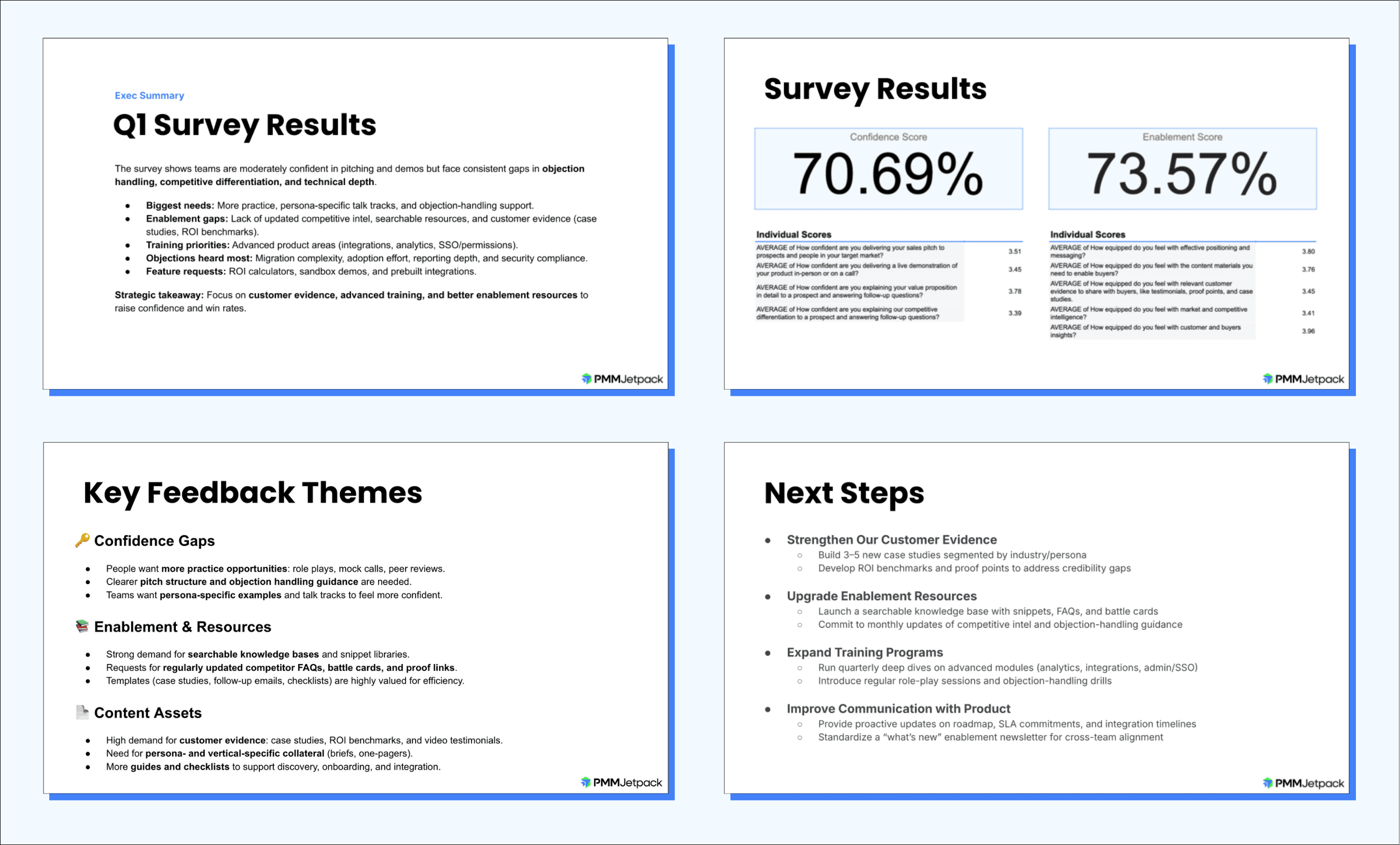
To your boss: Bring the highlights into your 1:1. Show off the trendlines and throw up a slide with the top themes. It’s your moment to shine—proof that your efforts are making a difference—and a solid way to back up your performance reviews and OKRs. Plus, it keeps your boss in the loop and on board.
To leadership/executives: Present in a leadership meeting or all-hands. Highlight the two scores, plus 2–3 themes that are blocking deals, and propose some next steps. This positions product marketing as the owner of frontline insight.
Back to sales/CS: Share results transparently with the teams who responded. Show them their collective scores, those common themes, and most importantly, the game plan you’re rolling out based on their feedback.
To your boss: Bring the highlights into your 1:1. Show off the trendlines and throw up a slide with the top themes. It’s your moment to shine—proof that your efforts are making a difference—and a solid way to back up your performance reviews and OKRs. Plus, it keeps your boss in the loop and on board.
To leadership/executives: Present in a leadership meeting or all-hands. Highlight the two scores, plus 2–3 themes that are blocking deals, and propose some next steps. This positions product marketing as the owner of frontline insight.
Back to sales/CS: Share results transparently with the teams who responded. Show them their collective scores, those common themes, and most importantly, the game plan you’re rolling out based on their feedback.
Show what’s working (and what’s not): You get meaningful metrics that leadership can track and celebrate—things like confidence levels, readiness, and engagement. Plus, it’s easy to point to actual data when talking about success.
Identify the weak spots: Maybe reps don’t feel comfortable demoing certain features, or they’re missing key collateral—whatever it is, it’s more obvious and easier to fix.
Gather ideas from the field: Your team on the ground often has the best insights on what could help them close more deals. These surveys create a direct line for collecting their enablement ideas.
Position yourself as a valued insider: By capturing fresh, real-world insights, you can shine a light on market-facing observations that make product marketing and leadership sit up and take notice.
Get this right, and you’re the hero: the person bringing clarity, tracking progress, and building a smarter, more confident team. Miss out on it, and you might find yourself wading through the murky waters of indecision, struggling to prove your worth, and risk being relegated to merely the “help desk” of sales.
How to Run a PMM Confidence Survey
We’ve talked about why confidence surveys matter, so now let’s dive into how to actually make it happen. Think of the survey process as five connected stages.
Tip: Don’t just say “thanks for your input.” Come back with a roadmap: “You told us you need more objection-handling content and better competitive intel. Here’s what we’re delivering next quarter.” When people see their feedback spark action, they’re way more likely to keep participating.
Tip: Don’t just say “thanks for your input.” Come back with a roadmap: “You told us you need more objection-handling content and better competitive intel. Here’s what we’re delivering next quarter.” When people see their feedback spark action, they’re way more likely to keep participating.
Pro tip: Always include a question like “What team are you on?” right at the start. It allows you to segment the responses later, so you can see if confidence levels are different between account executives, SDRs, CS reps, or support staff. Without that, you’re treating the whole organization as one big, uniform group—which can hide important nuances and make your insights less actionable.
Confidence surveys in the wild
Sometimes seeing real-world examples is all it takes to get inspired. Here are two stories of how confidence surveys totally transformed PMM teams at different companies:
Example 1 – Zach (Foundry member):
Zach was a new PMM trying to make a good impression on his CEO. He ran a confidence survey using the Jetpack template, customized the questions, and presented the results. When he shared the insights, the leadership team had a lightbulb moment: they’d never seen structured feedback from sales like this before. The CEO was impressed, not just by what the data revealed but by Zach’s initiative in asking for it. That survey didn’t just spark insights, it earned Zach credibility as a strategic partner rather than just a tactical marketer. Talk about a power move!
Example 2 – Klue:
At Klue, enablement was a huge part of our PMM charter. To measure its effectiveness, we introduced a Sales Confidence Score as a standing KPI in quarterly reports. Every quarter, the score was updated and presented alongside OKRs. It gave leadership a clear, trackable measure of whether sales was becoming more confident and better equipped. It also validated priorities: if scores showed gaps in differentiation messaging, that became the focus for the next quarter’s enablement. Over time, the scores steadily climbed, and so did our credibility as a strategic partner. It was proof, plain and simple, that our work made a real difference.
Seeing these success stories, it’s clear: confidence surveys aren’t just checkboxes. They’re powerful tools for building trust, demonstrating impact, and driving real change. And who knows? Maybe next time, it’ll be your story in the highlight reel.
Mistakes to Avoid
Now that you’re ready to roll, here are a few common traps to steer clear of.
Confidence surveys in the wild
Sometimes seeing real-world examples is all it takes to get inspired. Here are two stories of how confidence surveys totally transformed PMM teams at different companies:
Example 1 – Zach (Foundry member):
Zach was a new PMM trying to make a good impression on his CEO. He ran a confidence survey using the Jetpack template, customized the questions, and presented the results. When he shared the insights, the leadership team had a lightbulb moment: they’d never seen structured feedback from sales like this before. The CEO was impressed, not just by what the data revealed but by Zach’s initiative in asking for it. That survey didn’t just spark insights, it earned Zach credibility as a strategic partner rather than just a tactical marketer. Talk about a power move!
Example 2 – Klue:
At Klue, enablement was a huge part of our PMM charter. To measure its effectiveness, we introduced a Sales Confidence Score as a standing KPI in quarterly reports. Every quarter, the score was updated and presented alongside OKRs. It gave leadership a clear, trackable measure of whether sales was becoming more confident and better equipped. It also validated priorities: if scores showed gaps in differentiation messaging, that became the focus for the next quarter’s enablement. Over time, the scores steadily climbed, and so did our credibility as a strategic partner. It was proof, plain and simple, that our work made a real difference.
Seeing these success stories, it’s clear: confidence surveys aren’t just checkboxes. They’re powerful tools for building trust, demonstrating impact, and driving real change. And who knows? Maybe next time, it’ll be your story in the highlight reel.
Mistakes to Avoid
Now that you’re ready to roll, here are a few common traps to steer clear of.
Show what’s working (and what’s not): You get meaningful metrics that leadership can track and celebrate—things like confidence levels, readiness, and engagement. Plus, it’s easy to point to actual data when talking about success.
Identify the weak spots: Maybe reps don’t feel comfortable demoing certain features, or they’re missing key collateral—whatever it is, it’s more obvious and easier to fix.
Gather ideas from the field: Your team on the ground often has the best insights on what could help them close more deals. These surveys create a direct line for collecting their enablement ideas.
Position yourself as a valued insider: By capturing fresh, real-world insights, you can shine a light on market-facing observations that make product marketing and leadership sit up and take notice.
Get this right, and you’re the hero: the person bringing clarity, tracking progress, and building a smarter, more confident team. Miss out on it, and you might find yourself wading through the murky waters of indecision, struggling to prove your worth, and risk being relegated to merely the “help desk” of sales.
How to Run a PMM Confidence Survey
We’ve talked about why confidence surveys matter, so now let’s dive into how to actually make it happen. Think of the survey process as five connected stages.
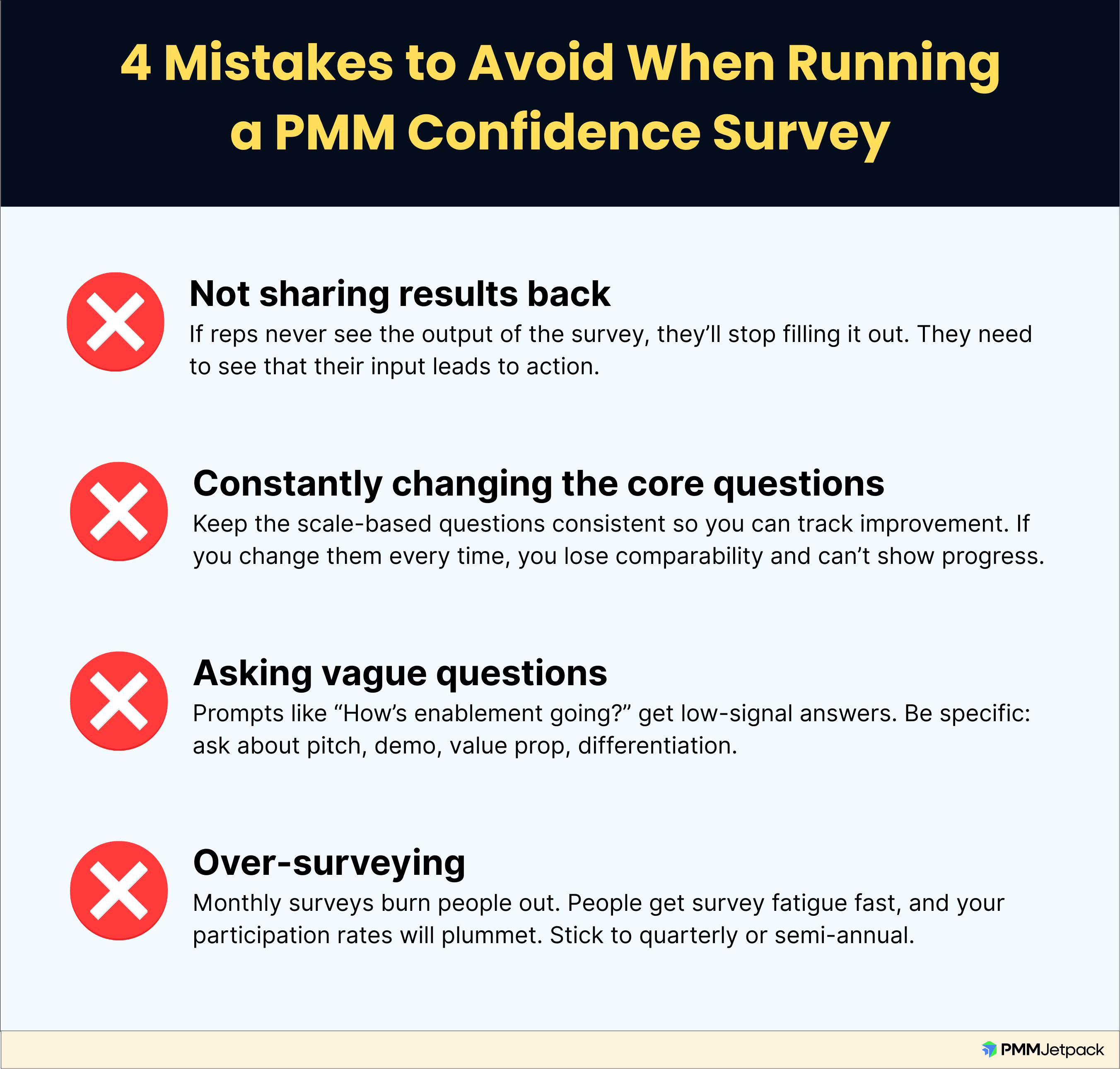
Mistake 1: Not sharing the results
If reps never see what came out of their answers, they’ll wonder why they bothered. Remember, they need to see that their input actually leads to action.
Mistake 2: Constantly changing the core questions
Keep your scale-based questions steady so you can spot real trends and improvements over time. Consistency is your best friend here.
Mistake 3: Asking vague questions
Questions like “How’s enablement going?” will deliver low-signal answers. Be specific: ask about pitch, demo, value prop, differentiation - things you can actually improve.
Mistake 4: Over-surveying
Bombarding your team with surveys every month? Big mistake. People get survey fatigue fast, and your participation rates will plummet. Stick to quarterly or semi-annual check-ins.
Mistake 1: Not sharing the results
If reps never see what came out of their answers, they’ll wonder why they bothered. Remember, they need to see that their input actually leads to action.
Mistake 2: Constantly changing the core questions
Keep your scale-based questions steady so you can spot real trends and improvements over time. Consistency is your best friend here.
Mistake 3: Asking vague questions
Questions like “How’s enablement going?” will deliver low-signal answers. Be specific: ask about pitch, demo, value prop, differentiation - things you can actually improve.
Mistake 4: Over-surveying
Bombarding your team with surveys every month? Big mistake. People get survey fatigue fast, and your participation rates will plummet. Stick to quarterly or semi-annual check-ins.
Show what’s working (and what’s not): You get meaningful metrics that leadership can track and celebrate—things like confidence levels, readiness, and engagement. Plus, it’s easy to point to actual data when talking about success.
Identify the weak spots: Maybe reps don’t feel comfortable demoing certain features, or they’re missing key collateral—whatever it is, it’s more obvious and easier to fix.
Gather ideas from the field: Your team on the ground often has the best insights on what could help them close more deals. These surveys create a direct line for collecting their enablement ideas.
Position yourself as a valued insider: By capturing fresh, real-world insights, you can shine a light on market-facing observations that make product marketing and leadership sit up and take notice.
Get this right, and you’re the hero: the person bringing clarity, tracking progress, and building a smarter, more confident team. Miss out on it, and you might find yourself wading through the murky waters of indecision, struggling to prove your worth, and risk being relegated to merely the “help desk” of sales.
How to Run a PMM Confidence Survey
We’ve talked about why confidence surveys matter, so now let’s dive into how to actually make it happen. Think of the survey process as five connected stages.
Conclusion
What have we learned here?
Confidence surveys are a small investment that create outsized returns. They give you proof of your impact, a regular stream of frontline insights, and a boost in credibility with leadership. By running them consistently, being transparent with the results, and most importantly, acting on what you hear, you can shift how product marketing is seen within your company. You won’t just be the team that creates cool content; you’ll be the strategic partner whose voice truly shapes the business.
Keep at it, stay curious, and watch how confidence surveys turn into your secret weapon for growth and influence.
Conclusion
What have we learned here?
Confidence surveys are a small investment that create outsized returns. They give you proof of your impact, a regular stream of frontline insights, and a boost in credibility with leadership. By running them consistently, being transparent with the results, and most importantly, acting on what you hear, you can shift how product marketing is seen within your company. You won’t just be the team that creates cool content; you’ll be the strategic partner whose voice truly shapes the business.
Keep at it, stay curious, and watch how confidence surveys turn into your secret weapon for growth and influence.
Conclusion
What have we learned here?
Confidence surveys are a small investment that create outsized returns. They give you proof of your impact, a regular stream of frontline insights, and a boost in credibility with leadership. By running them consistently, being transparent with the results, and most importantly, acting on what you hear, you can shift how product marketing is seen within your company. You won’t just be the team that creates cool content; you’ll be the strategic partner whose voice truly shapes the business.
Keep at it, stay curious, and watch how confidence surveys turn into your secret weapon for growth and influence.
Resources
Resources
Resources


Copyright © 2024 Productive PMM Inc.
Copyright © 2024 Productive PMM Inc.
Copyright © 2024 Productive PMM Inc.